
Preferences
Privacy is important to us, so you have the option of disabling certain types of storage that may not be necessary for the basic functioning of the website. Blocking categories may impact your experience on the website. More information
Privacy is important to us, so you have the option of disabling certain types of storage that may not be necessary for the basic functioning of the website. Blocking categories may impact your experience on the website. More information

Managed SEO explained: what the service includes, what it costs per month and how to choose a provider that does not promise rankings.








Founder Sorank, 7+ years in SEO.
Summary
Managed SEO is a service where an outside provider runs your search optimization for you, usually for a monthly fee. The provider handles the audit, the content, the link building and the reporting, so your team does not need its own SEO specialist to get results from Google.
Want to go further? Ask
Managed SEO means you pay a provider to own the whole search plan for your website. Instead of buying single tasks, such as one article or one batch of links, you get a team that checks your site, decides what to fix first, publishes content, earns links and tells you what changed. Some providers are agencies with staff. Others are software that runs parts of the work on autopilot.
Managed SEO is a long-term service. The provider works on your site every month, not once. The goal is to be found on Google and named in AI answers from ChatGPT, Gemini and Claude, and the provider reports the progress in plain numbers.
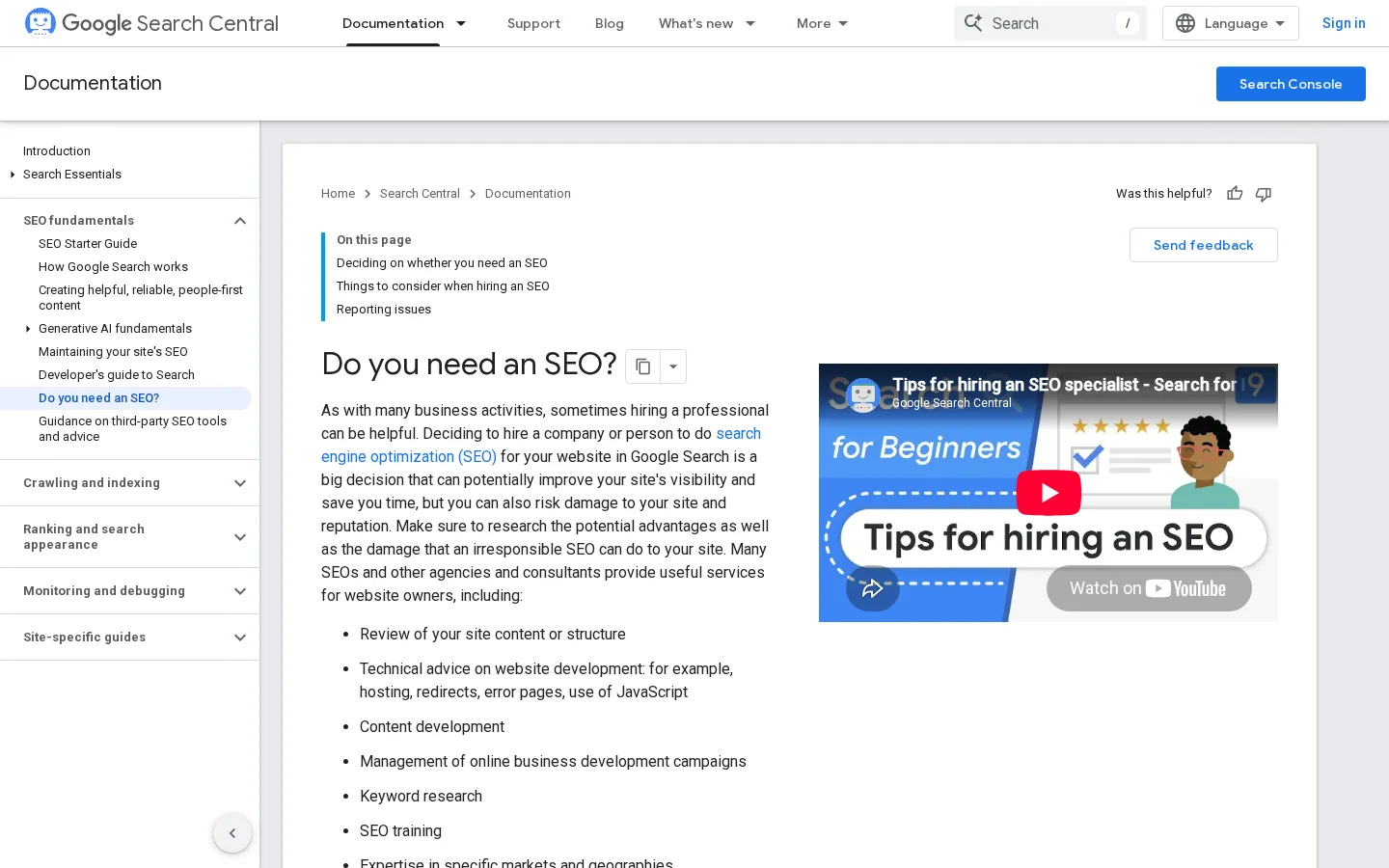
Google's guide "Do you need an SEO?" gives a clear warning for this choice: "Be careful if a company is secretive or won't clearly explain what they intend to do." A good provider explains its plan in writing before it starts work.
Most plans cover the same five parts. The audit is usually a technical SEO audit plus a review of your content. Link building means earning links from other sites, which are called backlinks. The table shows what each part covers and what to ask for before you sign.
| Part | What it covers | What to ask for |
|---|---|---|
| Audit | Technical problems, content gaps and the pages that already rank | A written list of fixes, with the reason for each one |
| Content | New pages and articles that answer the questions your buyers ask | The number of pieces each month, who writes them and who approves them |
| Link building | Links from other sites to yours, earned from real pages | The sites that will link to you, and how each link was earned |
| Technical SEO | Crawling, indexing, page speed and site structure | Read access to Search Console and a log of every change |
| Reporting | Results each month in plain words | Which numbers they track and how often you get the report |
A managed plan follows a loop. The same steps repeat every month, and each month builds on the last one.
Tip
Ask for the monthly task list in writing before you sign. It is the fastest way to compare two offers that look the same on price.
Prices depend on the size of the site, the number of pages and the country. Clutch's SEO Agency Pricing Guide 2026 puts the average monthly cost of SEO projects at $3199. Clutch also lists $100 to $149 an hour for local SEO and content creation, and $25 to $49 an hour for link building and technical SEO. These figures come from agency listings, so use them as a benchmark, not as a quote.
Ask every provider for the setup fee and the minimum contract length. Some providers charge a one-time setup fee on top of the monthly fee, and the first year costs more than the months that follow. A simple way to check the real price is this formula.
Year one cost = (monthly fee x 12) + setup feeTo plan the budget before you ask for quotes, use the SEO budget calculator.
The answer depends on who has the time and the skills. Use this list to decide.
Software can also do part of the work. Sorank runs keyword research, article publishing and natural backlink acquisition on autopilot, and it tracks your visibility in ChatGPT, Gemini and Claude. To see how the link part works, read about natural backlink acquisition.
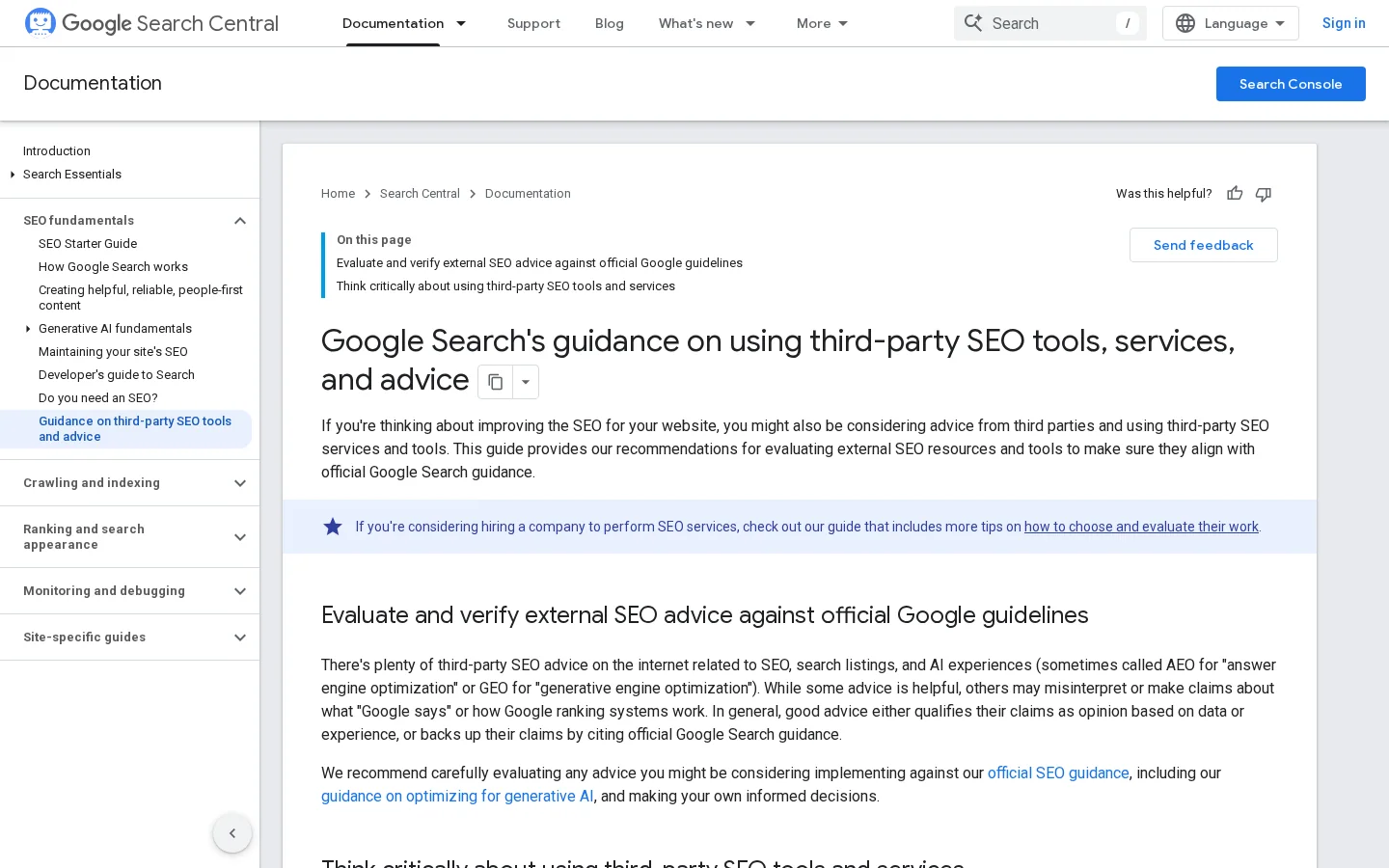
Start with the scope of work, not the price. Google's guide on third-party SEO services says that good advice either qualifies its claims as opinion based on data or experience, or cites Google's own guidance. Use the checklist below to compare providers.
No. Google's guide on hiring an SEO says: "No one can guarantee a #1 ranking on Google." It also warns about providers who claim to guarantee rankings, or who allege a "special relationship" with Google. Walk away if a provider promises a fixed position or says it has a secret link to the search team.
These five errors are the first ones to check for. For each one, the list shows what it is, how to spot it and how to fix it.
Search and AI answers reward steady work. A page that is updated, linked and checked each month has a better chance of being used by Google and by AI models than a site that gets help once a year. A managed plan keeps that work going when your own team is busy. For GEO, the same plan should track the questions your buyers ask AI models, and turn them into pages that answer them clearly.
Managed SEO means an outside team runs your search plan each month. Check what is in the fee, ask for read-only access first and never pay for a ranking promise. If you are still deciding on a budget, read the guide to affordable SEO options for small businesses.
Sources
It can be, if the provider gives you a written scope and clear reporting. Many small businesses have no one who can run SEO every week, so a managed plan keeps the work going. Compare the monthly fee with the time you would spend on the same tasks yourself.
A freelancer usually does one task, such as writing articles or contacting sites for links. A managed SEO provider owns the whole plan: audit, content, links and reporting, with one team answerable for the results. Ask which tasks are in the monthly fee and which cost extra.
No. Google's guide says that no one can guarantee a number one ranking on Google. A good provider explains what it will do, why it matters and what results to expect over what period. Be careful with anyone who promises a fixed position.
 “I tested Sorank on a real client site and it's insane. It does everything an agency would bill you $1500 a month for. It's going into production on that client now.”

 Guillaume Guersanguersanguillaume.com“We are an Ads agency and we wanted to get our SEO back on track once and for all. Sorank gave us a clear view of our site, helped us prioritize optimizations, and properly structure our content. The tool is easy to use, well designed for a team, and very practical for centralizing tracking without having to juggle multiple platforms. A very solid foundation to start fresh with our SEO.”
 Gaspard MadouiAds Agency
 “I just let the Sorank software do its thing, and now my DR is 25 and my page is ranking higher.”
 Lucas Flandrefoundertrace.fr“I specialized in GEO thanks to Sorank. The GEO Leaderboard allows me to show my clients their position vs competitors on ChatGPT. It’s a real commercial differentiator.”
 MélanieSEO Freelance“Great service, works well for our website and helps us understand how to improve it to rank better on Google and elsewhere. Congrats, keep going, I recommend it.”
 Hugo T.E-commerce merchant



















