
Preferences
Privacy is important to us, so you have the option of disabling certain types of storage that may not be necessary for the basic functioning of the website. Blocking categories may impact your experience on the website. More information
Privacy is important to us, so you have the option of disabling certain types of storage that may not be necessary for the basic functioning of the website. Blocking categories may impact your experience on the website. More information

Google sandbox is the SEO term for why new websites rank slowly in Google. Learn what is confirmed, how long it lasts and how to check your site.







Founder Sorank, 7+ years in SEO.
Summary
Google sandbox is an SEO term for the period when new websites struggle to rank in Google, even with good content. Google has never documented a filter with that name, so the effect is better explained by how long Google takes to notice, crawl, and trust a new site.
Want to go further? Ask
Google sandbox is the label SEOs gave to a pattern they see often: a new domain gets indexed but barely shows up for competitive keywords for months. Some SEOs call it a filter, others call it a normal ranking lag. Either way, the practical question is the same: what can you do while your site is still new?
No. Google has not confirmed a sandbox that holds new sites back, and its own documentation does not describe one. The term comes from SEO forums and blogs that discussed the pattern for years. Google does describe a delay for new sites, and that delay is the part you can act on.
Google has to find your pages, index them, and judge how useful they are before it ranks them for anything valuable. A new site starts with no history, few links from other sites, and no proof of trust. Google's crawling and indexing FAQ says the most common reason a site is not indexed is that it is too new.
The delay usually comes from several causes at once:
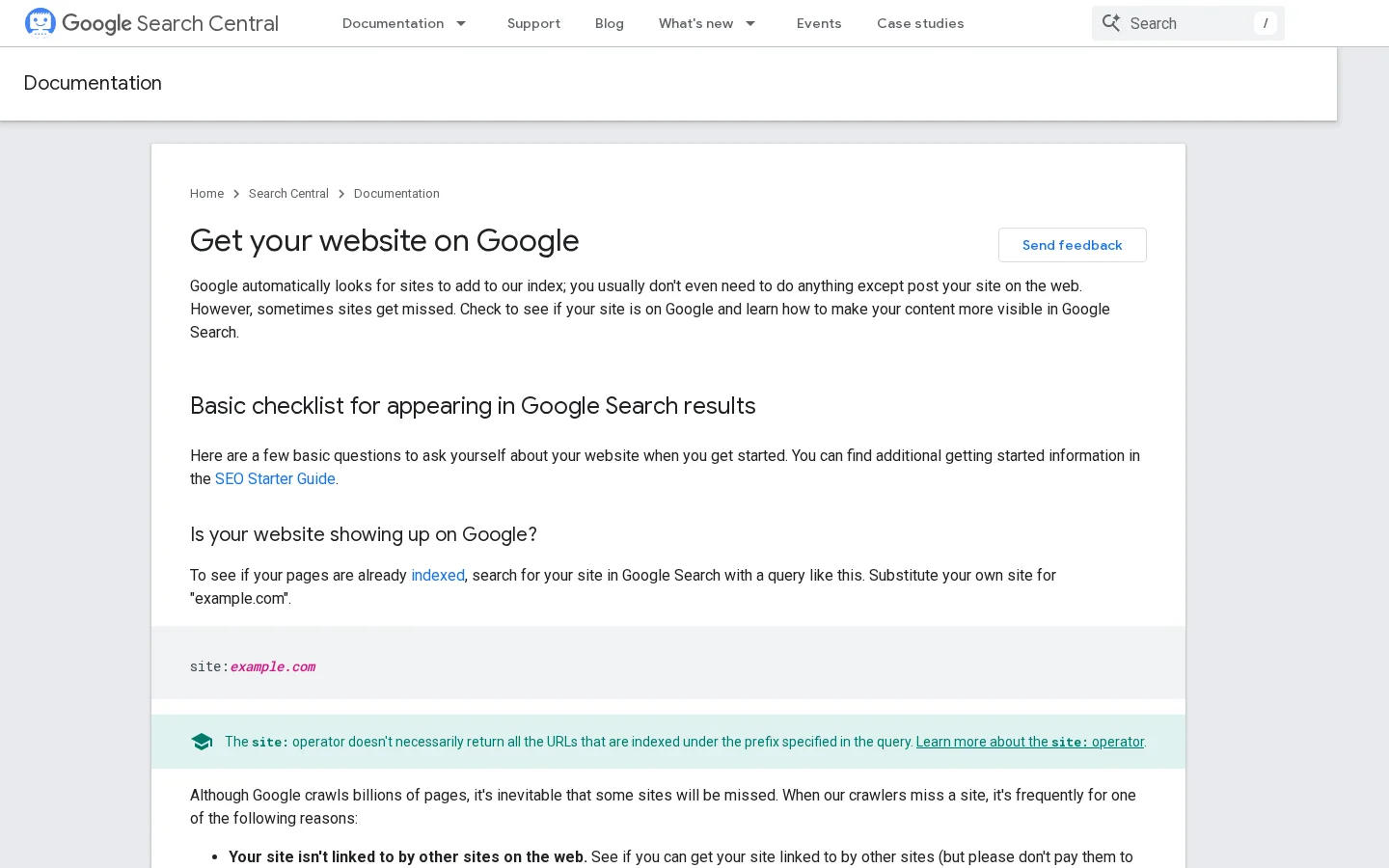
There is no fixed period. Google's guide to getting on Google says it can take a few weeks for Google to notice a new site or changes to an existing one. The same FAQ adds that Google cannot promise timing: "we cannot make predictions or guarantees about when or if your URLs will be crawled or indexed."
Stories of months or even years circulate in SEO communities. They come from individual sites, not from a controlled test by Google, so treat them as a warning to plan for patience, not as a schedule. If your pages are still missing after a few weeks, stop waiting and check what is blocking them.
Look at two things: which pages Google has indexed, and which queries those pages show up for. The pattern tells you more than the word "sandbox" does.
| What you see | Likely cause | What to do |
|---|---|---|
| Pages are not indexed at all | A block such as noindex or robots.txt, or pages missing from the sitemap | Check indexability, remove the block, and submit a sitemap |
| Pages are indexed but get almost no impressions | Weak internal links, few links from other sites, or low trust | Link the pages from your core pages and earn a few relevant links |
| Impressions only on long-tail queries, with few clicks | Normal early stage, with pages ranking low on the results page | Improve titles and make each page more complete |
| Ranking only for your brand name | Google knows your name but not yet your topic | Publish a focused cluster of pages on one subject |
Tip
Check indexing before you blame the sandbox. A page that is not indexed has a technical problem, and that is the one you can fix today.
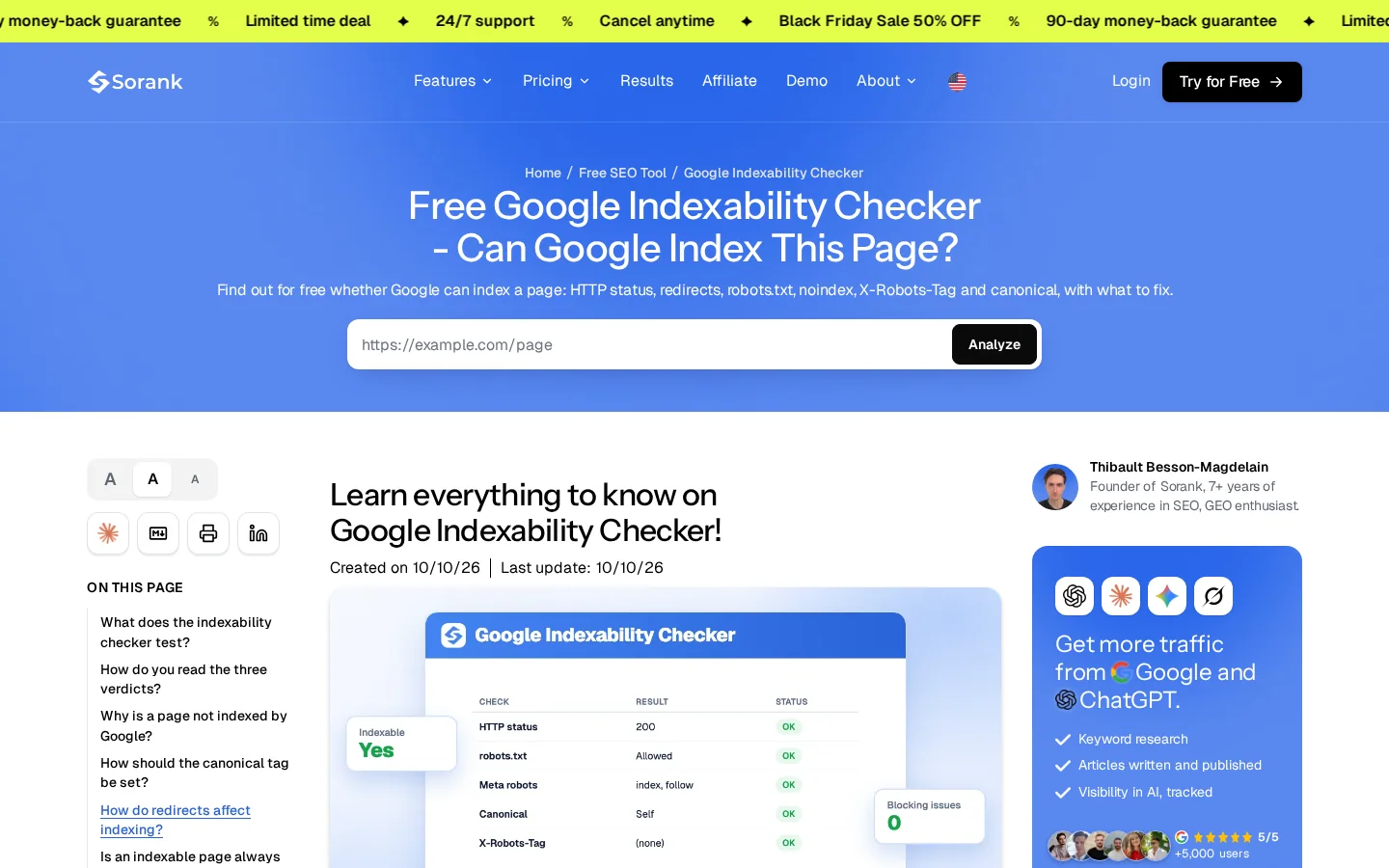
Run a URL through the free Google indexability checker from Sorank. It tells you whether a status code, robots.txt rule, noindex directive, or canonical tag stops Google from indexing the page. Then compare the result with the page indexing report in Google Search Console. A page that fails the check has a fixable problem, and waiting will not fix it.
Focus on signals Google can verify. Work through these steps in order:
For a launch checklist, read our guide to SEO for new websites and what to do in the first 90 days.
Not by itself. Age is a weak signal, and an old domain with thin content still starts with little visibility. Read what domain age is and whether it helps SEO before you pay for an aged domain. An old domain can also carry a past penalty, so check its history first.
Most sandbox problems are self-inflicted. Check these three first.
This is a sudden spike of links from low-quality or unrelated sites. You spot it when your link profile grows much faster than your content, and most links come from directories or link networks. To fix it, stop buying links, remove or disavow the worst ones you can reach, and rebuild slowly with a few relevant links. Bulk link buying is a known route to penalties, as explained in black hat SEO tactics that get sites penalized.
This happens when a tag or rule keeps Google from indexing a page, and the owner blames the wait. You spot it when a page is still missing after several weeks and the indexability check reports a block. To fix it, remove the noindex tag or the robots.txt rule, then resubmit the sitemap. Do not wait for a block to clear on its own.
This is dozens of short pages on loosely related topics. You spot it when many pages are indexed but none ranks, or when Google drops pages soon after indexing them. To fix it, merge weak pages, expand the ones with real potential, and delete pages that do not answer a real question. Read more about how to spot and fix low-value pages.
The signals that decide whether a new site ranks in Google also decide whether AI tools use it. Search needs your pages indexed. AI answer engines also need to find and fetch your pages before they can cite them. A site that is hard to crawl, unclear about its topic, or short on trust is slow to appear in both. The sandbox question is therefore a visibility question across Google and AI. Learn more about how to get named by ChatGPT and Claude.
The Google sandbox is a useful name for a real pattern: new sites take time to earn visibility. Google has not confirmed a filter with that name, and it does not give a fixed timeline. Check indexing first, fix any blocks, and build trust with a few focused pages and relevant links. Then give the site time, because patience is part of the process.
Sources
Google has never confirmed a sandbox filter for new sites. The term describes a common pattern where new sites rank slowly, which Google explains as the time it takes to find, index, and trust a new site. Treat it as a useful label, not as a proven penalty.
There is no fixed length. Google's guide says it can take a few weeks for Google to notice a new site, and it does not guarantee timing. If your pages are still missing after that, check indexing first.
Not safely. A sudden burst of low-quality links is a known spam pattern that can slow your site down or lead to penalties. A few relevant links earned over time help Google find and trust your pages.
 “I tested Sorank on a real client site and it's insane. It does everything an agency would bill you $1500 a month for. It's going into production on that client now.”

 Guillaume Guersanguersanguillaume.com“We are an Ads agency and we wanted to get our SEO back on track once and for all. Sorank gave us a clear view of our site, helped us prioritize optimizations, and properly structure our content. The tool is easy to use, well designed for a team, and very practical for centralizing tracking without having to juggle multiple platforms. A very solid foundation to start fresh with our SEO.”
 Gaspard MadouiAds Agency
 “I just let the Sorank software do its thing, and now my DR is 25 and my page is ranking higher.”
 Lucas Flandrefoundertrace.fr“I specialized in GEO thanks to Sorank. The GEO Leaderboard allows me to show my clients their position vs competitors on ChatGPT. It’s a real commercial differentiator.”
 MélanieSEO Freelance“Great service, works well for our website and helps us understand how to improve it to rank better on Google and elsewhere. Congrats, keep going, I recommend it.”
 Hugo T.E-commerce merchant



















