
Preferences
Privacy is important to us, so you have the option of disabling certain types of storage that may not be necessary for the basic functioning of the website. Blocking categories may impact your experience on the website. More information
Privacy is important to us, so you have the option of disabling certain types of storage that may not be necessary for the basic functioning of the website. Blocking categories may impact your experience on the website. More information

Contextual marketing shows ads and messages based on the subject of the page, not on the reader. Learn how it works, with examples, benefits and limits.








Founder Sorank, 7+ years in SEO.
Summary
Contextual marketing is the practice of placing an ad or message where its subject matches the content around it, such as a web page, a video or a list of search results. It does not need data about the person who sees it, so it works without cookies that follow people across sites.
Want to go further? Ask
Contextual marketing means you choose where to show a message by looking at the content around it. If the reader is on an article about running shoes, a running shoe ad fits that moment. You do not need to know who the reader is, what they bought last month or which sites they visited before. The question changes from "Who is this person?" to "What is this page about?"
The idea sits inside contextual advertising, and many people use the two terms for the same thing. The UK industry body IAB defines contextual targeting as ads that are targeted based purely on the subject and environment of the content, including text, audio, video or images. Context can also mean the place, the device or the time of day, but the content itself is the core. Contextual marketing is the broader term: it can also cover a sponsored link or a call to action that matches the topic of the page it sits on.
Platforms read the content of a page and decide whether an ad fits. Google's contextual targeting help page says that Google's system "analyzes each webpage to determine its central theme". Advertisers then steer the match in three ways: keywords, topics or placements.
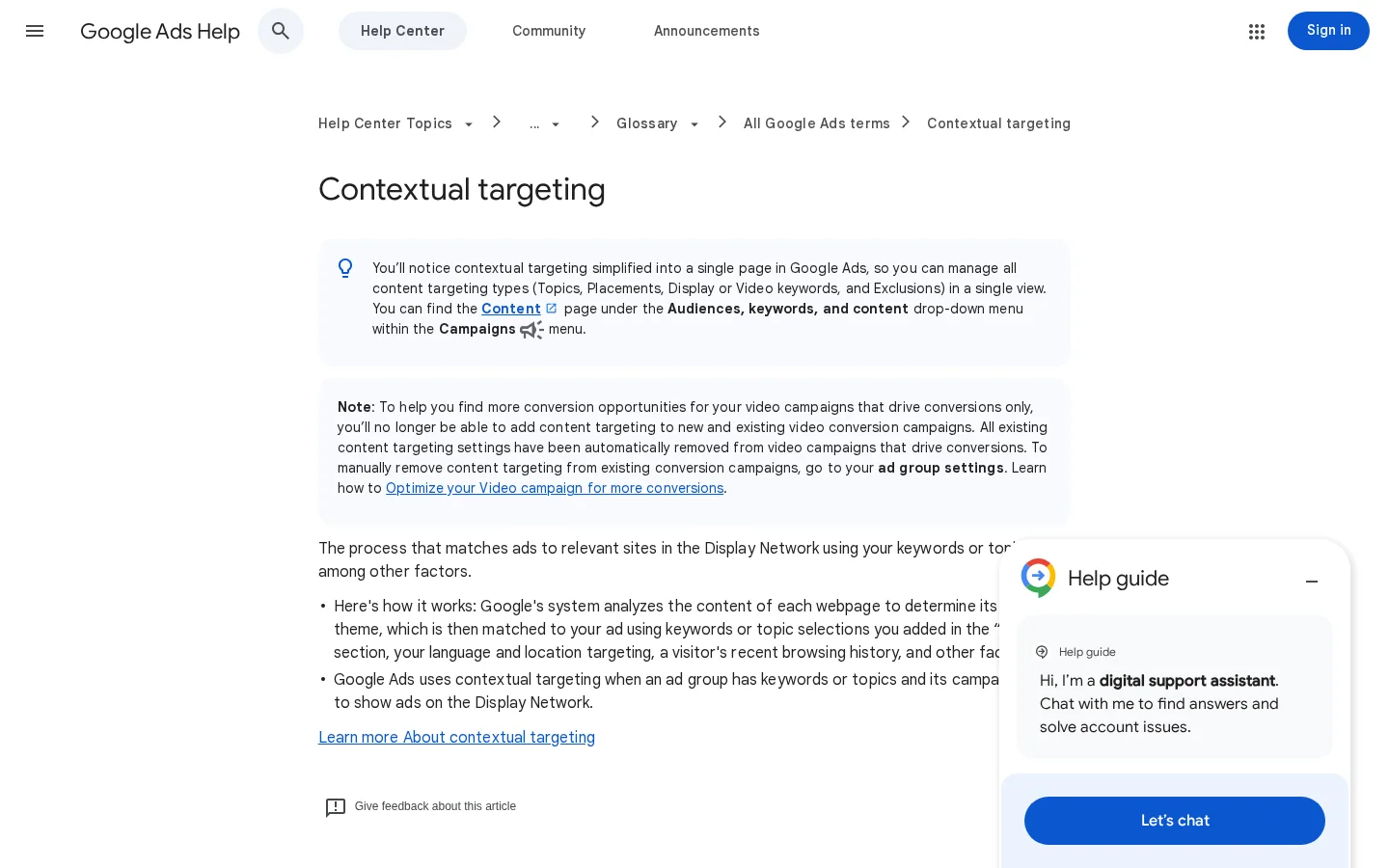
Each method works in a different way:
The match is only a start. Your bid, which is the price you pay under a pay-per-click model, and the quality of your ad decide whether you win a place on the page. Narrow topics give you more control. Broad topics give you more reach. You need to choose which one matters more for your goal.
These examples do not use any data about the reader. The page alone decides which ad fits.
The same logic works offline. A magazine places a golf equipment ad in its golf section, and a sponsor of a cooking show gets its message into the episode about baking. In both cases, the message sits next to content the reader already wants.
The main benefits come from one fact: the method does not need personal data about the reader.
Contextual marketing has real limits, and you should know them before you spend money.
Behavioral targeting works the other way round. It follows the person, using past visits, searches or purchases, and shows the ad to that person wherever they go next. Contextual marketing follows the page instead. The table shows the main differences.
| Point | Contextual marketing | Behavioral targeting |
|---|---|---|
| What it uses | The content of the page or search | The past actions of the person |
| Personal data needed | Mostly no | Yes |
| Who sees the ad | Anyone reading the matching content | The person being tracked, on any site |
Good campaigns start with the reader's goal, then pick the pages. Five habits help:
The ad appears on pages that use your keyword in another sense. A phone case ad that shows on a recipe page about apples is a typical case. To spot it, read the placement report and look for pages that do not match the subject. To fix it, choose topics instead of single words, and add the wrong meaning as a negative keyword.
Your ad runs next to content that works against your brand, such as news about a product recall or a tragedy. To spot it, check the page itself, not only the topic name in the report. To fix it, exclude those topics and sites before launch, and review the list every week.
The same ad runs on a page about hiking and on a page about camping, with the same words. Clicks may come in, but sign-ups or sales stay low. To spot it, compare results by topic. To fix it, group pages by subject and write one short message for each group.
Contextual marketing is an advertising idea, but the same logic shapes search. For SEO, a link from a page about your topic is easier to understand than a link from an unrelated page. Be careful with the term, though. Contextual links in SEO are links placed inside the text of a relevant page, which is a different thing from a contextual ad. Sorank's natural backlink acquisition page is about getting links from sites in your niche. To understand the link side of the work, read our entry on the backlink.
For GEO, an AI model has to decide which source answers a question. A page with one clear subject is easier to match to that question. This is the same idea behind content relevance. Clear topics help both search engines and AI answers, so the work you do on each page serves both.
Contextual marketing asks one question: what is this page about? If you answer it well, you reach the right reader without tracking them. Start with the topic, keep the message close to it, and check the placements often. For the wider picture of paid channels, read our guide to digital advertising, and see how search engine marketing fits next to display placements.
Sources
People often use the two terms for the same thing. Contextual marketing is the broader idea: a message that fits the content around it, whether it is an ad, a sponsored link or a call to action.
Not for the matching itself. The ad is chosen from the page or search it appears on, so it does not need a profile of the person. Some platforms still use other signals, such as recent browsing, so check how each one works.
It can help indirectly. A link from a page about the same topic is easier to understand than a link from an unrelated page. Contextual links in SEO are links placed inside the text of a relevant page.
 “I tested Sorank on a real client site and it's insane. It does everything an agency would bill you $1500 a month for. It's going into production on that client now.”

 Guillaume Guersanguersanguillaume.com“We are an Ads agency and we wanted to get our SEO back on track once and for all. Sorank gave us a clear view of our site, helped us prioritize optimizations, and properly structure our content. The tool is easy to use, well designed for a team, and very practical for centralizing tracking without having to juggle multiple platforms. A very solid foundation to start fresh with our SEO.”
 Gaspard MadouiAds Agency
 “I just let the Sorank software do its thing, and now my DR is 25 and my page is ranking higher.”
 Lucas Flandrefoundertrace.fr“I specialized in GEO thanks to Sorank. The GEO Leaderboard allows me to show my clients their position vs competitors on ChatGPT. It’s a real commercial differentiator.”
 MélanieSEO Freelance“Great service, works well for our website and helps us understand how to improve it to rank better on Google and elsewhere. Congrats, keep going, I recommend it.”
 Hugo T.E-commerce merchant



















