
Preferences
Privacy is important to us, so you have the option of disabling certain types of storage that may not be necessary for the basic functioning of the website. Blocking categories may impact your experience on the website. More information
Privacy is important to us, so you have the option of disabling certain types of storage that may not be necessary for the basic functioning of the website. Blocking categories may impact your experience on the website. More information

AI content ranking is how AI assistants score and select passages to cite in an answer. Learn how it differs from SEO ranking and how to get cited.







Founder Sorank, 7+ years in SEO.
Summary
AI content ranking is the process by which an AI assistant scores and selects the most relevant, trustworthy passages of content to build one generated answer, instead of ordering whole pages into a list of links. Each passage is judged on how well it answers the specific question, so a page can be cited without ranking first.
Want to go further? Ask
AI content ranking is how AI assistants decide which content to use when they answer a question. Instead of showing ten whole pages and letting the reader click, an assistant breaks content into smaller chunks, scores how well each chunk answers the query, and assembles the best pieces into one response. Being ranked here means being selected as a trusted source, not holding a position on a results page.
The unit of success has changed. A page can rank first in classic search and still never be cited by an assistant, while a page ranked lower can be quoted again and again if one of its passages answers the exact sub question the engine is asking. Understanding this selection process is now central to visibility, and it is closely tied to AI search ranking factors.
Assistants do not read a 2000 word article as one block. They split it into standalone chunks, each a paragraph or list that carries a complete thought, a process described in content chunking. Each chunk is then compared with the information the assistant still needs for the answer. Relevance is judged on topical similarity, on how complete the chunk is when read alone, and on whether it names the right entities, such as products, people, places and concepts.
This passage level evaluation follows the same logic as passage ranking in classic search, where individual sections compete to be shown instead of whole documents. The difference is what happens next: the assistant writes a synthesized answer from the winning passages and links to the sources it used, rather than returning a list of blue links.
Traditional SEO ranks pages, and success is measured by position and clicks. AI content ranking selects passages, and success is measured by whether your content is referenced inside the answer. The two systems overlap, since both reward relevance and trust, but they do not count the same things.
| Question | Traditional SEO ranking | AI content ranking |
|---|---|---|
| What is ranked? | Whole pages | Individual passages |
| What is the goal? | A click on your link | Being cited in the generated answer |
| What is measured? | Position and clicks | Citations and mentions across assistants |
| What can fail? | Weak page relevance or weak links | A passage that does not stand alone |
For that reason a strong organic position does not guarantee AI visibility. An assistant may find the right page through its own search, yet quote a competitor because that competitor's paragraph answers the sub question more directly.
Direct answers come first. Put a clear, self contained answer in the first sentences under each heading, so the engine can lift a strong chunk without guessing. A section that opens with a long introduction forces the engine to search for the answer, and many passages never get that far.
Clean structure helps as well. Descriptive headings, lists, tables and helpful, reliable, people-first content give an engine clear boundaries to extract from. Google's guidance asks whether a page provides original information, reporting, research or analysis, and whether it gives a substantial and complete description of the topic. Those questions matter for AI selection as much as for classic search. Visible update dates, facts that are checked regularly and genuine authority from brand mentions and citations complete the picture.
Google's documentation on AI Overviews and AI Mode explains that both features may use a "query fan-out" technique, issuing multiple related searches across subtopics and data sources before writing a response. While the response is generated, the systems identify more supporting pages, which means a single question can pull passages from pages that answer different sub questions.
The practical lesson is to cover the adjacent questions of your topic, not only the head term. A page that answers the main question and the two or three follow ups a reader would ask gives the engine more passages to select. Groups of linked pages on one subject make this easier, and the same logic sits behind AI citation optimization.
Not according to Google. Its guide to AI features and your website states that there are no additional requirements to appear in AI Overviews or AI Mode, and that you do not need to create new machine readable files, AI text files or markup. The same guide lists the familiar basics: crawling allowed in robots.txt, easy internal links, a good page experience, important content available as text, and structured data that matches the visible text on the page.
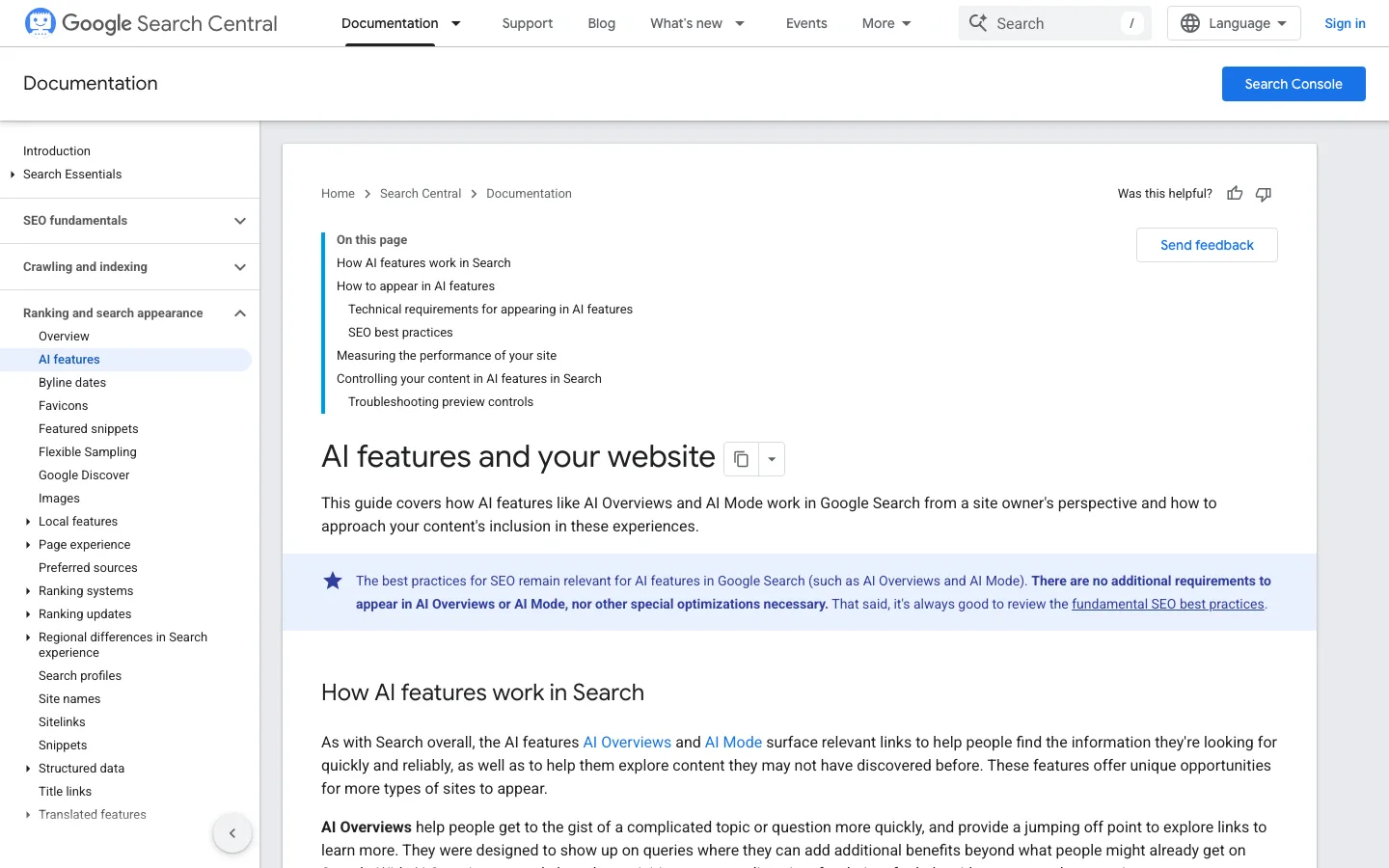
In practice, keep the answer in plain visible text first, and mark up only what the page really shows, since Google asks that structured data match the visible text.
Not directly. Google's documentation describes how AI features work, but it does not list the passages it selects for a given answer, so optimization relies on patterns and testing rather than on a public scoring formula.
Testing means checking the prompts your buyers actually ask, recording which sources appear, and comparing the results over time. Sorank's AI mention tracking is built for that job, showing when assistants cite your pages so you can strengthen the ones that are never mentioned.
For SEO, the passage level view explains why a page can rank well and still earn fewer clicks than expected: an assistant may answer the question on the results page and link to only a few sources. For GEO, the goal is to be one of the sources an assistant trusts enough to cite, which is the aim of generative search optimization. Classic traffic still counts too. The LV3D case study reports that the site multiplied its organic traffic by four in five months with Sorank, a reminder that organic growth and AI visibility are built on the same well structured pages.
AI content ranking is the passage level scoring that decides which parts of your content an assistant trusts enough to cite. It rewards direct answers, clean structure, concrete facts, freshness and genuine authority, and it measures success by citations instead of positions. To go further, read how AI assistants choose their sources, then plan your next pages around the questions your buyers ask.
Sources
Traditional ranking orders whole pages and measures success by position and clicks. AI content ranking scores individual passages and measures success by whether your content is cited in the generated answer, so a top organic position does not guarantee AI visibility.
Direct answers placed early under clear headings, standalone paragraphs that make sense on their own, concrete facts, clean structure and visible freshness help an engine extract and trust your content. Google's guidance also stresses helpful, reliable, people-first content.
Not directly. Engines do not publish the passages they select or why, so monitor your citations over time with a tool such as Sorank's AI mention tracking, then strengthen the pages that are never cited.
 “I tested Sorank on a real client site and it's insane. It does everything an agency would bill you $1500 a month for. It's going into production on that client now.”

 Guillaume Guersanguersanguillaume.com“We are an Ads agency and we wanted to get our SEO back on track once and for all. Sorank gave us a clear view of our site, helped us prioritize optimizations, and properly structure our content. The tool is easy to use, well designed for a team, and very practical for centralizing tracking without having to juggle multiple platforms. A very solid foundation to start fresh with our SEO.”
 Gaspard MadouiAds Agency
 “I just let the Sorank software do its thing, and now my DR is 25 and my page is ranking higher.”
 Lucas Flandrefoundertrace.fr“I specialized in GEO thanks to Sorank. The GEO Leaderboard allows me to show my clients their position vs competitors on ChatGPT. It’s a real commercial differentiator.”
 MélanieSEO Freelance“Great service, works well for our website and helps us understand how to improve it to rank better on Google and elsewhere. Congrats, keep going, I recommend it.”
 Hugo T.E-commerce merchant



















