Preferences
Privacy is important to us, so you have the option of disabling certain types of storage that may not be necessary for the basic functioning of the website. Blocking categories may impact your experience on the website. More information
Privacy is important to us, so you have the option of disabling certain types of storage that may not be necessary for the basic functioning of the website. Blocking categories may impact your experience on the website. More information

SEO software for retailers like Sorank helps a store with a shop front get chosen before the shopper leaves home: when someone searches "running shoe store with gait analysis near me", checks whether a sofa can be seen in a showroom, or asks ChatGPT where to buy a road bike in town. It writes and publishes the articles that answer these questions on your website, links them to your departments and in-store services, and tracks which retailers the AI assistants recommend.
Built for retailers with stores and a website. If you sell only online, see our page on ecommerce SEO software.















































27,869
Articles created
11,261,227
Visits from Google
19,086
Visits from AI
"Is it better to buy a mattress in store or online?", "Can I return an online order in store?", "Where to get a bike fitted near me": many store visits start with a search about the product, the service or the trip itself. Sorank finds these questions for each department and in-store service you offer, with their volume, and turns them into a publishing plan ahead of each season: back to school, holidays, garden season.
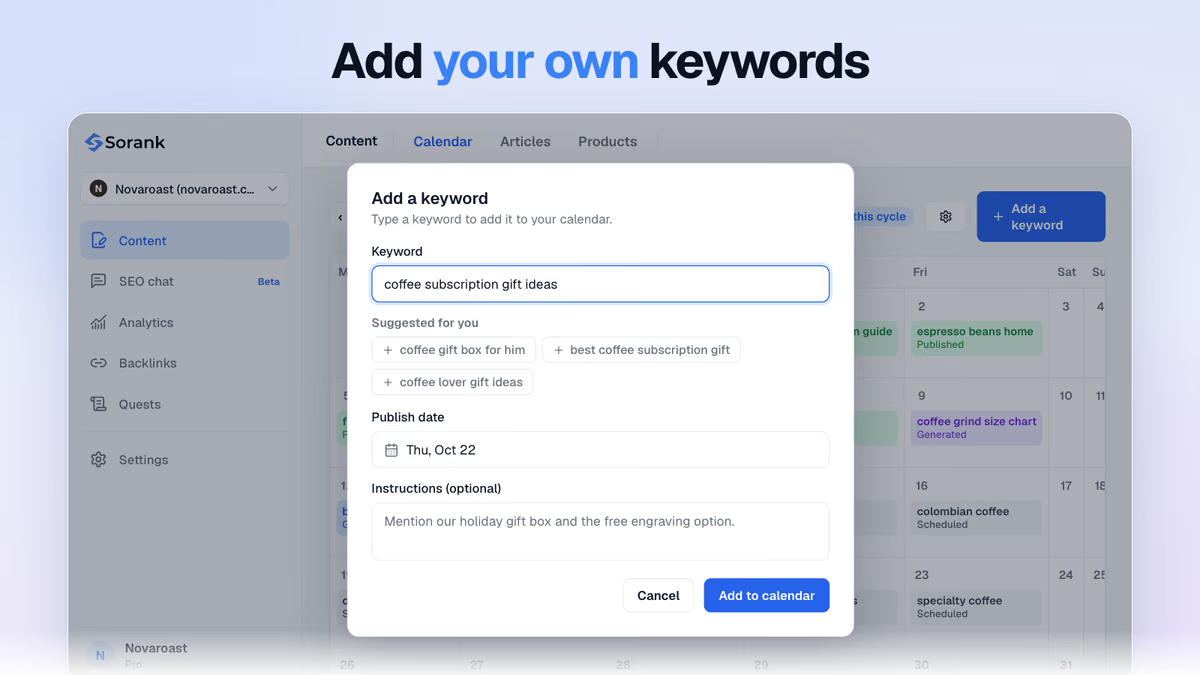
You can add your own topics and dates in the content calendar, with a note such as "mention our holiday gift wrapping".
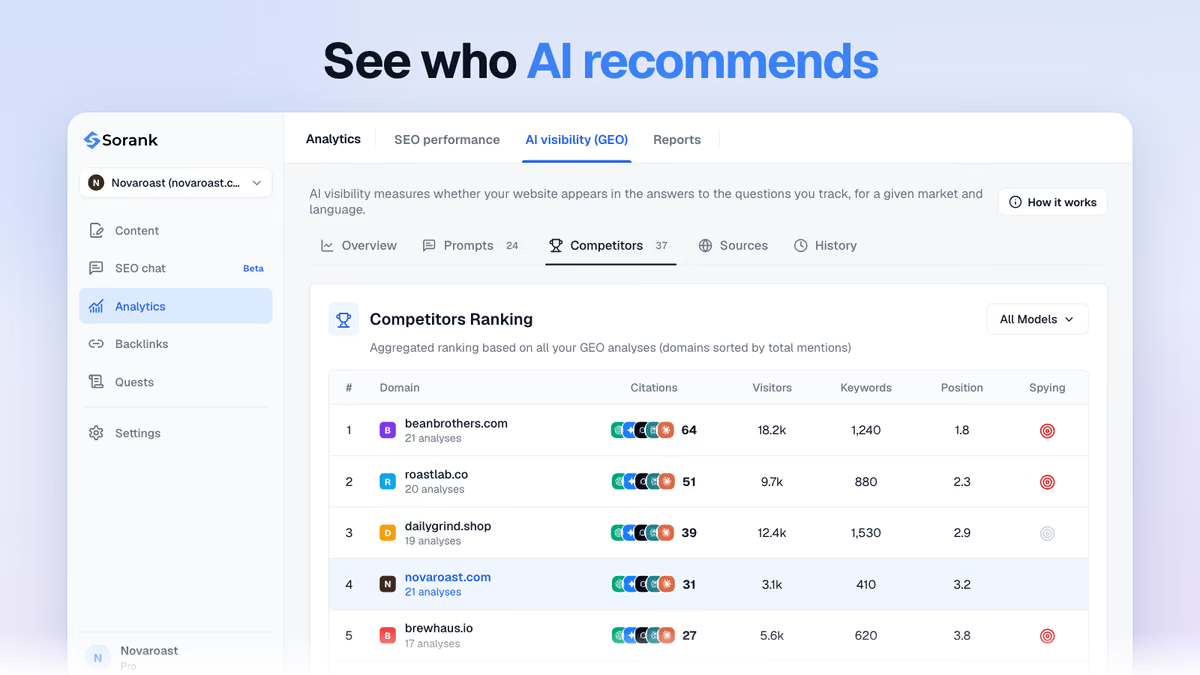
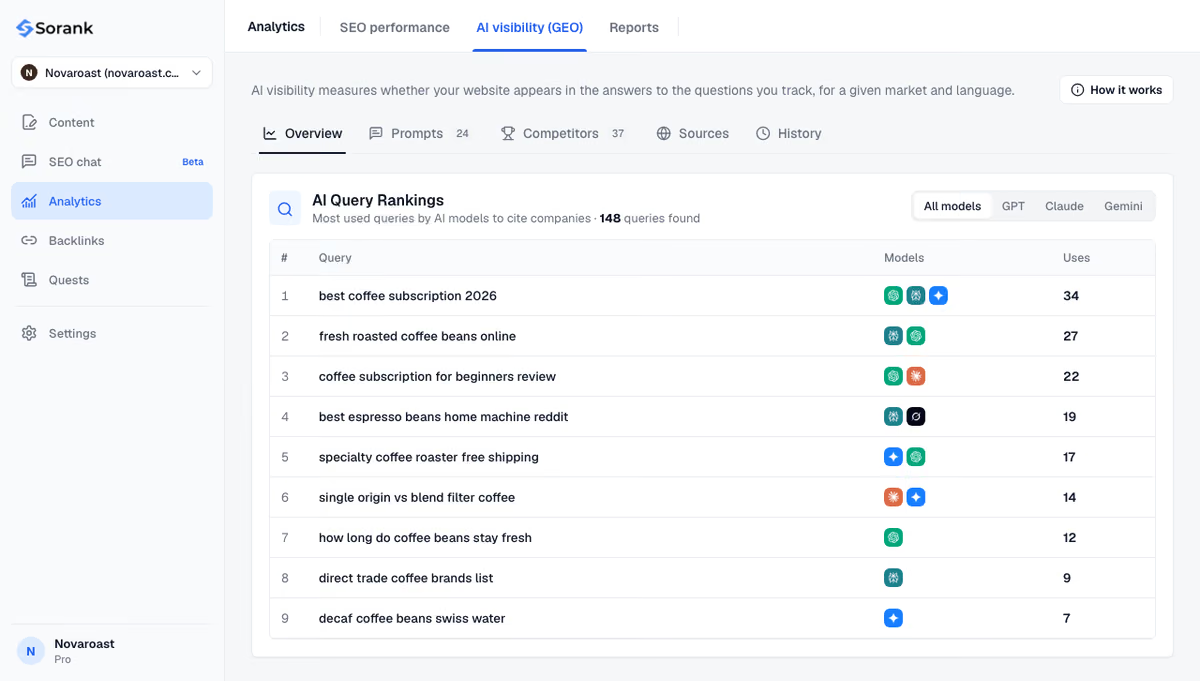
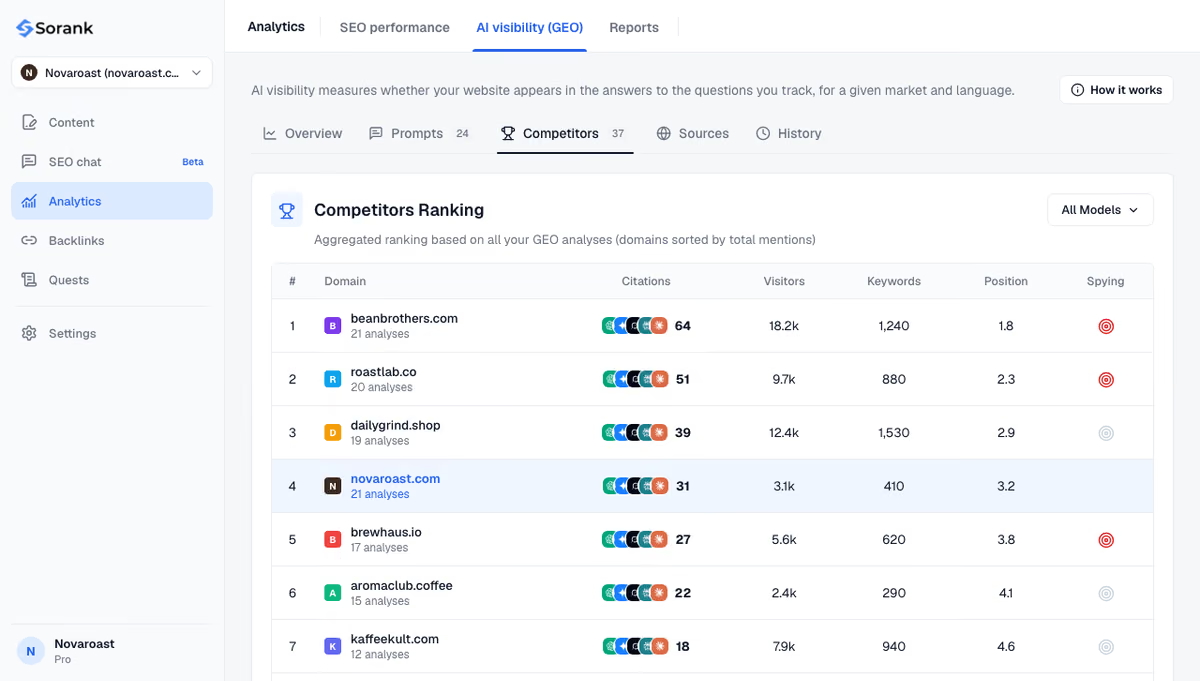
Ask ChatGPT for "the best place to buy kitchen knives in Chicago" and it often searches the web first, then names two or three retailers. Sorank records the searches each model runs for the questions you track, which stores come up and which pages they quote. You see whether your stores are named, and which topics your site still lacks.
Each answer is detailed in AI query fan-out.
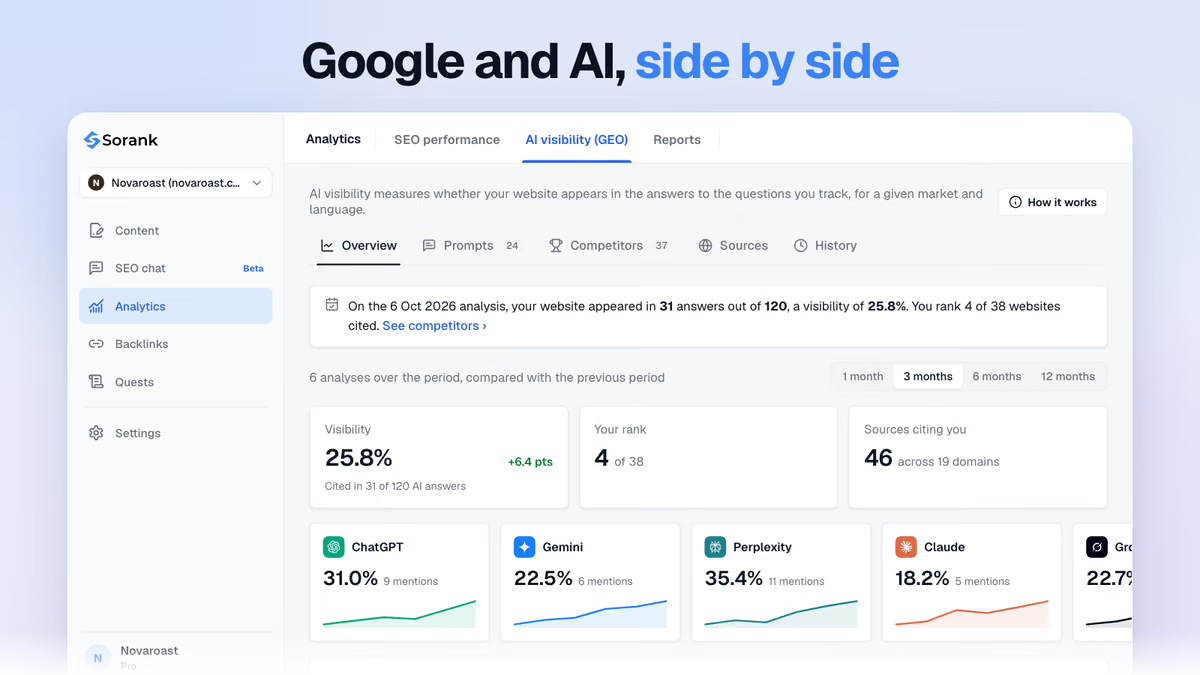
Your Search Console and Analytics data sit next to the AI visibility report: which articles gain clicks, which departments bring visits, and how many visitors arrive from ChatGPT, Gemini or Perplexity. A store manager can read it in two minutes before the weekly meeting.

Shopify, WooCommerce, WordPress, Wix, Webflow or a custom platform through a webhook. Sorank reads Search Console and Analytics to see which departments already attract visitors.
Add your product ranges, in-store services (fittings, repairs, click and collect, workshops) and the weeks when your stores are busiest. Sorank proposes the shopper questions for each one and dates them before the rush.

Each article links to the matching range on your site, to your store locator and to the service it mentions. It goes live on the day you set, or waits as a draft for your marketing team.
THEY TRIED SORANK BEFORE YOU
“I tested Sorank on a real client site and it's insane. It does everything an agency would bill you $1500 a month for. It's going into production on that client now.”
 Guillaume Guersanguersanguillaume.com
 “I just let the Sorank software do its thing, and now my DR is 25 and my page is ranking higher.”
 Lucas Flandrefoundertrace.fr“Great service, works well for our website and helps us understand how to improve it to rank better on Google and elsewhere. Congrats, keep going, I recommend it.”
 Hugo T.E-commerce merchant“For 2 years, 100% of my clients came from LinkedIn. Posting daily, commenting, DM follow-ups… totally dependent on the algorithm. I knew I needed to work on SEO but always postponed it: too long, too technical, not my job. With Sorank, I finally took the step. In 4 months, I generate 15 organic leads per month without posting anything. It’s not 50/50 with LinkedIn yet, but I sleep better knowing I now have a second lead source growing on autopilot.”
 Valentin ThomyColdMailing Agency
 “I’m a developer, not a marketer. My Shopify theme was selling only through word-of-mouth and ads. With Sorank I finally understood how to structure my SEO and write articles to rank. The audit showed my product page was too slow. In 2 months, my organic traffic doubled and I’m starting to appear in ChatGPT answers when people search for Shopify themes. All of that with about 2 hours per week.”
 Thème FullStackgo.themefullstack.com“Great solution to manage SEO without headaches. Audits are fast, the interface is clear, and you quickly see which actions to implement. It has become an essential tool to track and improve the SEO of my sites. I highly recommend it.”
 XavEntrepreneur“I used Sorank for a client who needed SEO and it clearly made my life easier. I can quickly audit a site, track my projects, and keep a clear overview without multiplying tools. The onboarding is fast and the interface is great.”
 Céline MaurinFreelance CM
 “Blown away by Sorank’s performance. After testing many solutions on the market, I was amazed by how quickly our articles started ranking in the SERP. The results are concrete and much faster than anything we’ve experienced so far. It has been an excellent surprise for our team. We are confidently renewing our trust and highly recommend Sorank to agencies that demand fast and measurable results.”
 Patrick PerretFreelance Webdesign SEO“We’re a development agency and we use Sorank to run on-page audits on our clients’ Shopify stores. It helps us quickly identify optimization opportunities, structure fixes, and collaborate more easily with clients on the SEO side. Very useful to complement our technical support 🔥”

 Younes Yahyaluvaika.com“Sorank has transformed the results we deliver to our clients. We now identify the keywords AI really uses, understand why certain competitors get cited, and spot opportunities we were completely missing before. Our clients see faster rankings, better visibility in AI answers, and clearer ROI on every action we take.”

 Benjamin Rouxovirank.com“We are an Ads agency and we wanted to get our SEO back on track once and for all. Sorank gave us a clear view of our site, helped us prioritize optimizations, and properly structure our content. The tool is easy to use, well designed for a team, and very practical for centralizing tracking without having to juggle multiple platforms. A very solid foundation to start fresh with our SEO.”
 Gaspard MadouiAds Agency“I specialized in GEO thanks to Sorank. The GEO Leaderboard allows me to show my clients their position vs competitors on ChatGPT. It’s a real commercial differentiator.”
 MélanieSEO Freelance“I manage our dealership’s website and it had dozens of issues: slow pages, 404 errors, missing tags. We were losing rankings every month without understanding why. The Sorank audit detected everything in 5 minutes. I sent the report to our web provider with the priority fixes. We regained our rankings and traffic picked back up. Perfect for someone non-technical like me!”
 Xavier BreullMarketing Manager“I’m a CMO for a SaaS and I manage acquisition in a very competitive market. We were investing heavily in our product but not working on our SEO. No visibility on our real competitors, no tracking of our presence in AI. Sorank showed us our positioning vs competitors, which keywords to target, and GEO opportunities we had completely ignored!”
 Louis RAPPCMO SaaS
 “Very good version 2, I recommend it.”

 Antoine Verhillethenewblack.ai“I was skeptical at first, but this is the best SEO tool I’ve ever used. The interface is clear, audits are fast, and the recommendations are easy to implement. I’ve saved hours and hours managing SEO and tracking performance. I recommend it to all my entrepreneur friends who run an agency or work independently.”
 NoahEntrepreneur“Sorank completely changed the way our SEO agency operates. We now spend far less time on each client because everything is centralized and automated. What used to take hours now takes minutes, which finally allows us to stop working in the business and start working on the business.”

 Océane Bondismaison-leverage.com
Founder’s Note.
I ran my own SEO agency for years. I built Sorank to deliver the same results to every business, at scale.
Everything I know about Google rankings and Generative Engine Optimization (GEO) is coded into this software, and it runs on autopilot for you.
Try for Free
Retail SEO is the work that makes a retailer with physical stores visible when shoppers research a product, a service or a place to buy it: in Google Maps, in the regular Google results, in the Shopping results and in AI assistants such as ChatGPT. It differs from pure ecommerce SEO because the goal is often a visit, a pickup or a booked service rather than an online checkout.
The website and the stores feed each other. The US Census Bureau reports that e-commerce accounted for 17.1% of total US retail sales in the second quarter of 2026: the large majority of sales still happen outside online checkouts, so a retail website has a second job: sending people to the stores.
On Google, they compare what is close, open and in stock. A retailer can show its in-store products at no cost across Google through free local listings in Merchant Center, which require physical stores and a local product feed. The Business Profile then carries the hours, photos and reviews of each store.
In AI assistants, the shopper gets a short list of retailers drawn from the pages the model reads. Our retail AI citation study measured 29925 AI answers between May and August 2026: Amazon is cited at 2.17%, nearly twice its average across sectors, and Reddit at 2.23%. Each model leans on different sources: Gemini cites Shopify first (9.3%), Grok cites Facebook first (8.79%), Claude cites Trustpilot first (1.41%). A retailer whose own pages are as detailed as its marketplace listings gives every model something to quote.
It answers one shopper question in the first lines, then gives what a buyer needs to decide: the options compared, what to check in store, the price range, and where the product can be seen or picked up. It links to the matching range on your site and to the store locator, with the services that apply (delivery, assembly, fitting). Dates, sizes and prices are written as text, not inside images, so assistants can quote them. Sorank writes on this structure, with your store names, ranges and services filled in.
Sorank handles the keyword plan by department and season, the articles and their links to your ranges, publication on Shopify, WooCommerce, WordPress, Wix or Webflow, the monthly check of the AI answers, the watch on the retailers you compete with in competitor spy, and your Search Console data in one dashboard.
Your team keeps the store side: a Google Business Profile per store, the reviews, the local product feed, the store pages and the product sheets. Google's guidelines for representing your business require the same name for every location of a chain within a country, and give separate profiles only to departments that work as distinct entities. On your store pages, Google's LocalBusiness structured data can describe hours and departments. Our guides to multi-location SEO and omnichannel marketing cover that part. Specialist retailers will find more on our pages for grocery stores, electronics stores and jewelry stores.
Sorank is billed per website, whatever the number of stores behind it: $49 a month on the yearly Essential plan (20 articles a month) or $99 month to month. Pro publishes 60 articles for $129 a month billed yearly ($249 monthly) and adds Grok to the tracking; Business publishes 120 for $249 yearly ($499 monthly). Details are on the pricing page, and a 3-day trial comes first. Retail agencies usually quote a monthly retainer that bundles local listings, reviews and content.
Google sets no fixed delay. A guide published two weeks before Black Friday arrives too late: plan seasonal articles two to three months ahead so they are indexed when searches rise (our Black Friday marketing guide has the calendar). Evergreen articles on services and policies build visits over several months; judge each department on its Search Console impressions and clicks after a full season.
Ecommerce SEO aims at an online checkout. Retail SEO also aims at store visits, pickups and in-store services, so it adds local results, store hours, local stock and questions about the trip to the store.
No. Your Business Profiles, reviews, store pages, product sheets and Merchant Center feed stay with your team. Sorank publishes articles that answer shopper questions, links them to your ranges and stores, and tracks the AI answers.
A subscription covers one website, however many stores it presents. A retailer with one domain and fifty stores needs one plan; a second brand on a separate domain needs its own.
Publish the facts shoppers ask for as text on your own site: ranges, services, policies, store details. Keep your profiles and reviews current, then track every month which retailers ChatGPT names for your category and town, and which pages it quotes.
Start with your in-store services and the departments where you beat online-only rivals (advice, fitting, same-day pickup), then the seasonal searches of your next peak. "Near me" searches depend first on your Business Profile.
With Sorank, from $49 a month per website on the yearly plan or $99 without commitment, after a 3-day trial. Agencies usually charge a monthly retainer that adds listings and review management.
We don't. Sorank isn't trying to be another Semrush or Ahrefs. Those tools are built for data, Sorank is built to do the work. Instead of more dashboards to check, it turns SEO and GEO insights into actions: articles written and published, backlinks earned, technical fixes and AI visibility tracking. Less complexity, more results.
From $49/month per website on a yearly plan, with a 3-day free trial and a 90-day money-back guarantee (conditions apply). Every plan includes articles, AI visibility tracking and access to natural backlink acquisition; higher plans add more articles, more AI prompts tracked and more backlinks. No setup fees, no paying for seats you don't use.
You shouldn't need a full marketing team or expensive tools to grow. Sorank handles your entire SEO and AI visibility, so you save time and money.