Preferences
Privacy is important to us, so you have the option of disabling certain types of storage that may not be necessary for the basic functioning of the website. Blocking categories may impact your experience on the website. More information
Privacy is important to us, so you have the option of disabling certain types of storage that may not be necessary for the basic functioning of the website. Blocking categories may impact your experience on the website. More information

SEO software for junk removal companies like Sorank helps a crew get found by the homeowner who types "same day junk removal", the renter who asks "how to dispose of a mattress", or the office manager who looks up "appliance removal cost" before calling anyone. It finds the questions behind each job you take, publishes clear answers on your site about what you haul, what you refuse and what it costs, and checks every month whether ChatGPT, Claude and Gemini name your company.
Your crew keeps the trucks, the quotes and the bookings. You decide whether each article goes live at once or waits for your review.















































31,128
Articles created
12,138,576
Visits from Google
22,199
Visits from AI
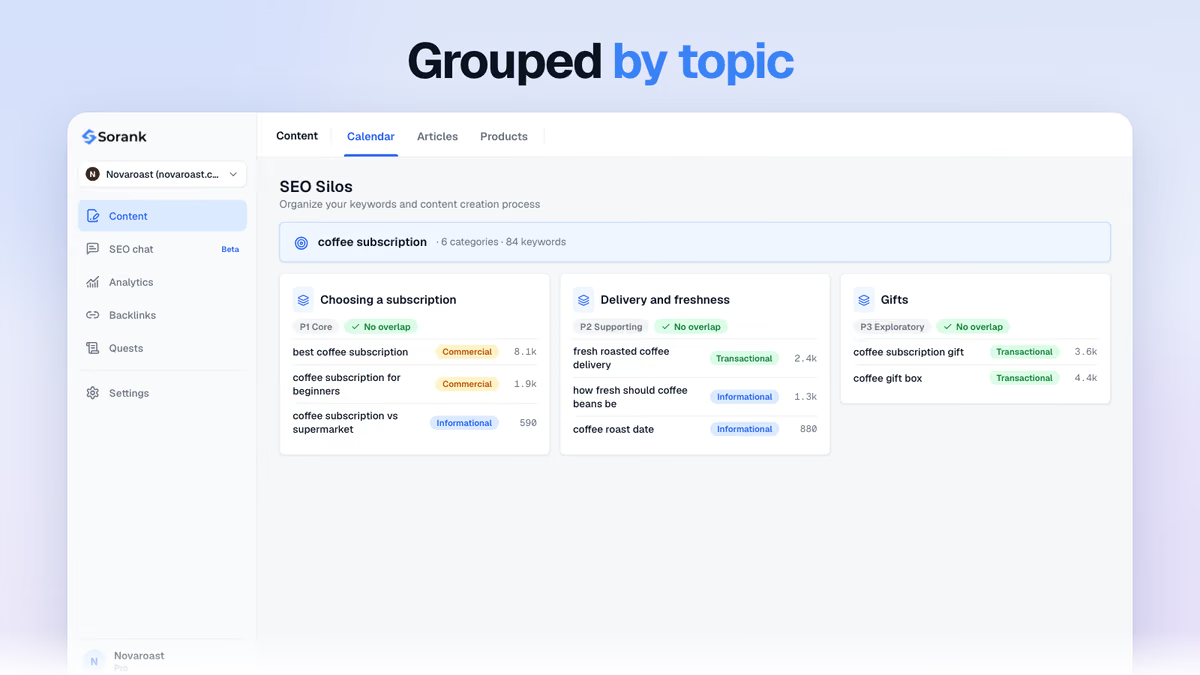
Most customers do not search for "junk removal company". They type "same day junk removal", "appliance removal cost" or "how to dispose of a mattress in [city]", and each search reads like a job about to happen. Sorank sorts these questions by intent, shows difficulty and monthly volume, and turns the ones closest to your service area into articles: what a sofa removal costs, which items your crew cannot take, what a garage cleanout includes.
The questions come from automated keyword research based on your Search Console data, the companies you compete with and the AI answers.
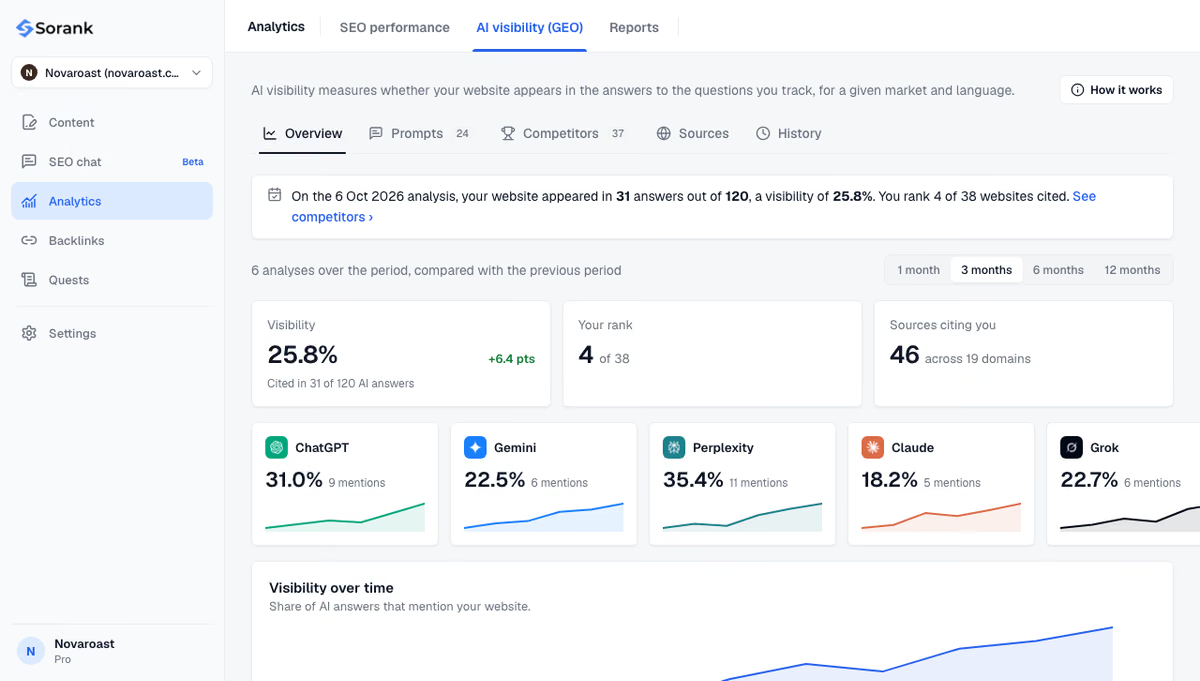
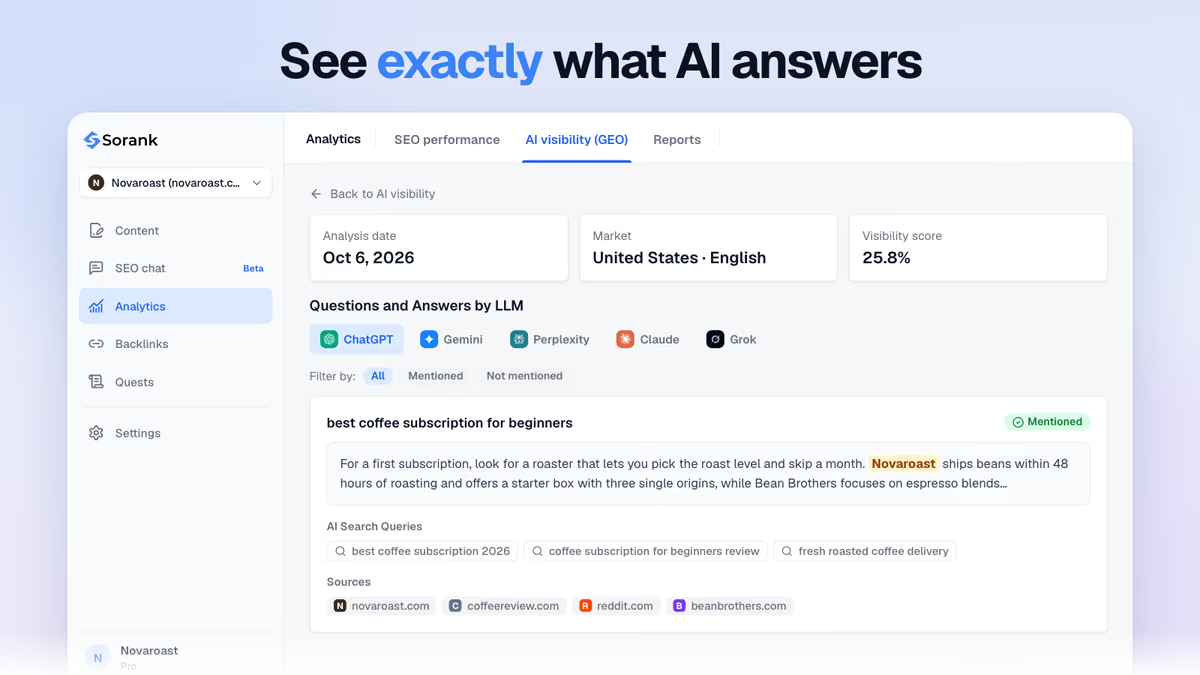
Ask ChatGPT for "best junk removal companies near me" and it names a few crews. Those names come from the pages the model can read: reviews, directories and local listings. Sorank asks the assistants the prompts you choose every month, shows whether your company appears, and lists the websites and searches the model used before it answered.
Past answers stay on file in AI mention tracking, so you can see when a rival first appears and which page the model quoted.
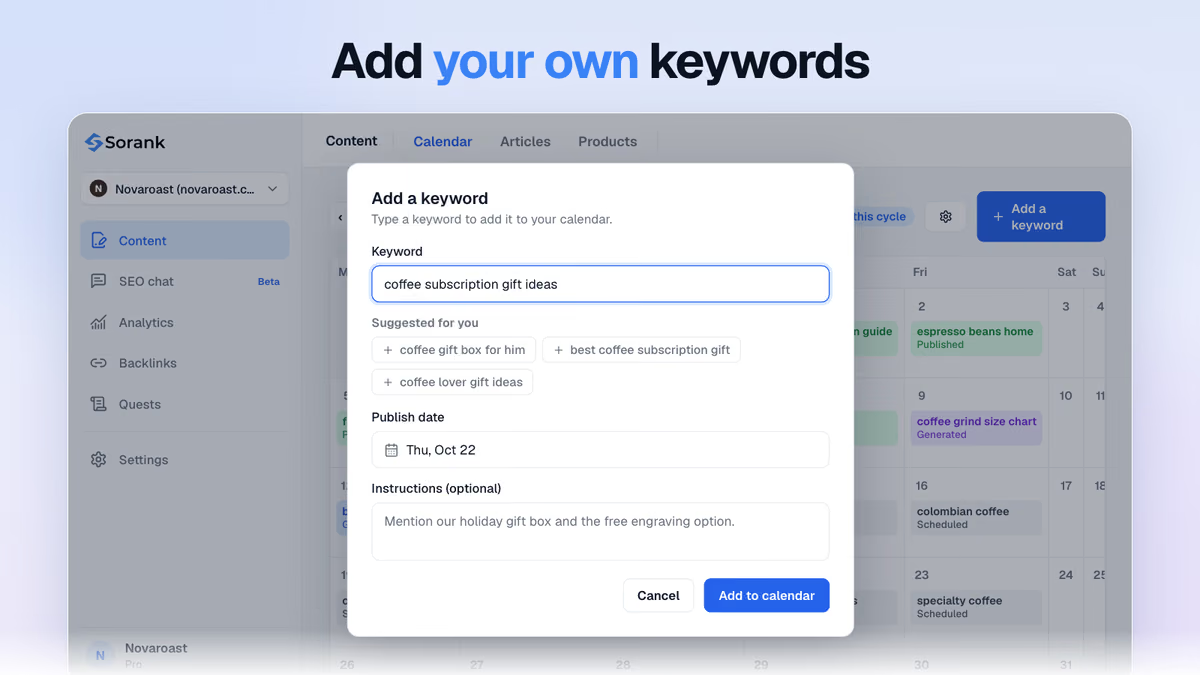
Junk removal demand follows dates: lease ends and summer moves, spring and fall clean-outs, estate cleanouts, storm cleanup and the weeks after the holidays. Sorank places articles on the days you choose, so a garage cleanout guide is online weeks before people start on the garage. Each one links to your booking page or your quote form.
Build the schedule in the content calendar. Articles wait as drafts until you approve them, then publish on the days you set.

WordPress, Wix or Webflow, or any other builder through a webhook. Sorank reads your Search Console data to see which service pages already bring visits, such as mattress removal or estate cleanouts.

The items you take and the items you refuse, the trucks and crew size, the cities or zip codes you serve, and whether you work on homes, offices or construction sites. Sorank turns them into keyword groups with intent, difficulty and volume, and makes sure two articles never chase the same search.

Articles reach your site as drafts for the owner or dispatcher, or go live on the dates you set. Prices in an article come from the rates you give, so no customer reads a figure your team has not approved.
“I tested Sorank on a real client site and it's insane. It does everything an agency would bill you $1500 a month for. It's going into production on that client now.”
 Guillaume Guersanguersanguillaume.com
 “I just let the Sorank software do its thing, and now my DR is 25 and my page is ranking higher.”
 Lucas Flandrefoundertrace.fr“Great service, works well for our website and helps us understand how to improve it to rank better on Google and elsewhere. Congrats, keep going, I recommend it.”
 Hugo T.E-commerce merchant“…In 4 months, I generate 15 organic leads per month without posting anything. It’s not 50/50 with LinkedIn yet, but I sleep better knowing I now have a second lead source growing on autopilot.”

 Valentin Thomyoffbound.fr
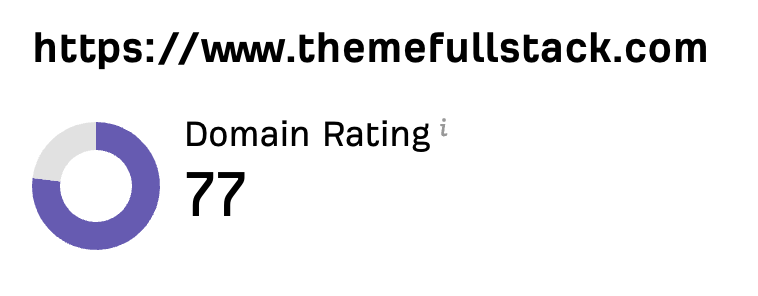 “…With Sorank I finally understood how to structure my SEO and write articles to rank. The audit showed my product page was too slow. In 2 months, my organic traffic doubled and I’m starting to appear in ChatGPT answers when people search for Shopify themes. All of that with about 2 hours per week.”
 Thème FullStackgo.themefullstack.com“Great solution to manage SEO without headaches. Audits are fast, the interface is clear, and you quickly see which actions to implement. It has become an essential tool to track and improve the SEO of my sites. I highly recommend it.”
 XavEntrepreneur“I used Sorank for a client who needed SEO and it clearly made my life easier. I can quickly audit a site, track my projects, and keep a clear overview without multiplying tools. The onboarding is fast and the interface is great.”
 Céline MaurinFreelance CM
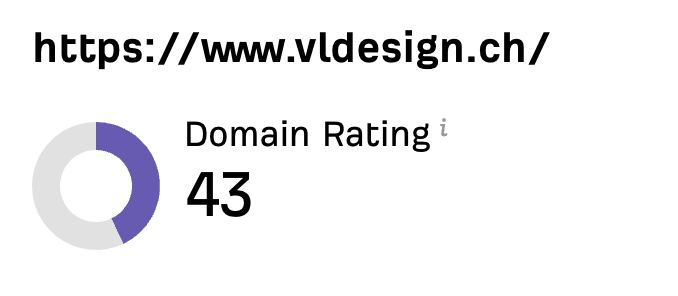 “Blown away by Sorank’s performance. After testing many solutions on the market, I was amazed by how quickly our articles started ranking in the SERP. The results are concrete and much faster than anything we’ve experienced so far. It has been an excellent surprise for our team. We are confidently renewing our trust and highly recommend Sorank to agencies that demand fast and measurable results.”
 Patrick PerretFreelance Webdesign SEO“We’re a development agency and we use Sorank to run on-page audits on our clients’ Shopify stores. It helps us quickly identify optimization opportunities, structure fixes, and collaborate more easily with clients on the SEO side. Very useful to complement our technical support 🔥”

 Younes Yahyaluvaika.com“Sorank has transformed the results we deliver to our clients. We now identify the keywords AI really uses, understand why certain competitors get cited, and spot opportunities we were completely missing before. Our clients see faster rankings, better visibility in AI answers, and clearer ROI on every action we take.”

 Benjamin Rouxovirank.com“We are an Ads agency and we wanted to get our SEO back on track once and for all. Sorank gave us a clear view of our site, helped us prioritize optimizations, and properly structure our content. The tool is easy to use, well designed for a team, and very practical for centralizing tracking without having to juggle multiple platforms. A very solid foundation to start fresh with our SEO.”
 Gaspard MadouiAds Agency“I specialized in GEO thanks to Sorank. The GEO Leaderboard allows me to show my clients their position vs competitors on ChatGPT. It’s a real commercial differentiator.”
 MélanieSEO Freelance“I manage our dealership’s website and it had dozens of issues: slow pages, 404 errors, missing tags. We were losing rankings every month without understanding why. The Sorank audit detected everything in 5 minutes. I sent the report to our web provider with the priority fixes. We regained our rankings and traffic picked back up. Perfect for someone non-technical like me!”
 Xavier BreullMarketing Manager“I’m a CMO for a SaaS and I manage acquisition in a very competitive market. We were investing heavily in our product but not working on our SEO. No visibility on our real competitors, no tracking of our presence in AI. Sorank showed us our positioning vs competitors, which keywords to target, and GEO opportunities we had completely ignored!”
 Louis RAPPCMO SaaS
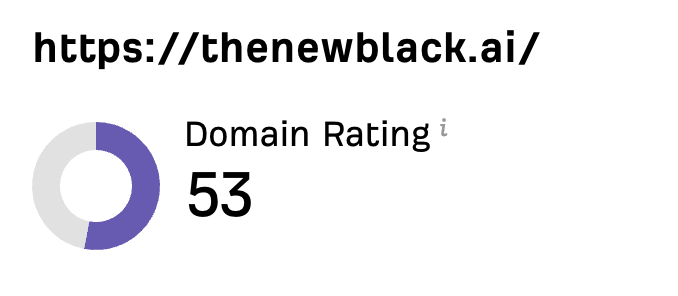 “Very good version 2, I recommend it.”

 Antoine Verhillethenewblack.ai“I was skeptical at first, but this is the best SEO tool I’ve ever used. The interface is clear, audits are fast, and the recommendations are easy to implement. I’ve saved hours and hours managing SEO and tracking performance. I recommend it to all my entrepreneur friends who run an agency or work independently.”
 NoahEntrepreneur“Sorank completely changed the way our SEO agency operates. We now spend far less time on each client because everything is centralized and automated. What used to take hours now takes minutes, which finally allows us to stop working in the business and start working on the business.”

 Océane Bondismaison-leverage.com

Founder’s Note.
I ran my own SEO agency for years. I built Sorank to deliver the same results to every business, at scale.
Everything I know about Google rankings and Generative Engine Optimization (GEO) is coded into this software, and it runs on autopilot for you.
Try for Free
SEO for junk removal companies is the work that gets a crew found when someone needs a load gone today or next week. It has three parts: a Google Business Profile when your company is eligible for one, a website with a page for each service and item you take, and articles that answer the questions customers ask before they call. Sorank writes and publishes those articles, and tracks how the whole site performs on Google and in AI answers.
Other companies with a truck and a crew face similar questions. Waste management companies often work on contracts with businesses, movers plan a move for a set date, and recycling companies sort and resell what they collect. A junk hauler sits between them: the customer hands over whatever they have, and the crew decides what goes to a recycler and what goes to the landfill.
Because the customer needs the job done soon and often compares a few companies before calling one. Many searches happen on a phone, standing next to a pile of furniture. A search for "same day junk removal" is a booking that can close in one call. The company that answers the question first, with a clear idea of what it takes and what it costs, is usually the one the customer calls.
Searches do not stop at the booking. People look up how to dispose of a mattress, what a fridge removal costs and whether paint can go in the trash. Each answer is a chance to be the company they call, even when they ask on a Sunday night.
Sort them by what the customer is about to do:
Searches with your company name in them come closest to a booking. Our local SEO checklist lists the points to check before you publish a page for each city.
Customers worry about the one item they cannot throw away. Paint, batteries and propane tanks often need a separate drop-off, and a crew that says so before pickup avoids a surprise on the driveway. An article that lists what you take, what you refuse and where each refused item goes answers the question in one place, and gives an AI assistant a clear answer to quote.
Many cities and counties treat junk hauling as waste collection, and they license it. The City of Austin, Texas, requires a Private Waste Hauler License from anyone who collects, removes or transports waste for a fee, and its definition of solid waste includes tires and construction scraps. Licensing applies to each vehicle. The fee is $380 per vehicle for haulers that take waste to a landfill, according to the city's private hauler license page.
Rules differ from one place to the next, so check your city and county solid waste office before you publish an article that promises a service. Sorank publishes the facts you give it. It does not check your licenses.
The size of the waste stream puts the work in context. The Environmental Protection Agency estimated that 600 million tons of construction and demolition debris were generated in the United States in 2018, and that demolition made up more than 90 percent of it, according to its sustainable management page. A single junk load is far smaller than a demolition job, but a renovation can leave construction scraps in the same truck, and the same licensing and disposal rules can apply.
They read what other people write about you: reviews, local directories, forum threads and pages that list services by city. A company that states what it takes, what it refuses and the area it serves gives an assistant clear facts to quote. Keep those facts the same on every listing: the same company name, phone number, service area and hours.
Our guide to entity SEO explains why the same facts should match on every site that mentions you. Then check the answers each month to see what changes.
Google's guidelines for representing your business allow a profile for a business that has a physical location customers can visit, or that travels to customers where they are. A crew that works at the customer's home is usually a service-area business. Google asks for one profile with a designated service area, and it asks you to hide the business address from customers. If you also run a yard or an office that customers visit, that address has to be real.
You keep the profile, the reviews and the photos. Our page on getting more Google reviews explains how to ask for them, and the Google Business Profile entry covers the setup.
Start with the answer. Say whether you take the item, what it costs in general terms, and how long pickup takes. Then list what you refuse and where it goes instead. Sorank writes from the facts you give it: your items, your rates, your service area and your disposal sites. An article should never promise a price your team has not set, or a same-day slot you cannot keep.
Add the points that protect the customer: how the crew measures a load, who carries items out of the house, and what happens when a load is heavier than the quote. Link each item guide to the matching service page on your site, so the reader can book in one click.
Sorank finds the questions, writes and publishes the articles with internal links to your service and item pages, and sends them to WordPress, Wix, Webflow, Shopify or WooCommerce, or to any other site through a webhook. It earns backlinks from the sites of other Sorank customers, checks each month what ChatGPT, Claude and Gemini say about you, and gathers Search Console, Analytics and AI visits in one place, the GEO / SEO Dashboard.
Your team keeps the quotes, the scheduling, the trucks, the disposal sites and the licenses. Sorank does not manage your Google Business Profile, your reviews or your bookings.
The Essential plan costs $49 a month on yearly billing, or $99 billed monthly. It includes 20 articles a month and monthly AI tracking on ChatGPT, Claude and Gemini, for one website. A company that runs a separate site for each city pays one plan per site. Pro costs $129 a month on yearly billing or $249 monthly, and moves to 60 articles and adds Grok. Business costs $249 on yearly billing or $499 monthly, for 120 articles. The first 3 days are free, and the pricing page lists every limit.
Expect months. Google publishes no timetable. Profile changes and new reviews can show within weeks, while articles collect impressions in Search Console before they earn clicks. Seasonal work needs more lead time: publish the spring clean-out guide in winter and the storm cleanup guide before the storm season starts. Our note on seasonal SEO explains how to plan those updates.
Several months. Profile changes and new reviews can show within weeks, while articles collect impressions first and clicks later. Publish seasonal guides ahead of each season, and judge every guide after three months in Search Console.
$49 a month per website on the yearly Essential plan, or $99 billed monthly, for 20 articles a month and monthly AI tracking. Each website needs its own plan, and the first 3 days are free.
No. Your profile, your reviews, your quotes and your schedule stay with your team. Sorank publishes articles on your website and reports what the AI assistants say about your company.
State the same facts everywhere: your company name, your service area, the items you take and the items you refuse. Publish guides that answer item and disposal questions, then check each month whether ChatGPT names you and which sites it quotes.
Yes. Many cities and counties license anyone who hauls waste for a fee, and some require a license for each vehicle. Austin, Texas, charges $380 per vehicle for haulers that take waste to a landfill. Check your local rules before an article promises a service.
Sorank publishes to WordPress, Wix, Webflow, Shopify or WooCommerce, and to any other site through a webhook. Your quote form and booking tool stay on your site, and every article can wait as a draft until you approve it.
We don't. Sorank isn't trying to be another Semrush or Ahrefs. Those tools are built for data, Sorank is built to do the work. Instead of more dashboards to check, it turns SEO and GEO insights into actions: articles written and published, backlinks earned, technical fixes and AI visibility tracking. Less complexity, more results.
From $49/month per website on a yearly plan, with a 3-day free trial and a 90-day money-back guarantee (conditions apply). Every plan includes articles, AI visibility tracking and access to natural backlink acquisition; higher plans add more articles, more AI prompts tracked and more backlinks. No setup fees, no paying for seats you don't use.
You shouldn't need a full marketing team or expensive tools to grow. Sorank handles your entire SEO and AI visibility, so you save time and money.