Preferences
Privacy is important to us, so you have the option of disabling certain types of storage that may not be necessary for the basic functioning of the website. Blocking categories may impact your experience on the website. More information

Privacy is important to us, so you have the option of disabling certain types of storage that may not be necessary for the basic functioning of the website. Blocking categories may impact your experience on the website. More information

Auto parts SEO is how a parts store, a distributor or an aftermarket brand gets found when a driver searches "brake pads for 2018 Honda Civic", a mechanic types an OEM part number, or someone asks ChatGPT whether ceramic pads suit a heavy SUV. Sorank writes the content around your catalogue: fitment guides, comparisons and installation articles that point to the right category and product pages, published on autopilot, with a monthly check of what the AI assistants answer.
Your catalogue stays the reference; Sorank adds the pages that explain it.








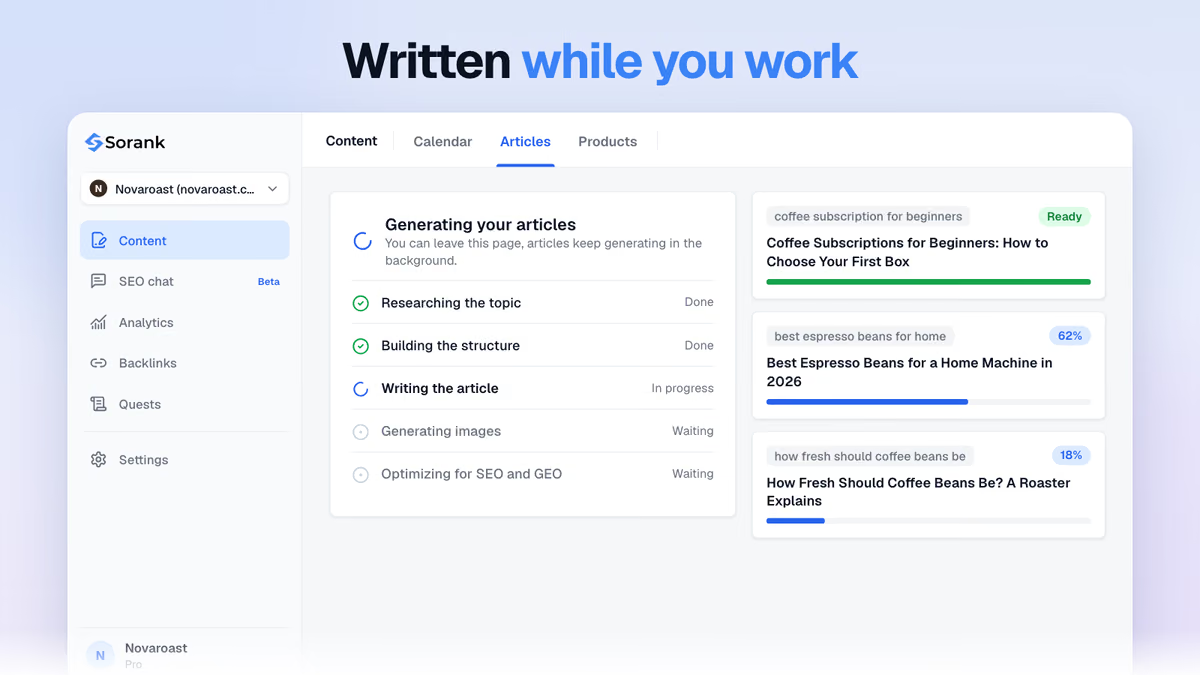








































27,199
Articles created
11,080,701
Visits from Google
18,446
Visits from AI
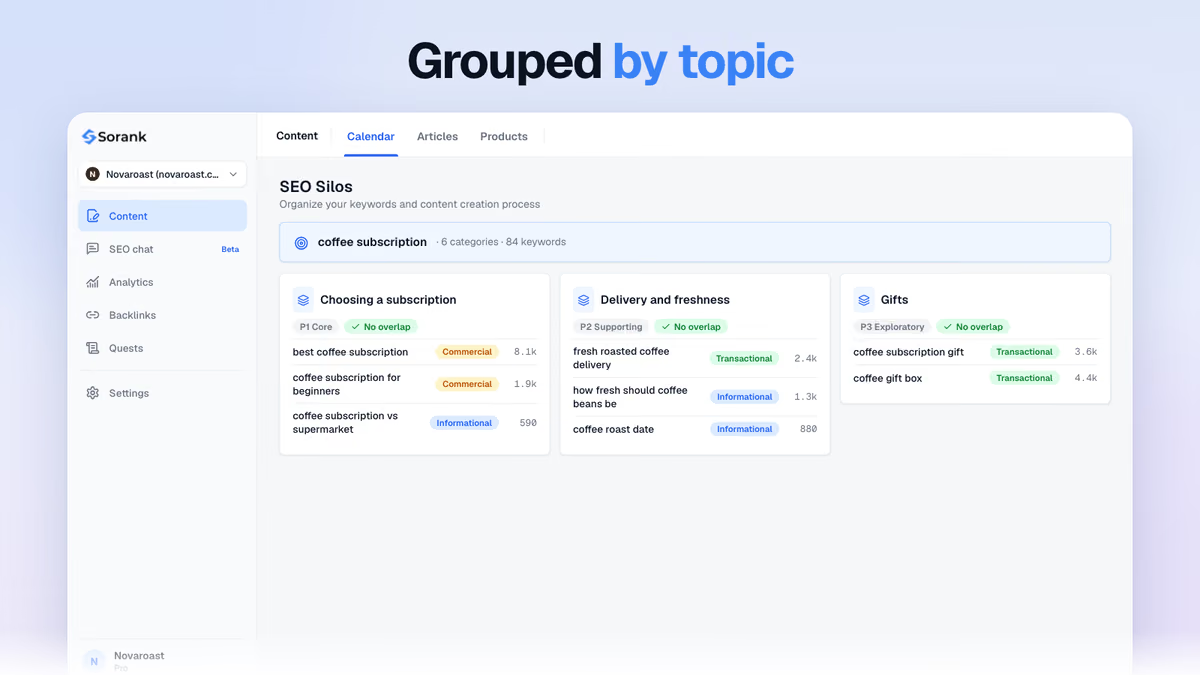
"2014 Silverado 1500 headlight assembly", "will 2017 Camry wipers fit a 2019", "ceramic vs semi-metallic brake pads": buyers type the vehicle, the part and sometimes the doubt. Thousands of these searches look alike, so Sorank groups them into silos by part family and vehicle, gives each keyword a single page and ranks them by intent, difficulty and volume.
Every topic is stored in the library of keyword research.
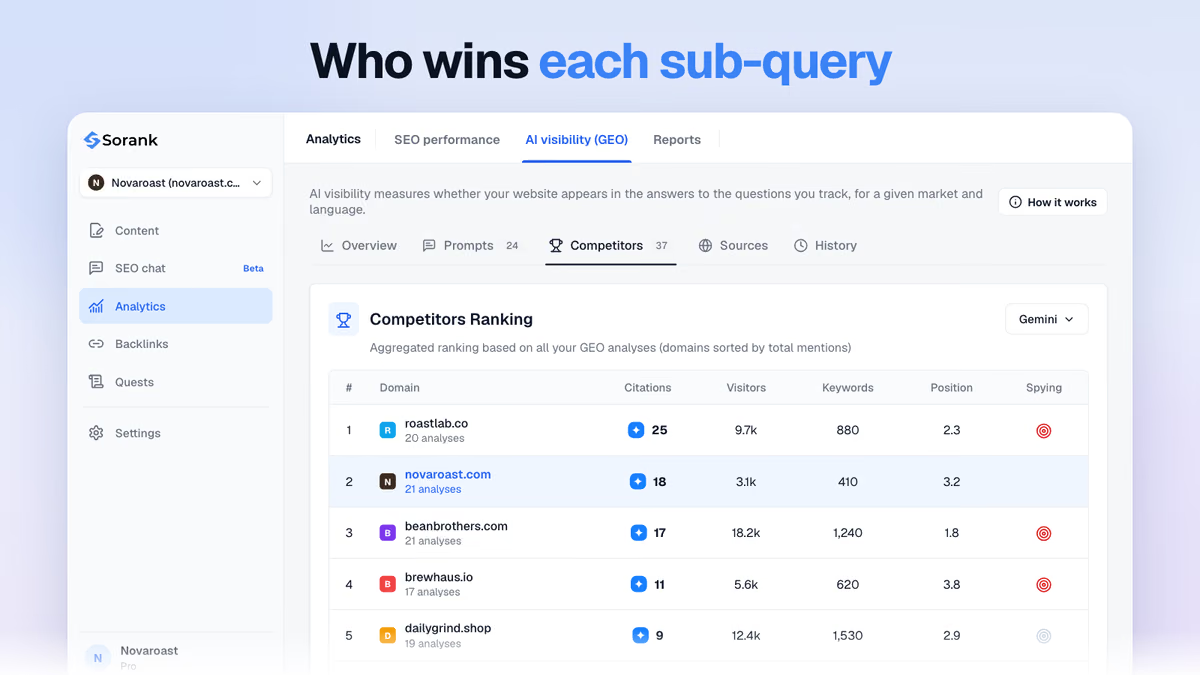
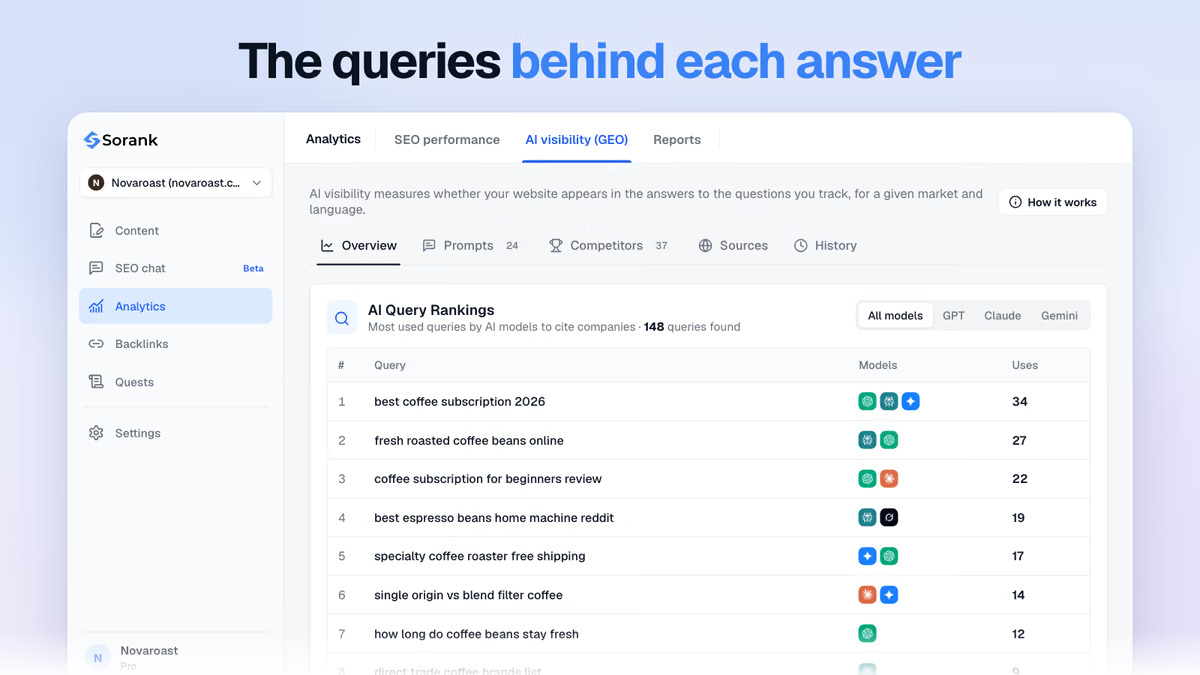
When a driver asks Gemini "which alternator brand lasts longest?" or asks ChatGPT for "the best place to buy genuine Toyota parts online", the answer quotes a few sites. Sorank ranks every domain the models cite for the questions you track, with its visitors, keywords and Google position, and lets you spy on a rival so its keywords feed your next plan.
Follow the ranking with competitor spy.
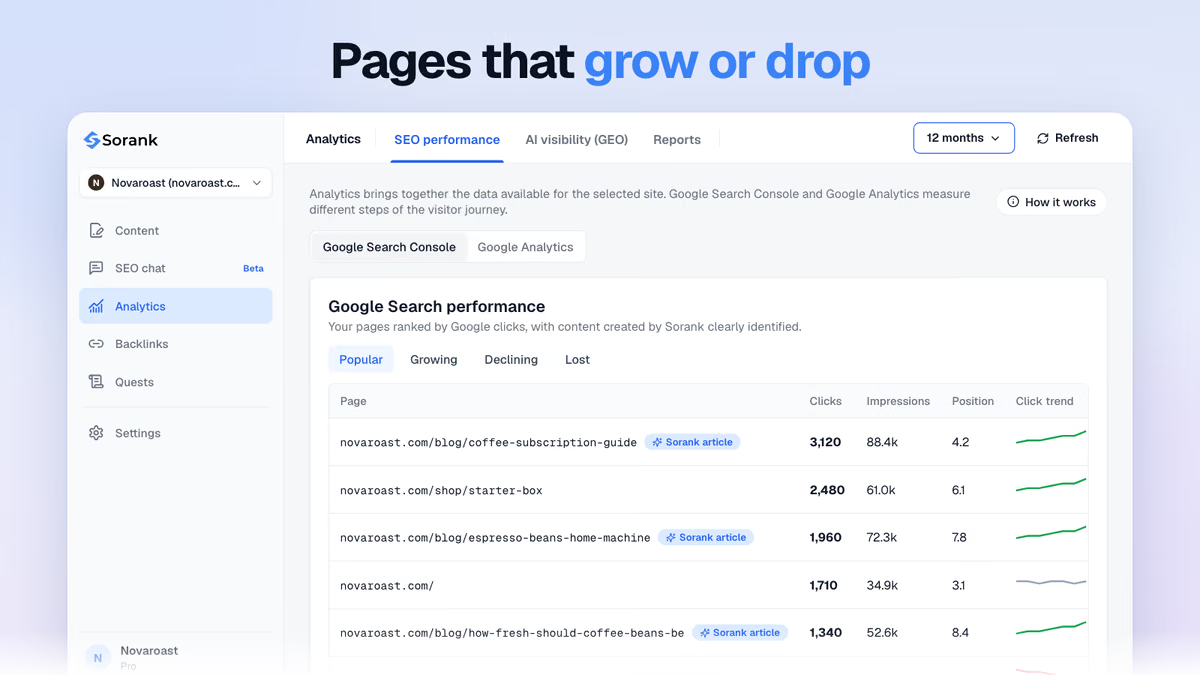
Your Search Console data sits in the same dashboard, with the articles written by Sorank flagged. You see which vehicles and part families bring visits, which pages grow or decline, and where a new fitment guide would help most.
Everything is grouped in the GEO / SEO dashboard.

WordPress, Shopify, WooCommerce, Wix or Webflow, or another platform through a webhook. Sorank reads Search Console to see which vehicles, part families and part numbers already bring visitors.
List your part families (brakes, filters, suspension, lighting, engine parts), the makes you cover, OEM or aftermarket, and whether you sell to drivers, garages or both. Sorank proposes the questions of each family, from fitment checks to installation.

Articles can wait as drafts until a parts specialist confirms torque values, part numbers and fitment notes. Each one links to the matching category and to the products it names.
THEY TRIED SORANK BEFORE YOU
 “I tested Sorank on a real client site and it's insane. It does everything an agency would bill you $1500 a month for. It's going into production on that client now.”

 Guillaume Guersanguersanguillaume.com
 “I just let the Sorank software do its thing, and now my DR is 25 and my page is ranking higher.”
 Lucas Flandrefoundertrace.fr“Great service, works well for our website and helps us understand how to improve it to rank better on Google and elsewhere. Congrats, keep going, I recommend it.”
 Hugo T.E-commerce merchant“For 2 years, 100% of my clients came from LinkedIn. Posting daily, commenting, DM follow-ups… totally dependent on the algorithm. I knew I needed to work on SEO but always postponed it: too long, too technical, not my job. With Sorank, I finally took the step. In 4 months, I generate 15 organic leads per month without posting anything. It’s not 50/50 with LinkedIn yet, but I sleep better knowing I now have a second lead source growing on autopilot.”
 Valentin ThomyColdMailing Agency
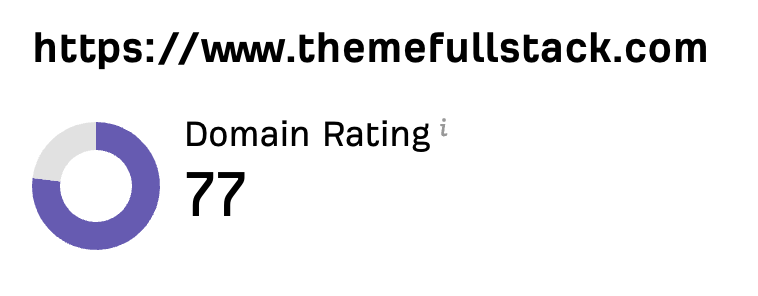 “I’m a developer, not a marketer. My Shopify theme was selling only through word-of-mouth and ads. With Sorank I finally understood how to structure my SEO and write articles to rank. The audit showed my product page was too slow. In 2 months, my organic traffic doubled and I’m starting to appear in ChatGPT answers when people search for Shopify themes. All of that with about 2 hours per week.”
 Thème FullStackgo.themefullstack.com“Great solution to manage SEO without headaches. Audits are fast, the interface is clear, and you quickly see which actions to implement. It has become an essential tool to track and improve the SEO of my sites. I highly recommend it.”
 XavEntrepreneur“I used Sorank for a client who needed SEO and it clearly made my life easier. I can quickly audit a site, track my projects, and keep a clear overview without multiplying tools. The onboarding is fast and the interface is great.”
 Céline MaurinFreelance CM
 “Blown away by Sorank’s performance. After testing many solutions on the market, I was amazed by how quickly our articles started ranking in the SERP. The results are concrete and much faster than anything we’ve experienced so far. It has been an excellent surprise for our team. We are confidently renewing our trust and highly recommend Sorank to agencies that demand fast and measurable results.”
 Patrick PerretFreelance Webdesign SEO“We’re a development agency and we use Sorank to run on-page audits on our clients’ Shopify stores. It helps us quickly identify optimization opportunities, structure fixes, and collaborate more easily with clients on the SEO side. Very useful to complement our technical support 🔥”

 Younes Yahyaluvaika.com“We are an Ads agency and we wanted to get our SEO back on track once and for all. Sorank gave us a clear view of our site, helped us prioritize optimizations, and properly structure our content. The tool is easy to use, well designed for a team, and very practical for centralizing tracking without having to juggle multiple platforms. A very solid foundation to start fresh with our SEO.”
 Gaspard MadouiAds Agency“I specialized in GEO thanks to Sorank. The GEO Leaderboard allows me to show my clients their position vs competitors on ChatGPT. It’s a real commercial differentiator.”
 MélanieSEO Freelance“I manage our dealership’s website and it had dozens of issues: slow pages, 404 errors, missing tags. We were losing rankings every month without understanding why. The Sorank audit detected everything in 5 minutes. I sent the report to our web provider with the priority fixes. We regained our rankings and traffic picked back up. Perfect for someone non-technical like me!”
 Xavier BreullMarketing Manager“I’m a CMO for a SaaS and I manage acquisition in a very competitive market. We were investing heavily in our product but not working on our SEO. No visibility on our real competitors, no tracking of our presence in AI. Sorank showed us our positioning vs competitors, which keywords to target, and GEO opportunities we had completely ignored!”
 Louis RAPPCMO SaaS
 “Very good version 2, I recommend it.”

 Antoine Verhillethenewblack.ai“I was skeptical at first, but this is the best SEO tool I’ve ever used. The interface is clear, audits are fast, and the recommendations are easy to implement. I’ve saved hours and hours managing SEO and tracking performance. I recommend it to all my entrepreneur friends who run an agency or work independently.”
 NoahEntrepreneur
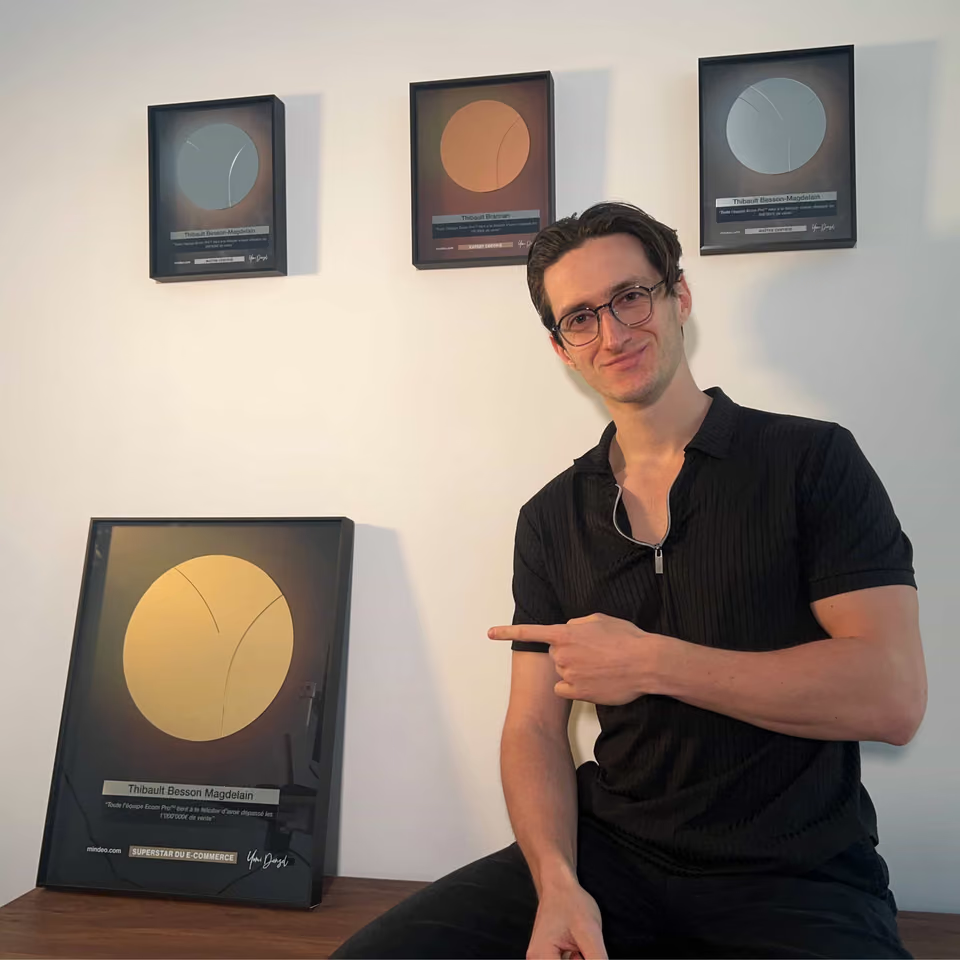
Founder’s Note.
I ran my own SEO agency for years. I built Sorank to deliver the same results to every business, at scale.
Everything I know about Google rankings and Generative Engine Optimization (GEO) is coded into this software, and it runs on autopilot for you.
Try for Free
Auto parts SEO is the work that makes a parts catalogue visible when someone needs a part for a precise vehicle: in Google results, in Google Shopping and in the answers of AI assistants such as ChatGPT. It rests on three things: accurate compatibility data behind every product, category and product pages Google can crawl at catalogue scale, and articles that answer the questions asked before an order.
Demand holds because cars stay on the road longer. S&P Global Mobility puts the average age of light vehicles in the United States at 12.8 years in 2025, with 289 million in operation, and expects more maintenance and repair as these vehicles leave warranty. Dealers have their own page on car dealership SEO software, and garages on SEO for auto repair shops; this one is for the businesses that sell or make the parts.
They search by vehicle, then check the fit. A driver who does the job at home types the year, make, model and part; a mechanic pastes an OEM number; a fleet buyer compares brands for durability. The seller that confirms compatibility clearly, with engine, trim and position, wins the order and avoids the return.
AI assistants answer vehicle questions from reference pages first. In our automotive AI citation study, Wikipedia went from 0.27% of the measured answers in May 2026 to 10.67% in August, and the three most cited sources hold 81% of the citations counted. A seller's page enters the answer when it adds what a reference entry lacks: the exact fitment, the stock, the price, the installation detail. Each model also reads its own sources (Perplexity cites LinkedIn first, at 2.12%), which is why Sorank tracks them one by one.
Because every page depends on it. In North America, most aftermarket companies exchange catalogue data through two standards of the Auto Care Association: ACES for fitment (which part fits which vehicle) and PIES for product information. Clean data feeds the year, make and model filter, the compatibility table of each product and the category pages Google indexes. Elsewhere, rely on the catalogue standard used in your market.
The second issue is duplication. Hundreds of retailers publish the same manufacturer text for the same part, and Google has little reason to prefer one copy (see duplicate content). Add what only you know: the vehicles you have confirmed, the usual fitment mistakes, the questions your counter staff hear. In structured data, Google's merchant listing documentation describes mpn as the manufacturer part number that uniquely identifies the product for a given manufacturer, and the schema.org property isAccessoryOrSparePartFor links a part to the product it belongs to. Vehicle filters multiply URLs, so read our guide to faceted navigation SEO before opening them to Google.
Marketplaces rank on many of these searches too: our guides to eBay SEO and Amazon SEO cover your listings there, and the one on question keywords shows how to find the doubts behind each search.
The vehicle and the answer in the first lines: which part fits, for which years, engines and trims, and where the exceptions are. Then the facts a buyer checks: part numbers and their equivalents, front or rear, what separates the options, the tools and time for the job, torque values when they matter, and the signs that the wrong part was fitted. Close with links to the matching category and products, and a short FAQ. Sorank writes its articles on this structure and can hold them as drafts so a parts specialist checks every number before publication.
Sorank handles keyword research by vehicle and part family, the articles and their links to your catalogue, publication on WordPress, Shopify, WooCommerce, Wix or Webflow, or on platforms such as BigCommerce and Magento through a webhook your developer sets up once, the monthly check of the AI answers in AI mention tracking, and your Search Console data in one dashboard.
Your team keeps the catalogue: fitment data, product pages and prices, the Merchant Center feed, marketplace listings and the Google Business Profile of any store with a counter. Our guide to technical SEO for ecommerce lists what to check on that side.
Sorank costs $49 a month per website on the yearly Essential plan, or $99 month to month, with 20 articles a month and monthly tracking on ChatGPT, Claude and Gemini. A deep catalogue usually calls for more volume: Pro publishes 60 articles for $129 a month billed yearly ($249 monthly) and adds Grok, and Business publishes 120 for $249 a month billed yearly ($499 monthly). Details are on the pricing page, after a 3-day free trial.
Google gives no fixed delay. Fitment articles on long, precise searches often show impressions in Search Console before broad category terms move, and a part family builds results over several months. Review each family after three months, and publish more where impressions grow.
Several months. Precise fitment articles usually gain impressions first, broad category terms later. Judge each part family on its Search Console impressions and clicks after three months.
Sorank starts at $49 a month per website on the yearly plan, or $99 without commitment, with 20 articles a month and a 3-day free trial. Large catalogues often choose Pro or Business, with 60 or 120 articles a month.
No. Fitment data, product pages, prices, feeds and the Business Profile of your store stay with your team. Sorank publishes the articles around your catalogue and links them to your categories and products.
Publish what reference pages lack: exact compatibility, part numbers and their equivalents, stock and price as text, and clear installation answers. Then track every month whether ChatGPT names your store and which sources it quotes.
Start with the part families you sell most, combined with the vehicles your customers drive, then add the comparisons and installation questions around them. Part-number searches depend first on accurate product pages.
Sorank publishes to WordPress, Shopify, WooCommerce, Wix and Webflow, and to other platforms such as BigCommerce or Magento through a webhook your developer sets up once. Articles go to your blog, live or as drafts, with links to your catalogue pages.
We don't. Sorank isn't trying to be another Semrush or Ahrefs. Those tools are built for data, Sorank is built to do the work. Instead of more dashboards to check, it turns SEO and GEO insights into actions: articles written and published, backlinks earned, technical fixes and AI visibility tracking. Less complexity, more results.
From $49/month per website on a yearly plan, with a 3-day free trial and a 90-day money-back guarantee (conditions apply). Every plan includes articles, AI visibility tracking and access to natural backlink acquisition; higher plans add more articles, more AI prompts tracked and more backlinks. No setup fees, no paying for seats you don't use.
You shouldn't need a full marketing team or expensive tools to grow. Sorank handles your entire SEO and AI visibility, so you save time and money.