
Preferences
Privacy is important to us, so you have the option of disabling certain types of storage that may not be necessary for the basic functioning of the website. Blocking categories may impact your experience on the website. More information
Privacy is important to us, so you have the option of disabling certain types of storage that may not be necessary for the basic functioning of the website. Blocking categories may impact your experience on the website. More information

Google MUM is a 2021 AI model that reads text, images and 75 languages together. Learn how it differs from BERT and what it changes for SEO.







Founder Sorank, 7+ years in SEO.
Summary
Google MUM (Multitask Unified Model) is an AI model from Google that understands text and images in 75 languages at the same time. Google announced it in May 2021 and said it was 1000 times more powerful than BERT. Its goal is to answer complex questions with fewer searches.
Want to go further? Ask
Google MUM is a model that Google presented in May 2021. Its name stands for Multitask Unified Model. Google built it to handle several tasks at once, across text, images and languages, so that you need fewer searches to finish a task.
MUM is multimodal. That means it understands information across text and images. Google's May 2021 announcement says it may later expand to video and audio. Google also says it was trained across 75 languages and many tasks at once.
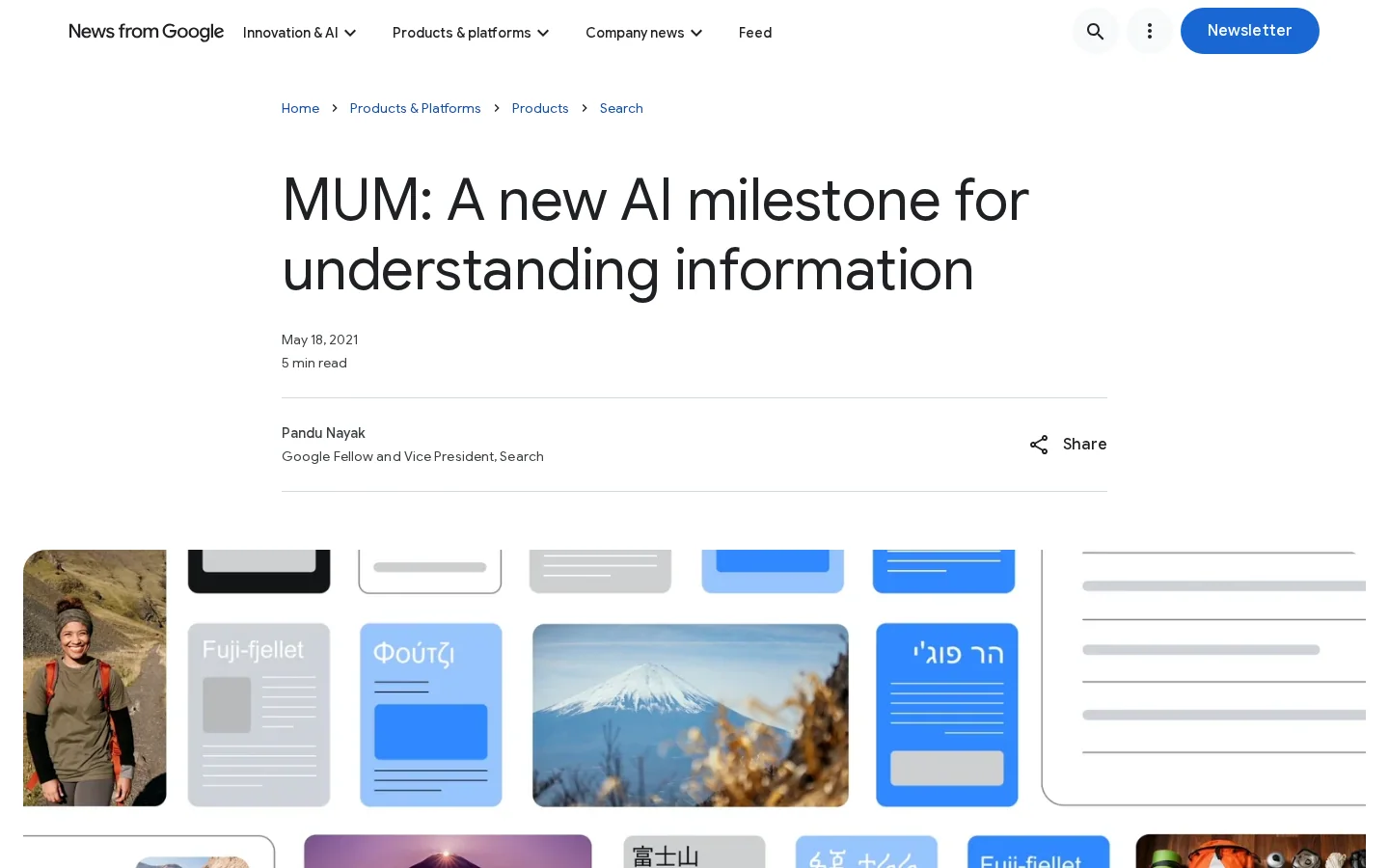
BERT is the earlier Google model that helps the search engine read each word in its context. You can read more in our BERT algorithm entry. MUM goes further. Google says it is 1000 times more powerful than BERT. That number comes from Google itself, so treat it as Google's claim.
Google said MUM would help with complex tasks that take several searches today. The example in the 2021 announcement was a hiking trip. If you plan to hike Mount Fuji after Mount Adams, MUM could note that fall is the rainy season and suggest a waterproof jacket. It could also add gear and training tips. Google gave a second example with a photo. You could show a picture of your hiking boots and ask if they work for Mount Fuji. MUM could confirm they do, and point you to a gear guide.
In its September 2021 Search On post, Google said MUM would unlock "deeper insights you might not have known to search for." It also said MUM would power a visual search where you ask questions about what you see. And it would show related topics in videos that are not named in the video itself.
The 2021 posts describe plans and early work. They do not prove what runs in Search today. Google's May 2026 post on AI Mode says AI Mode now runs on Gemini 3.5 Flash, and it does not mention MUM. For the answers you see today, read our Google AI Overviews entry. Treat the 2021 examples as history, not as a feature you can count on.
The hiking example shows the idea behind MUM. A good answer does not stop at the first question. It also covers the next question the reader is likely to ask, such as gear, weather and training. If your page covers only the first question, a reader must search again. That is the gap MUM was meant to close.
Google also said that useful information in another language could surface for you. Its example was Japanese pages about viewing spots, nearby onsen and souvenir shops for Mount Fuji. Write your pages so that the facts are clear and easy to find, whatever language the reader searches in.
You can apply this to any topic. List the three questions that come right after the main one. Then answer each of them in a short section, with facts and a source. Our semantic search entry explains why matching meaning matters more than matching exact words.
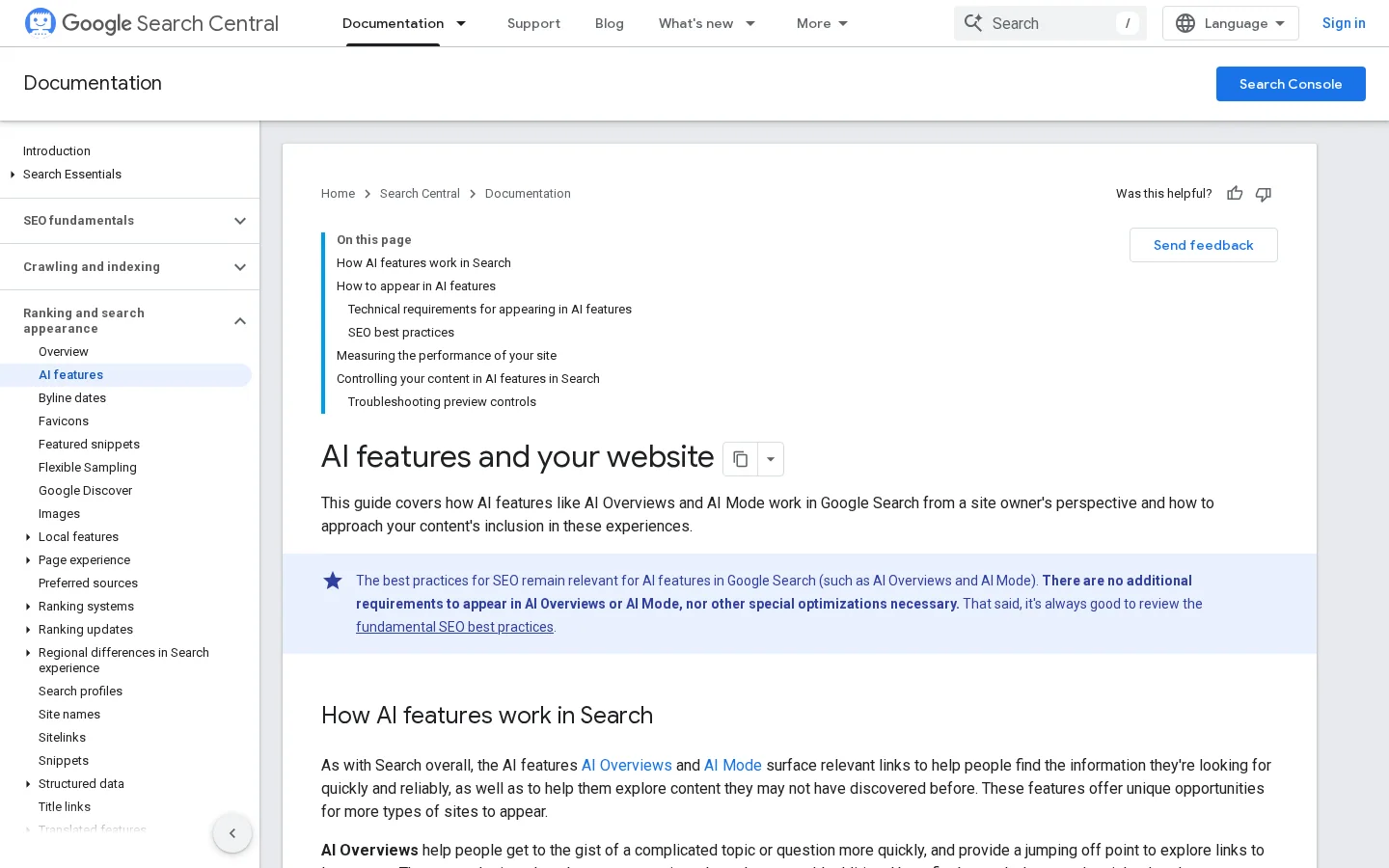
Google says you do not need a special setup. Its guide to AI features in Search states: "There are no additional requirements to appear in AI Overviews or AI Mode, nor other special optimizations necessary." It also says there is no special schema.org markup for these features, and that the best practices for SEO remain relevant.
Tip
MUM is not a setting. No tool can switch it on for your site, so do not look for a "MUM mode". Write for the reader and keep every fact sourced.
So the work is the same as before. Answer the question in the first sentence of each section. Use lists and tables where they help. Then check whether Google cites your brand with our AI Overview Checker.
Sorank can do this work on autopilot. It writes and publishes articles that answer these questions, and it tracks your brand in ChatGPT, Gemini and Claude answers. See GEO optimization for how it works.
MUM shows the direction Google took: from matching exact words to understanding meaning across formats and languages. For SEO, that means each page should answer a clear question for a clear reader. For GEO, the same clarity helps AI answers pick up your page. Related terms: multimodal AI and the Google algorithm.
Google MUM is a model Google presented in May 2021. It reads text and images, works across 75 languages, and was built so you need fewer searches. Its early examples show the direction of Search. For your site, the steps have not changed: answer the question first, then explain it with facts you can source.
Sources
MUM stands for Multitask Unified Model. Google presented it in May 2021. It is built to handle several tasks at once, across text, images and many languages.
No. Google describes MUM as a later model that works across text and images and was trained in 75 languages. Google says it is 1000 times more powerful than BERT, which is Google's own claim.
Google says there are no extra requirements for AI Overviews or AI Mode, and no special schema.org markup. Standard SEO best practices still apply, so focus on clear answers to real questions.
 “I tested Sorank on a real client site and it's insane. It does everything an agency would bill you $1500 a month for. It's going into production on that client now.”

 Guillaume Guersanguersanguillaume.com“We are an Ads agency and we wanted to get our SEO back on track once and for all. Sorank gave us a clear view of our site, helped us prioritize optimizations, and properly structure our content. The tool is easy to use, well designed for a team, and very practical for centralizing tracking without having to juggle multiple platforms. A very solid foundation to start fresh with our SEO.”
 Gaspard MadouiAds Agency
 “I just let the Sorank software do its thing, and now my DR is 25 and my page is ranking higher.”
 Lucas Flandrefoundertrace.fr“I specialized in GEO thanks to Sorank. The GEO Leaderboard allows me to show my clients their position vs competitors on ChatGPT. It’s a real commercial differentiator.”
 MélanieSEO Freelance“Great service, works well for our website and helps us understand how to improve it to rank better on Google and elsewhere. Congrats, keep going, I recommend it.”
 Hugo T.E-commerce merchant



















