
Preferences
Privacy is important to us, so you have the option of disabling certain types of storage that may not be necessary for the basic functioning of the website. Blocking categories may impact your experience on the website. More information
Privacy is important to us, so you have the option of disabling certain types of storage that may not be necessary for the basic functioning of the website. Blocking categories may impact your experience on the website. More information

Crawling and indexing are the two steps that put a page into search. Learn how each works, why pages get crawled but not indexed, and what it means for AI.







Founder Sorank, 7+ years in SEO.
Summary
Crawling indexing is the two-step process that puts a page into search, made of crawling and indexing. Crawling is when a search engine discovers and downloads a page, and indexing is when it analyzes that page and decides whether to store it in its database. A page must be crawled before it can be indexed, and only indexed pages can appear in results.
Want to go further? Ask
Crawling and indexing is the two-stage sequence a search engine goes through before a page can appear in its results. Crawling answers the question "Can the search engine reach this page?", while indexing answers "Is this page worth storing and showing?". Both stages decide whether your content is visible at all, so they come first in any diagnosis of weak search traffic.
Crawling is the discovery and download stage. Automated programs, called crawlers or bots, find URLs through links on other pages, through the sitemaps you submit, and through redirects. Google's main crawler, Googlebot, requests each URL, reads the response and passes the content on for further processing. Google's documentation on crawling and indexing describes this as the way Google finds and parses your content so that it can show it in Search.
Crawling is about access, not quality. A successful crawl only means that the search engine fetched the page. It says nothing yet about whether the page is useful, unique or important enough to keep. For the mechanics of discovery, see the crawling entry of this glossary.
Indexing happens after a page has been crawled. The search engine analyzes the text, images, titles, links and key tags of the page, then decides whether to add it to its index, the database that results are drawn from. Only indexed pages can appear when someone searches. The indexing entry covers this stage in more detail.
The decision is a judgment about quality and relevance, not a formality. Google looks at the content and its originality, at duplicate versions of the same content, at the technical structure of the page and at which URL should be the preferred version. A thin or duplicated page can be crawled and then left out of the index without any error message on your side.
The full journey has clear stages, and each one can fail on its own:
Mapping a problem to the right stage makes diagnosis faster than guessing. A page blocked in robots.txt is never crawled. A page that is crawled but judged low value is never indexed. A page that is indexed but has weak signals may never rank. On large sites, the amount of crawling a search engine is willing to do is limited, which is why crawl budget matters for pages that are deep in the site structure.
Indexing is selective, and that is normal. The Page indexing report in Search Console lists the pages that Google did not index and gives the reason. Two statuses cause the most confusion. "Crawled - currently not indexed" means that the page was crawled but not indexed, and Google's help says that this is common and not always a problem. "Discovered - currently not indexed" means that the page was found but not crawled yet, and Google may have delayed the crawl to avoid overloading the site.
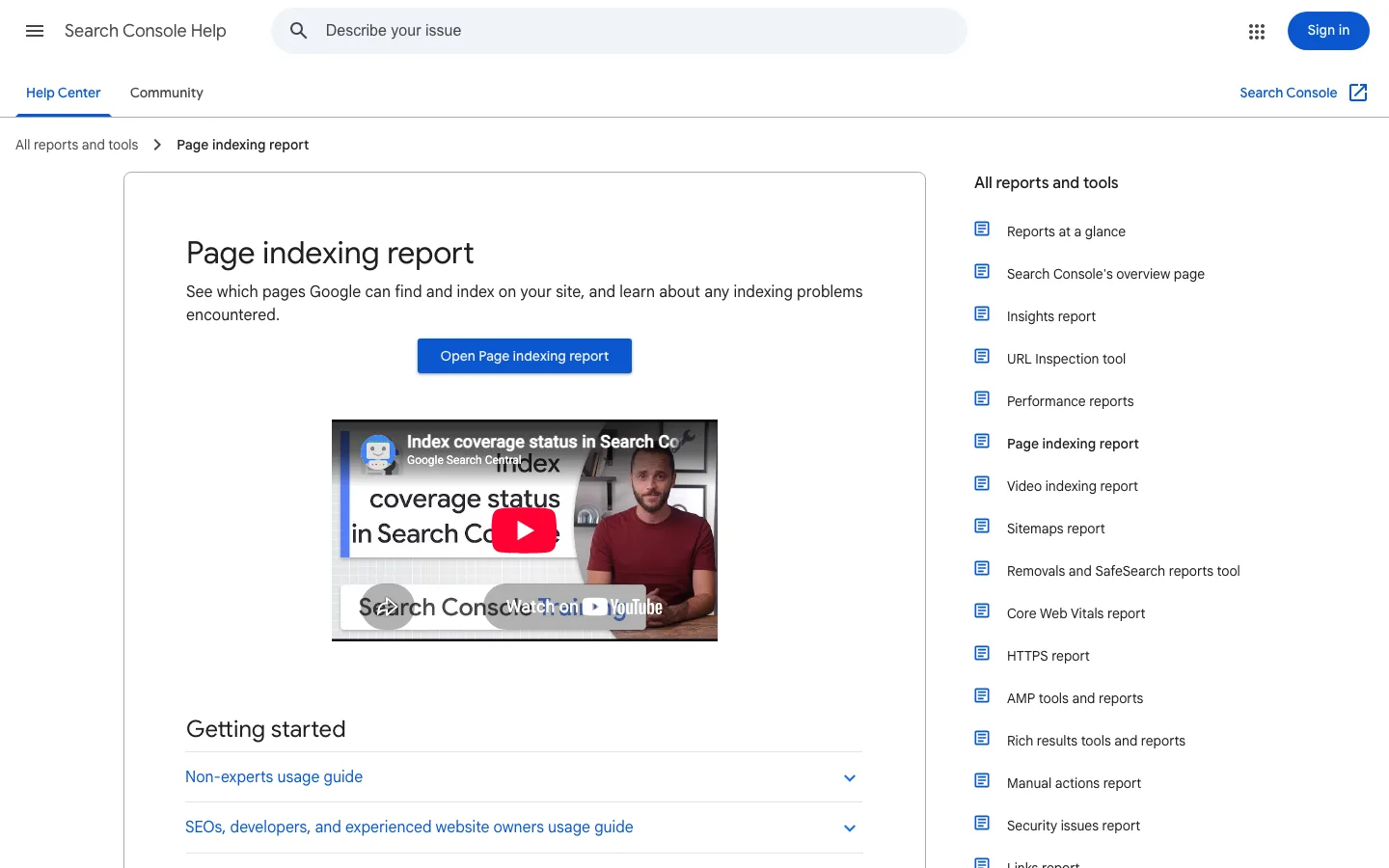
In practice, the usual causes are thin content, duplicate pages and weak canonical signals. Check the report before changing anything. Some pages should stay out of the index on purpose, such as internal search results or filtered listings, and a guide to getting Google to index new pages explains which fixes matter when a page you want found is missing.
Two different tools control two different stages, and mixing them up is the most common cause of accidental losses of visibility.
| Control | What it does | What it does not do |
|---|---|---|
| Robots meta tag with noindex | Keeps the page out of search results | Stop the page from being crawled, since Google must crawl it to read the tag |
| Disallow rule in robots.txt | Blocks crawling of the path | Let the search engine read a noindex tag on the blocked page |
Google's robots meta tag documentation states that these settings can be read and followed only if crawlers are allowed to access the pages that include them. A page you want out of search should therefore carry a noindex tag and remain crawlable. If it is blocked in robots.txt, the noindex rule is ignored.
For SEO, this pipeline is the entry ticket. A page that is not indexed cannot rank, however well it is written, so checking indexation is a basic health check to run regularly and not only after a problem. For pages that are indexed but not yet competitive, Sorank's content optimization helps you improve the text and structure that search engines and readers judge.
For generative engine optimization, a parallel process applies. AI indexing decides whether your content is stored and can be retrieved by the AI assistants that answer questions, such as ChatGPT, Perplexity and Gemini. A page that these systems cannot access or store is unlikely to be cited in their answers. Being crawlable and indexable is the precondition for visibility in both search results and AI answers.
Crawling and indexing are the two gates a page must pass before it can rank: first discovery and download, then analysis and storage. They are sequential and selective, so a crawled page is not automatically a visible page. Check indexation as a routine task, use noindex to keep pages out and robots.txt to control crawling, and remember that the same logic now extends to AI systems that retrieve content for their answers.
Sources
Crawling is when a search engine discovers and downloads a page. Indexing is the next step, where it analyzes the page and decides whether to store it. A page must be crawled before it can be indexed, but not every crawled page ends up in the index.
Indexing is selective. Search Console's Page indexing report lists this situation as "Crawled - currently not indexed". The usual causes are thin content, duplicate pages and weak canonical signals, so improve the page before asking for it to be indexed again.
Yes. AI assistants also need to access and store content before they can retrieve it and cite it in their answers. A page blocked from crawling or marked with a noindex tag may not be retrieved by these systems.
 “I tested Sorank on a real client site and it's insane. It does everything an agency would bill you $1500 a month for. It's going into production on that client now.”

 Guillaume Guersanguersanguillaume.com“We are an Ads agency and we wanted to get our SEO back on track once and for all. Sorank gave us a clear view of our site, helped us prioritize optimizations, and properly structure our content. The tool is easy to use, well designed for a team, and very practical for centralizing tracking without having to juggle multiple platforms. A very solid foundation to start fresh with our SEO.”
 Gaspard MadouiAds Agency
 “I just let the Sorank software do its thing, and now my DR is 25 and my page is ranking higher.”
 Lucas Flandrefoundertrace.fr“I specialized in GEO thanks to Sorank. The GEO Leaderboard allows me to show my clients their position vs competitors on ChatGPT. It’s a real commercial differentiator.”
 MélanieSEO Freelance“Great service, works well for our website and helps us understand how to improve it to rank better on Google and elsewhere. Congrats, keep going, I recommend it.”
 Hugo T.E-commerce merchant



















