
Preferences
Privacy is important to us, so you have the option of disabling certain types of storage that may not be necessary for the basic functioning of the website. Blocking categories may impact your experience on the website. More information
Privacy is important to us, so you have the option of disabling certain types of storage that may not be necessary for the basic functioning of the website. Blocking categories may impact your experience on the website. More information

Co-occurrence in SEO is when two terms appear together in the same text. Learn what it means, whether it affects rankings and how to write for it.








Founder Sorank, 7+ years in SEO.
Summary
Co-occurrence in SEO is the appearance of two terms, names or brands together in the same text, sentence or paragraph. Search engines and AI models see these pairs across many pages, which helps them learn how topics relate. Co-occurrence reflects how fully a topic is covered, but it is not a ranking switch you can set on its own.
Want to go further? Ask
Co-occurrence means two things show up together. In SEO, it usually refers to a pair of terms, entities or brand names that appear in the same unit of text. If a page about backlinks mentions anchor text and referring domains in one paragraph, those terms co-occur on that page. The same pair can also appear on thousands of other pages, and that pattern is what search engines and AI models can learn from.
Co-occurrence is the count of how often two words, names or entities appear together in the same unit of text. The unit can be a sentence, a paragraph, a page or a whole site. Linguists use this count to study how words relate, and SEO writers borrowed the term.
Take the phrase "Domain Rating". On a page about link building, it may sit in the same paragraph as "backlinks" and "anchor text". Those three terms co-occur there. When the same pattern repeats across many pages, a machine can pick up that the topics belong together.
Co-occurrence is easiest to see as a network. Each word is a node, and a line joins two words that meet in the same unit of text, such as the same article or the same sentence. The image below shows a network built from a body of text.
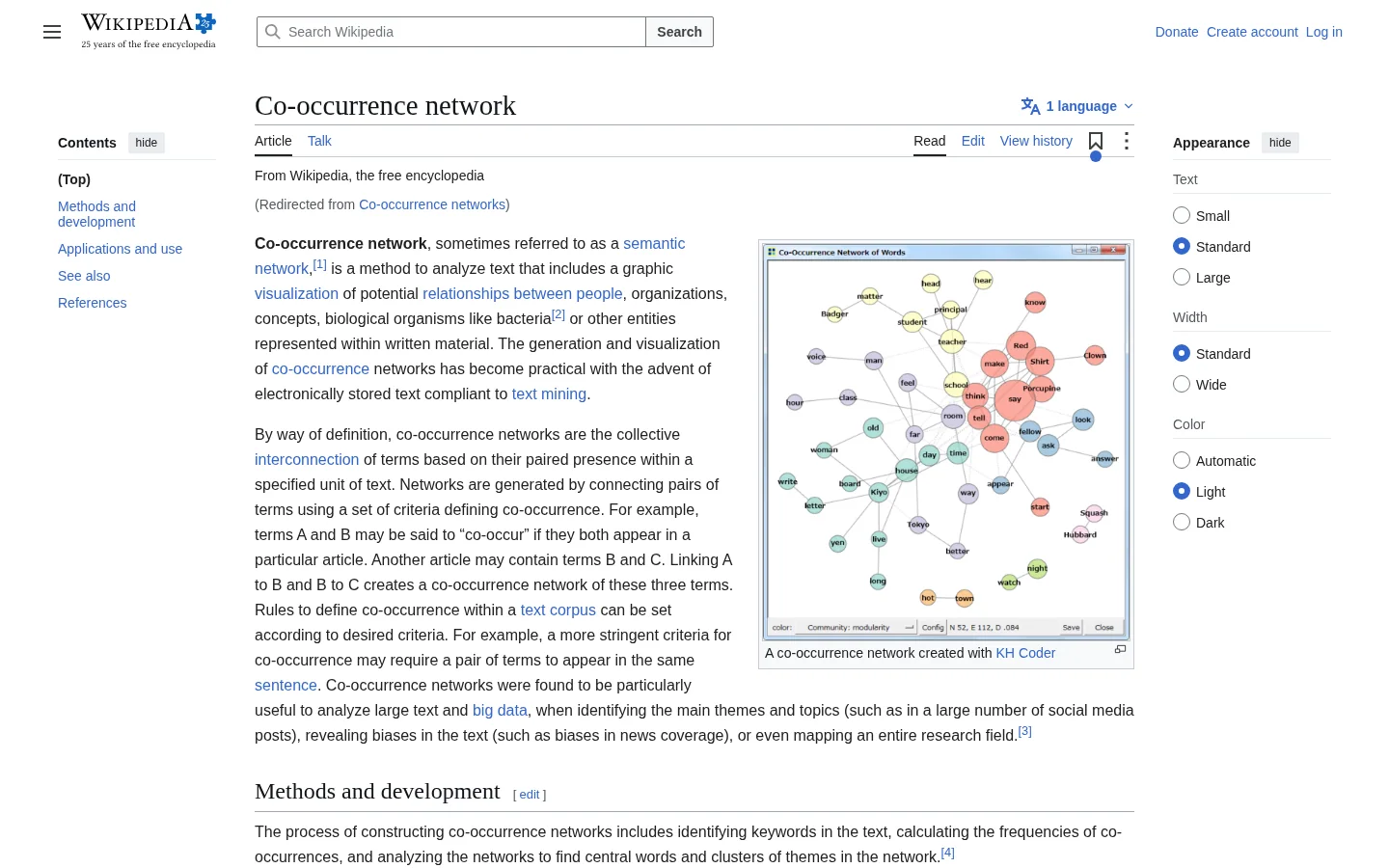
Google does not list co-occurrence among the ranking systems in its documentation. Its guide to ranking systems covers systems such as BERT, neural matching and passage ranking, and that guide does not mention co-occurrence. Google describes BERT as a system that helps it understand "how combinations of words express different meanings and intent." So the useful reading is that Google looks at meaning, and word pairs are one way meaning shows up in a page.
In practice, co-occurrence does not lift a page on its own. Placing "backlinks" next to "anchor text" in one paragraph will not move a page up the results by itself. What matters is whether the page covers the topic the way a real expert would. If you have read about the older idea of related word lists, the LSI keywords entry explains why that approach is no longer the target.
Co-occurrence happens inside a text, when two terms appear together on the same page. Co-citation happens across other sites, when a third site mentions or links to two things together. Co-occurrence comes from your own writing, while co-citation depends on what other people publish.
| Co-occurrence | Co-citation | |
|---|---|---|
| Where it happens | Inside the text of a page or site | Across other sites that mention or link to two things |
| What it counts | Terms, names or entities that appear together | Pages or brands that other sites cite together |
| Who controls it | You, through your own writing | Other site owners, through their links and mentions |
| Example | A backlinks article that mentions anchor text in the same paragraph | Two tools both listed in the same industry roundup |
For the link side of the idea, read the co-citation entry, which covers the question of whether Google uses it.
AI models learn from how words appear together in very large amounts of text, so word pairs shape what they expect to see next to a topic. When your page names a topic and its related terms in one clear place, a reader and a model can both follow the connection. This matters for GEO (generative engine optimization), the work of getting cited by AI models, because a page that explains a topic clearly is easier to match with the questions people ask.
Write for a reader who already knows the topic, then check that the related terms appear where an expert would use them. Use these steps.
Before you write, group your keywords so that each page gets a tight set of related terms. The free keyword clustering tool does this for one list. Sorank's topic cluster generator builds these groups across a whole site and avoids pages that compete with each other.
Most co-occurrence mistakes come from writing for a count instead of a reader. Each mistake below has a sign you can spot and a fix.
This is a run of terms with no sentences that connect them. Google's spam policies describe keyword stuffing as "filling a web page with keywords or numbers in an attempt to manipulate rankings," and note that these keywords often appear "in a list or group, unnaturally, or out of context." To spot it, read a paragraph aloud and check whether a person would say it. To fix it, rewrite the list as sentences that explain how the terms relate.
This happens when a page puts a popular term next to a topic it has nothing to do with, to borrow its interest. To spot it, ask whether the pairing would help a reader who came to learn the topic. To fix it, remove the pairing or write a section that really connects the two.
This is when a writer takes the exact terms used on the top ten pages and inserts them all. The page reads like a summary of other pages and says nothing new. To spot it, compare your term list with the top results. To fix it, start from the questions your reader asks, then add terms only where your explanation needs them.
This is when a writer aims for a set number of times a term appears on a page. No Google page we checked sets a target count for a term. To spot it, look for a sentence that exists only to hit a number. To fix it, delete that sentence. The keyword density entry explains why the percentage idea fades.
Co-occurrence matters because it shows whether a page covers a topic the way an expert would. A page that names the right related terms, explains them in order and links to deeper pages makes the topic clear to a reader and to a machine. For SEO, that clarity supports the relevance Google reads from the page. For GEO, it gives AI models a clear explanation they can quote.
It also helps you audit your own content. If a page on a topic never uses the terms a specialist would use, the gap is worth a closer look. The semantic SEO audit guide shows how to check topics, intents, entities and links on a site.
Co-occurrence is the count of terms that appear together in a text. Google does not list it among its ranking systems, so do not expect it to lift a page on its own. Use it as a check: write each section for a reader, name the related terms a specialist would expect, and cut any pairing that exists only to be counted. For the broader idea, see semantic SEO.
Sources
Google does not list co-occurrence among the ranking systems in its documentation. What counts is whether the page covers the topic clearly, which Google describes through systems that read meaning, such as BERT. Write for that clarity, and do not expect word pairs to lift a page on their own.
Co-occurrence happens inside a text, when two terms appear together on the same page. Co-citation happens across other sites, when a third site mentions or links to two things together. You control co-occurrence through your own writing, but co-citation depends on what other people publish.
List the terms a specialist would expect next to your main term, and place each one where it helps explain something. Name each thing the same way across the page, and cut any pairing that exists only to be counted. A reader should be able to follow every sentence.
 “I tested Sorank on a real client site and it's insane. It does everything an agency would bill you $1500 a month for. It's going into production on that client now.”

 Guillaume Guersanguersanguillaume.com“We are an Ads agency and we wanted to get our SEO back on track once and for all. Sorank gave us a clear view of our site, helped us prioritize optimizations, and properly structure our content. The tool is easy to use, well designed for a team, and very practical for centralizing tracking without having to juggle multiple platforms. A very solid foundation to start fresh with our SEO.”
 Gaspard MadouiAds Agency
 “I just let the Sorank software do its thing, and now my DR is 25 and my page is ranking higher.”
 Lucas Flandrefoundertrace.fr“I specialized in GEO thanks to Sorank. The GEO Leaderboard allows me to show my clients their position vs competitors on ChatGPT. It’s a real commercial differentiator.”
 MélanieSEO Freelance“Great service, works well for our website and helps us understand how to improve it to rank better on Google and elsewhere. Congrats, keep going, I recommend it.”
 Hugo T.E-commerce merchant



















