Preferences
Privacy is important to us, so you have the option of disabling certain types of storage that may not be necessary for the basic functioning of the website. Blocking categories may impact your experience on the website. More information

Privacy is important to us, so you have the option of disabling certain types of storage that may not be necessary for the basic functioning of the website. Blocking categories may impact your experience on the website. More information

Landscaping SEO brings a landscape company two kinds of work from Google and from AI assistants: one-off projects, such as a planting plan or a backyard redesign, and recurring contracts for mowing, pruning and cleanups. The searches behind them have little in common. One homeowner types "landscape designer near me" in January, another wants "weekly lawn mowing price" in May, and a property manager asks ChatGPT who maintains office grounds in town. Sorank sorts these searches by client type, publishes the answers on your site with photos of your own gardens, and shows which landscapers the assistants recommend in your area.
Plans start at $49 a month with yearly billing, and your Google Business Profile and reviews stay in your hands.
















































27,111
Articles created
11,057,030
Visits from Google
18,362
Visits from AI
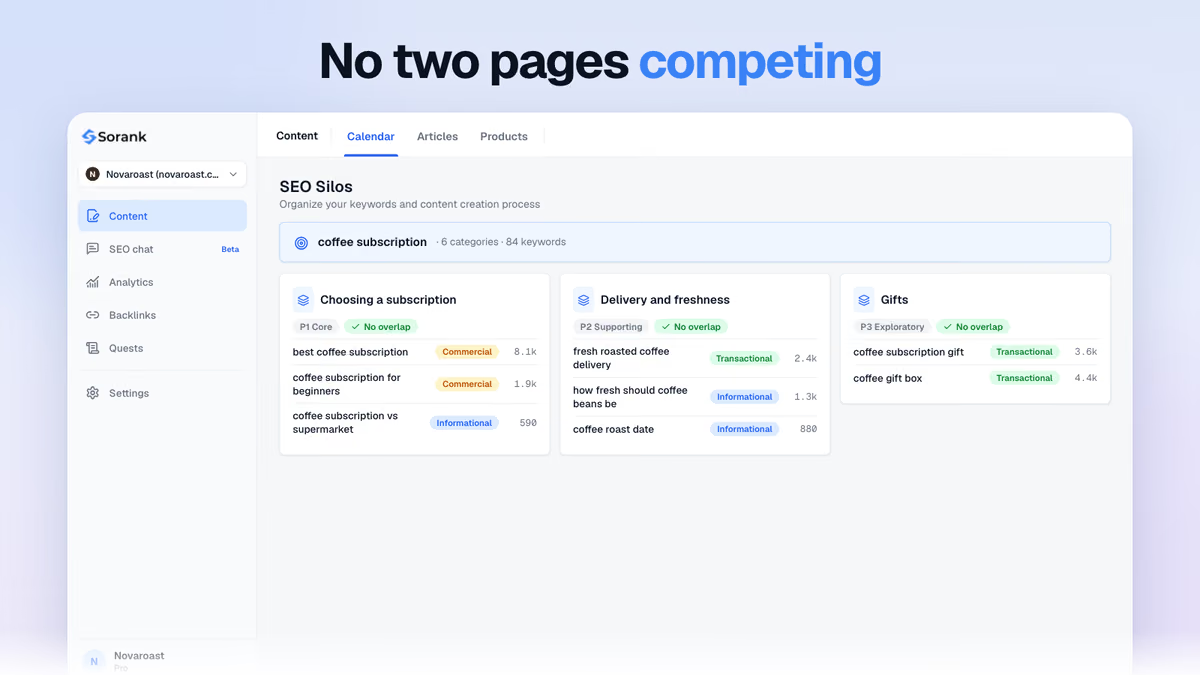
"Front yard landscape design cost", "how much is weekly lawn mowing", "commercial grounds maintenance contract": three searches, three buyers. The homeowner planning a redesign compares ideas for weeks; the maintenance client wants a price per visit from a crew already working on their street; the property manager wants one contract for the whole year. Sorank builds one keyword group for each of them, so a design article never competes with your mowing page for the same search.
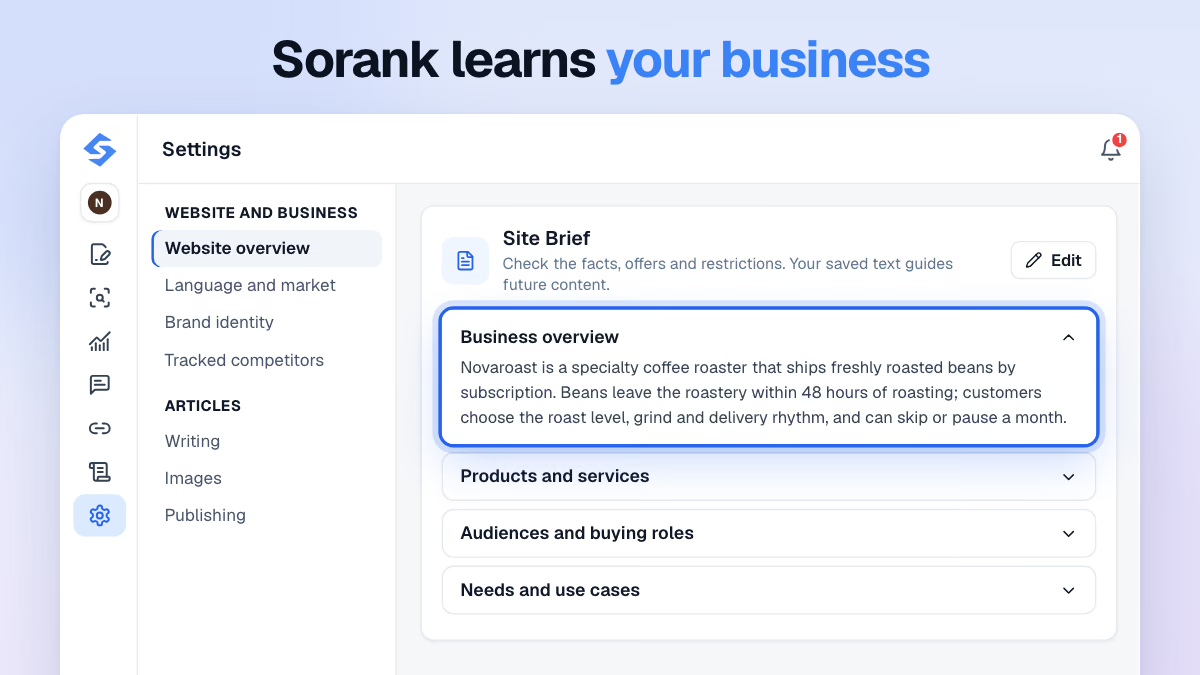
Describe your services and clients once in the site brief, and every article follows it.
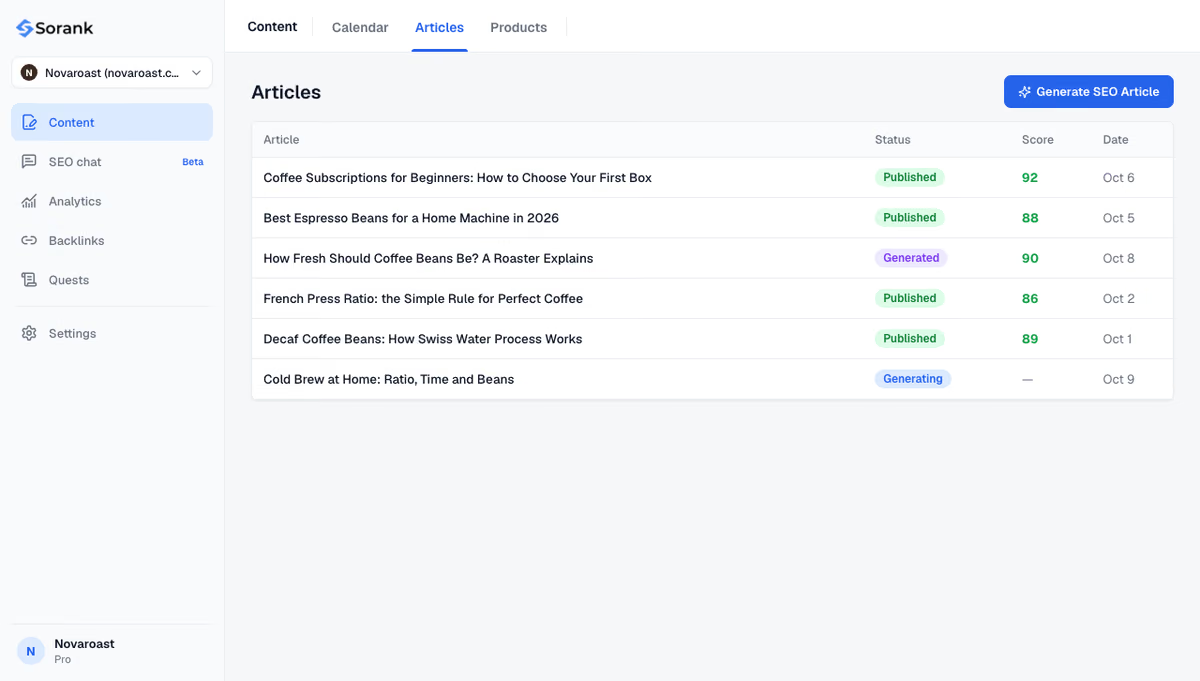
"Low maintenance front yard ideas", "native plants for a shady backyard", "small backyard makeover on a budget": people who search for landscaping want to see a result before they call. Sorank writes one idea guide or project story per search, with the plant list, the site constraints and the season of planting, and follows your image instructions so pictures of your own jobs sit next to the text they illustrate.
Titles and image instructions are set per article in the article generator.
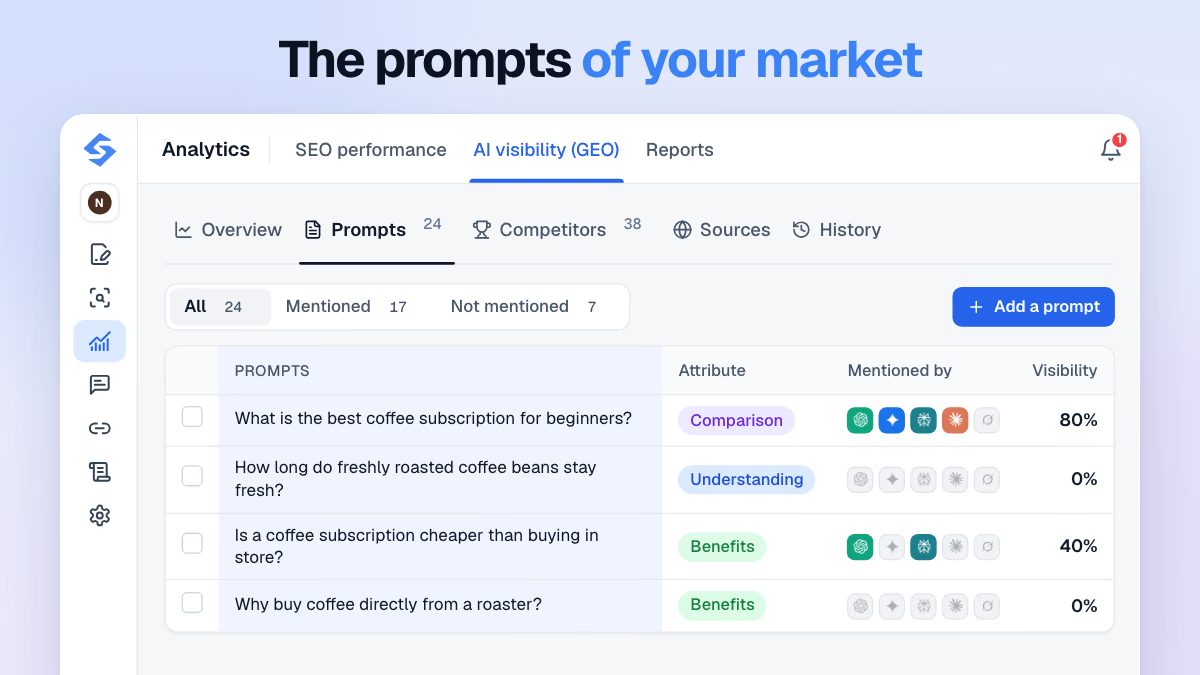
"Who does drought tolerant landscaping in Boise?", "best lawn care company for a large lot near Charlotte": the assistant replies with two or three names and a line about each. Sorank asks the questions you choose every month in ChatGPT, Claude and Gemini, tags each one as a comparison, an explanation or a benefit question, and shows which ones mention your company and which ones still leave you out.
Pick and follow those questions in AI prompt research.

WordPress, Wix, Webflow or another builder through a webhook: once it is connected, Sorank reads your Search Console data and sees whether design searches or mowing searches already bring visitors.
Design and planting, weekly maintenance, irrigation, commercial grounds: list what you sell, the towns on your routes and the plants that thrive there. Sorank turns that into keyword groups, one for each type of client.

Keep the first articles as drafts while you check plant names and prices, then let Sorank publish on the days you pick. Every article points to the matching service page and to your quote form.
THEY TRIED SORANK BEFORE YOU
 “I tested Sorank on a real client site and it's insane. It does everything an agency would bill you $1500 a month for. It's going into production on that client now.”

 Guillaume Guersanguersanguillaume.com
 “I just let the Sorank software do its thing, and now my DR is 25 and my page is ranking higher.”
 Lucas Flandrefoundertrace.fr“Great service, works well for our website and helps us understand how to improve it to rank better on Google and elsewhere. Congrats, keep going, I recommend it.”
 Hugo T.E-commerce merchant“For 2 years, 100% of my clients came from LinkedIn. Posting daily, commenting, DM follow-ups… totally dependent on the algorithm. I knew I needed to work on SEO but always postponed it: too long, too technical, not my job. With Sorank, I finally took the step. In 4 months, I generate 15 organic leads per month without posting anything. It’s not 50/50 with LinkedIn yet, but I sleep better knowing I now have a second lead source growing on autopilot.”
 Valentin ThomyColdMailing Agency
 “I’m a developer, not a marketer. My Shopify theme was selling only through word-of-mouth and ads. With Sorank I finally understood how to structure my SEO and write articles to rank. The audit showed my product page was too slow. In 2 months, my organic traffic doubled and I’m starting to appear in ChatGPT answers when people search for Shopify themes. All of that with about 2 hours per week.”
 Thème FullStackgo.themefullstack.com“Great solution to manage SEO without headaches. Audits are fast, the interface is clear, and you quickly see which actions to implement. It has become an essential tool to track and improve the SEO of my sites. I highly recommend it.”
 XavEntrepreneur“I used Sorank for a client who needed SEO and it clearly made my life easier. I can quickly audit a site, track my projects, and keep a clear overview without multiplying tools. The onboarding is fast and the interface is great.”
 Céline MaurinFreelance CM
 “Blown away by Sorank’s performance. After testing many solutions on the market, I was amazed by how quickly our articles started ranking in the SERP. The results are concrete and much faster than anything we’ve experienced so far. It has been an excellent surprise for our team. We are confidently renewing our trust and highly recommend Sorank to agencies that demand fast and measurable results.”
 Patrick PerretFreelance Webdesign SEO“We’re a development agency and we use Sorank to run on-page audits on our clients’ Shopify stores. It helps us quickly identify optimization opportunities, structure fixes, and collaborate more easily with clients on the SEO side. Very useful to complement our technical support 🔥”

 Younes Yahyaluvaika.com“We are an Ads agency and we wanted to get our SEO back on track once and for all. Sorank gave us a clear view of our site, helped us prioritize optimizations, and properly structure our content. The tool is easy to use, well designed for a team, and very practical for centralizing tracking without having to juggle multiple platforms. A very solid foundation to start fresh with our SEO.”
 Gaspard MadouiAds Agency“I specialized in GEO thanks to Sorank. The GEO Leaderboard allows me to show my clients their position vs competitors on ChatGPT. It’s a real commercial differentiator.”
 MélanieSEO Freelance“I manage our dealership’s website and it had dozens of issues: slow pages, 404 errors, missing tags. We were losing rankings every month without understanding why. The Sorank audit detected everything in 5 minutes. I sent the report to our web provider with the priority fixes. We regained our rankings and traffic picked back up. Perfect for someone non-technical like me!”
 Xavier BreullMarketing Manager“I’m a CMO for a SaaS and I manage acquisition in a very competitive market. We were investing heavily in our product but not working on our SEO. No visibility on our real competitors, no tracking of our presence in AI. Sorank showed us our positioning vs competitors, which keywords to target, and GEO opportunities we had completely ignored!”
 Louis RAPPCMO SaaS
 “Very good version 2, I recommend it.”

 Antoine Verhillethenewblack.ai“I was skeptical at first, but this is the best SEO tool I’ve ever used. The interface is clear, audits are fast, and the recommendations are easy to implement. I’ve saved hours and hours managing SEO and tracking performance. I recommend it to all my entrepreneur friends who run an agency or work independently.”
 NoahEntrepreneur
Founder’s Note.
I ran my own SEO agency for years. I built Sorank to deliver the same results to every business, at scale.
Everything I know about Google rankings and Generative Engine Optimization (GEO) is coded into this software, and it runs on autopilot for you.
Try for Free
Landscaping SEO is the work that gets a landscape company found by people who need a garden designed, planted or looked after, whether they search on the map, scroll the organic results or ask ChatGPT and Gemini. It covers two businesses that often share one name. Design and installation sells rare, visual projects; maintenance sells routes, visits and yearly contracts. A third group, commercial clients such as property managers and owners' associations, buys maintenance by tender.
Each group searches with its own words, so each one needs its own pages and articles. If you mostly build patios and retaining walls, our page on masonry and concrete contractors covers the hardscape side; this page is about plants, lawns and the people who pay to keep them healthy.
Homeowners look at pictures first. On Google, your Business Profile photos are often the first garden they see, and Google's photo guidelines for Business Profiles ask for pictures that are "in focus and well lit" with no heavy filters, images that "represent reality". Then they read reviews and open the site to check whether you work in their town and do the kind of garden they want.
AI assistants rarely see those pictures. Many landscapers keep their portfolio on Instagram or Pinterest, yet in our social media AI citation study, built on 301025 AI answers, Instagram is cited in 0.42% of them and Pinterest never registers. The study's advice is to publish the substance on your own site first. A project story on your domain, with the plants, the problem and the town written out, is something ChatGPT or Gemini can read and quote. Property managers follow a different path: they compare a few firms, then ask for a written proposal, which is why commercial pages should say what a contract covers.
Because it is the part of your expertise that national websites cannot copy. In the United States, plant choices start with the USDA hardiness zone. The 2023 map, as the USDA explains in its announcement of the update, is based on 30-year averages of the lowest winter temperatures, split into 10-degree Fahrenheit zones and 5-degree half zones, and about half of the country moved to the next warmer half zone.
That shift raises real questions, such as "can I plant a crape myrtle in zone 6b now?", and they get the best answer from a local professional. An article that names your zone, your soil and the plants you have seen survive three winters brings what our glossary calls information gain: facts the other results do not have.
Our guide to hyperlocal SEO shows how to find these searches street by street, in the neighborhoods your crews already serve.
As part of a page that explains them. Google's image SEO guidelines recommend short, descriptive file names, alt text written "in context of the content of the page" and images placed near relevant text. A gallery of 40 untitled pictures tells Google very little; one project page with eight captioned photos, the plant list and the before and after story tells it a lot. Our guide to image SEO and the glossary entry on alt text give the details.
Yes, and few landscapers use them. The EPA's WaterSense program states that residential outdoor water use in the United States reaches nearly 8 billion gallons a day, mainly for landscape irrigation, and that the average household uses more water outdoors than for showering and washing clothes combined. Homeowners facing watering limits or high bills search for drought tolerant plants, drip irrigation and lawn replacement. An article that explains these options for your town, and mentions a certification from a WaterSense labeled program if your team holds one, answers them with a local name attached.
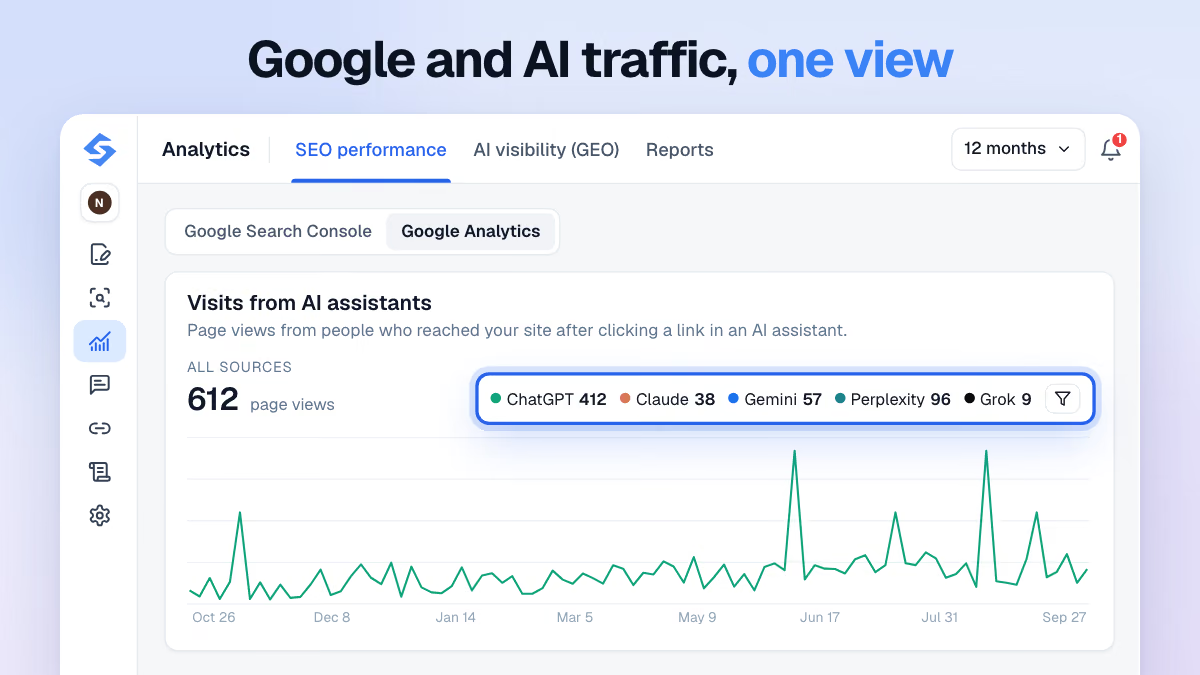
Sorank handles the keyword groups by client type, the articles with their sources, images and internal links, the publishing calendar, the monthly check of AI answers and your Search Console and Analytics data in one dashboard.
Your company keeps the Google Business Profile, its photos and categories (see our glossary entry on the Google Business Profile), the reviews you ask for after each job and how you answer them (our guide on responding to Google reviews helps), your service and town pages, and your proposals. If you also install pools or fences, our pages for pool companies and fence companies cover those trades, and the page for home services companies deals with a brand that sells several of them.
One website needs one Sorank subscription. Essential is $49 a month paid yearly, or $99 month to month, and publishes 20 articles a month while tracking 10 AI questions. Pro, at $129 a month yearly or $249 monthly, goes to 60 articles and adds Grok; Business, at $249 or $499, goes to 120 (all plans). A 3-day free trial comes first. Marketing agencies for landscapers usually bill a monthly retainer that can include ads and the website.
Count in months, not weeks. A new article first earns impressions in Search Console, then clicks. Design buyers start their research in winter, so plant and project articles published in the fall have time to settle before the spring calls; maintenance searches peak once the grass grows. Compare each season with the same season of the previous year, since weather moves landscaping demand more than any single article.
Combine what brings calls this month with what keeps working next year. A complete Google Business Profile, reviews after each job and referrals bring the first; project stories and plant guides on your own site keep drawing visits and give AI assistants a page to quote. Paid ads fill the gaps when your schedule has room.
No. Your profile, its photos, your reviews and your service and town pages stay with your company. Sorank writes and publishes articles on your website, links them to those pages and tracks the AI answers.
Yes. Add your hardiness zone, your towns and the plants you trust to the site brief, and Sorank writes with them. Keep the first articles as drafts if you want to check plant names before they go live.
Give the assistants something to read: project stories with towns and plants, a clear page per service, accurate directory listings and recent reviews. Then check every month in Sorank which questions name your company and which sites are quoted instead.
Sorank starts at $49 a month on the yearly Essential plan, or $99 month to month, after a 3-day free trial. It publishes to WordPress, Wix, Webflow and Shopify, and to other sites through a webhook.
Several months for articles. Business Profile changes and new reviews can show sooner. Publish design and planting content in the fall and winter, then judge each service against the same season a year earlier.
We don't. Sorank isn't trying to be another Semrush or Ahrefs. Those tools are built for data, Sorank is built to do the work. Instead of more dashboards to check, it turns SEO and GEO insights into actions: articles written and published, backlinks earned, technical fixes and AI visibility tracking. Less complexity, more results.
From $49/month per website on a yearly plan, with a 3-day free trial and a 90-day money-back guarantee (conditions apply). Every plan includes articles, AI visibility tracking and access to natural backlink acquisition; higher plans add more articles, more AI prompts tracked and more backlinks. No setup fees, no paying for seats you don't use.
You shouldn't need a full marketing team or expensive tools to grow. Sorank handles your entire SEO and AI visibility, so you save time and money.