Preferences
Privacy is important to us, so you have the option of disabling certain types of storage that may not be necessary for the basic functioning of the website. Blocking categories may impact your experience on the website. More information

Privacy is important to us, so you have the option of disabling certain types of storage that may not be necessary for the basic functioning of the website. Blocking categories may impact your experience on the website. More information

SEO for hosting companies is how a web host or a cloud provider gets chosen before anyone opens a pricing page: a developer searches "nginx 502 bad gateway", a site owner types "how to move WordPress to a new host without downtime", a CTO asks ChatGPT for the "cheapest GPU cloud to fine-tune a small model". The provider whose page answers first often gets the sign-up. Sorank finds these technical questions, publishes tutorials, comparisons and migration guides on your site, and tracks which providers the AI assistants recommend.
Every article can wait as a draft until an engineer on your team has run the commands.
















































27,199
Articles created
11,080,695
Visits from Google
18,446
Visits from AI
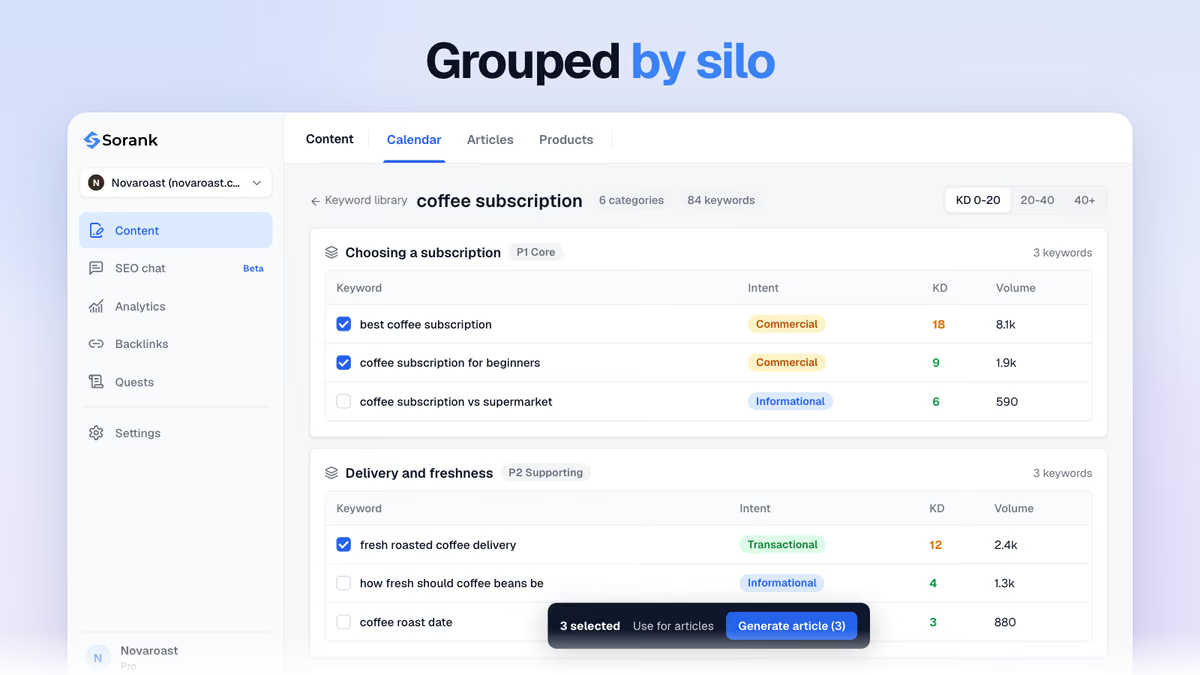
"How to set up a reverse proxy on Ubuntu 24.04", "Docker container keeps restarting", "PostgreSQL too many connections": technical searches are where a host earns trust long before a buyer compares plans. Sorank groups these questions into silos per product (VPS, managed WordPress, object storage, Kubernetes), ranks them by priority, and plans tutorials that link each fix to the plan that runs it.
Each silo is built in the topical cluster generator.
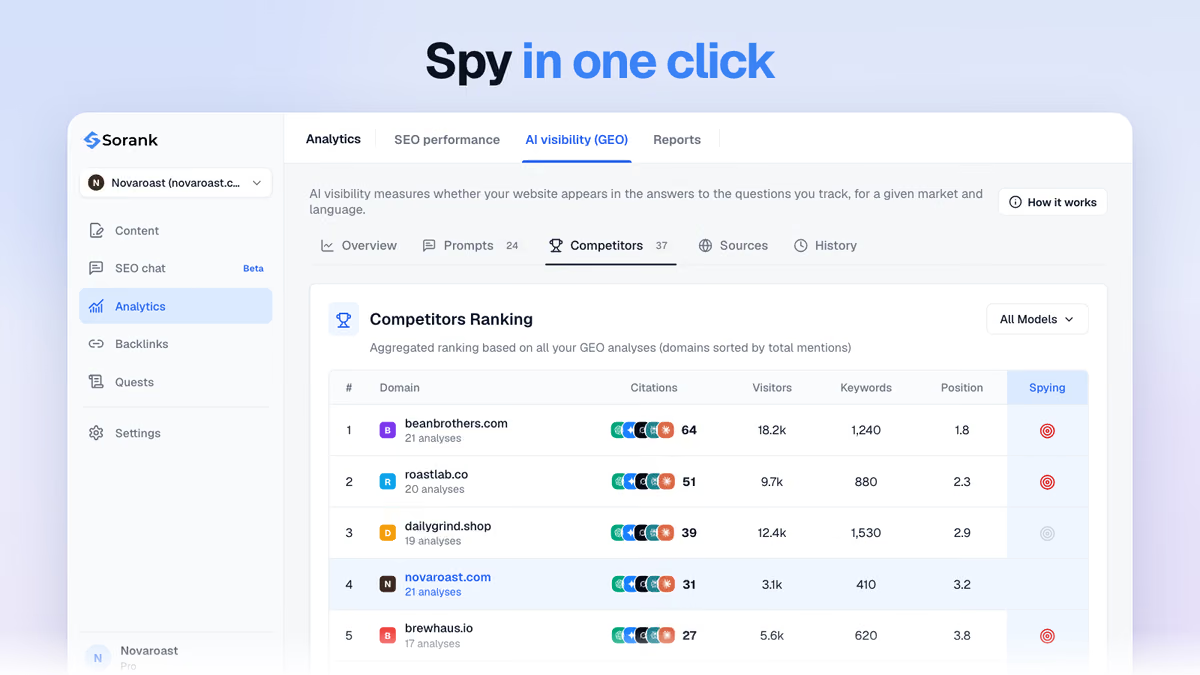
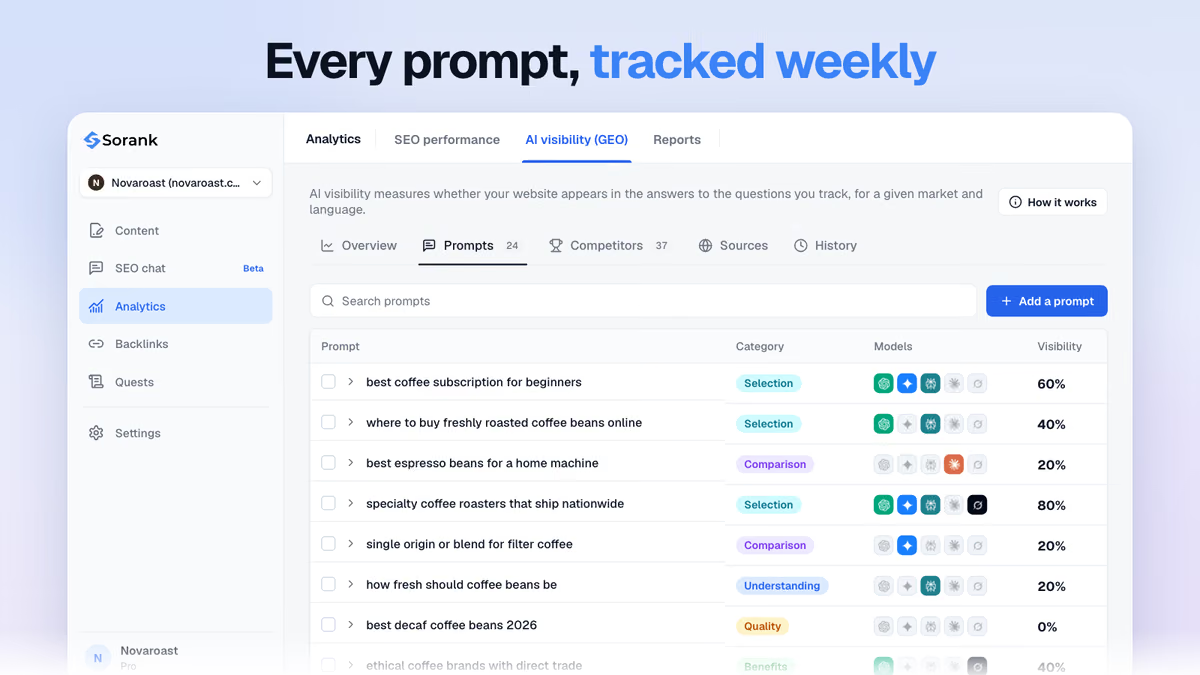
Developers now ask an assistant before a search engine: "which managed database is cheapest for a side project", "best hosting for a Django app", "is shared hosting enough for WooCommerce". Sorank asks the prompts you track every month, isolates the ones where your company is never named, and shows which providers and pages fill the answer instead, so your next tutorials target those gaps.
Filter them in AI mention tracking.
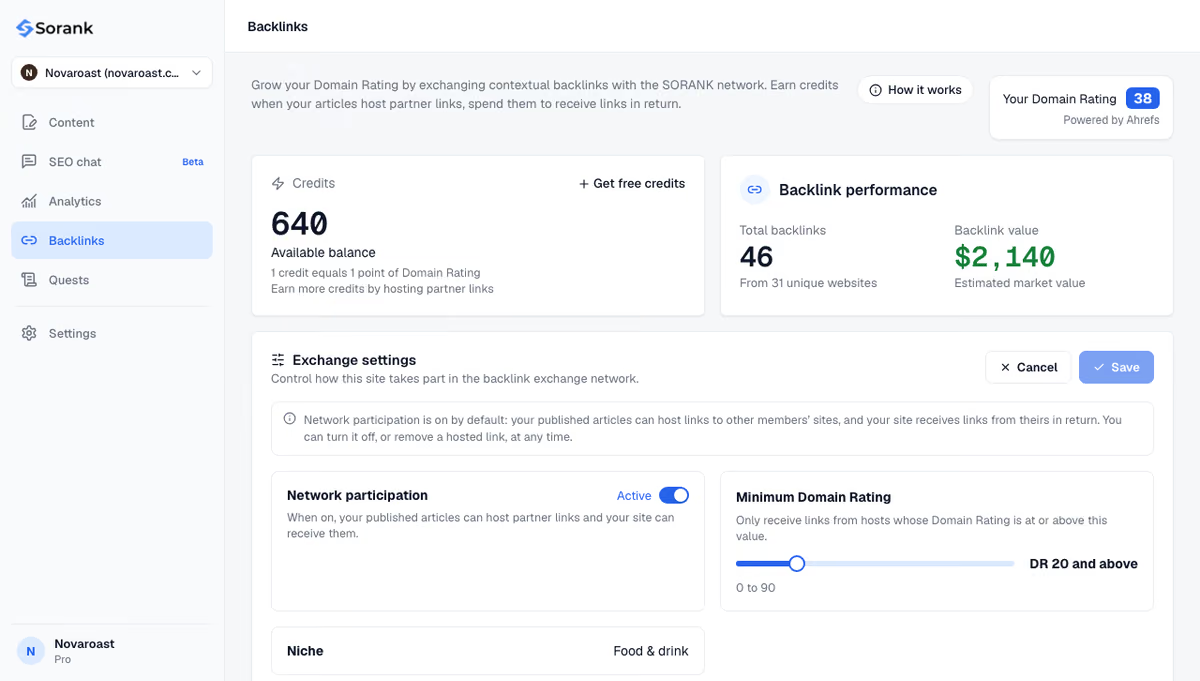
A tutorial that solves a real error can collect links from forums, code repositories and Q&A threads. Sorank adds backlinks from the sites of other Sorank customers, above the minimum Domain Rating you set and away from the domains you exclude, and follows your Domain Rating as tutorials and comparisons pile up.
Settings and results are in the domain authority tracker.

WordPress, Webflow, or a stack of your own through a webhook, static site generators included. Sorank reads Search Console and Analytics to see which tutorials, comparison pages and pricing pages already bring visits.
Shared and managed WordPress hosting, VPS, bare metal, object storage, GPUs, data center regions: add what you sell and who buys it, from freelancers to platform teams. Sorank proposes the questions of each audience, from first install to migration.

Tutorials arrive as drafts, so someone tests the commands before publication. Approved articles go out on your schedule and link to the matching plan, the documentation and the status page.
THEY TRIED SORANK BEFORE YOU
 “I tested Sorank on a real client site and it's insane. It does everything an agency would bill you $1500 a month for. It's going into production on that client now.”

 Guillaume Guersanguersanguillaume.com
 “I just let the Sorank software do its thing, and now my DR is 25 and my page is ranking higher.”
 Lucas Flandrefoundertrace.fr“Great service, works well for our website and helps us understand how to improve it to rank better on Google and elsewhere. Congrats, keep going, I recommend it.”
 Hugo T.E-commerce merchant“For 2 years, 100% of my clients came from LinkedIn. Posting daily, commenting, DM follow-ups… totally dependent on the algorithm. I knew I needed to work on SEO but always postponed it: too long, too technical, not my job. With Sorank, I finally took the step. In 4 months, I generate 15 organic leads per month without posting anything. It’s not 50/50 with LinkedIn yet, but I sleep better knowing I now have a second lead source growing on autopilot.”
 Valentin ThomyColdMailing Agency
 “I’m a developer, not a marketer. My Shopify theme was selling only through word-of-mouth and ads. With Sorank I finally understood how to structure my SEO and write articles to rank. The audit showed my product page was too slow. In 2 months, my organic traffic doubled and I’m starting to appear in ChatGPT answers when people search for Shopify themes. All of that with about 2 hours per week.”
 Thème FullStackgo.themefullstack.com“Great solution to manage SEO without headaches. Audits are fast, the interface is clear, and you quickly see which actions to implement. It has become an essential tool to track and improve the SEO of my sites. I highly recommend it.”
 XavEntrepreneur“I used Sorank for a client who needed SEO and it clearly made my life easier. I can quickly audit a site, track my projects, and keep a clear overview without multiplying tools. The onboarding is fast and the interface is great.”
 Céline MaurinFreelance CM
 “Blown away by Sorank’s performance. After testing many solutions on the market, I was amazed by how quickly our articles started ranking in the SERP. The results are concrete and much faster than anything we’ve experienced so far. It has been an excellent surprise for our team. We are confidently renewing our trust and highly recommend Sorank to agencies that demand fast and measurable results.”
 Patrick PerretFreelance Webdesign SEO“We’re a development agency and we use Sorank to run on-page audits on our clients’ Shopify stores. It helps us quickly identify optimization opportunities, structure fixes, and collaborate more easily with clients on the SEO side. Very useful to complement our technical support 🔥”

 Younes Yahyaluvaika.com“We are an Ads agency and we wanted to get our SEO back on track once and for all. Sorank gave us a clear view of our site, helped us prioritize optimizations, and properly structure our content. The tool is easy to use, well designed for a team, and very practical for centralizing tracking without having to juggle multiple platforms. A very solid foundation to start fresh with our SEO.”
 Gaspard MadouiAds Agency“I specialized in GEO thanks to Sorank. The GEO Leaderboard allows me to show my clients their position vs competitors on ChatGPT. It’s a real commercial differentiator.”
 MélanieSEO Freelance“I manage our dealership’s website and it had dozens of issues: slow pages, 404 errors, missing tags. We were losing rankings every month without understanding why. The Sorank audit detected everything in 5 minutes. I sent the report to our web provider with the priority fixes. We regained our rankings and traffic picked back up. Perfect for someone non-technical like me!”
 Xavier BreullMarketing Manager“I’m a CMO for a SaaS and I manage acquisition in a very competitive market. We were investing heavily in our product but not working on our SEO. No visibility on our real competitors, no tracking of our presence in AI. Sorank showed us our positioning vs competitors, which keywords to target, and GEO opportunities we had completely ignored!”
 Louis RAPPCMO SaaS
 “Very good version 2, I recommend it.”

 Antoine Verhillethenewblack.ai“I was skeptical at first, but this is the best SEO tool I’ve ever used. The interface is clear, audits are fast, and the recommendations are easy to implement. I’ve saved hours and hours managing SEO and tracking performance. I recommend it to all my entrepreneur friends who run an agency or work independently.”
 NoahEntrepreneur

Founder’s Note.
I ran my own SEO agency for years. I built Sorank to deliver the same results to every business, at scale.
Everything I know about Google rankings and Generative Engine Optimization (GEO) is coded into this software, and it runs on autopilot for you.
Try for Free
SEO for hosting companies is the work that gets a web host, a cloud platform or a CDN found when people plan, build or fix something online, on Google and in the answers of AI assistants. Few customers search for a host by name at first; they search for a task ("deploy a Next.js app"), an error, a migration or a price. The provider that answers those searches with accurate pages earns trust before the comparison starts.
Software vendors, security firms and development studios meet other searches: see our pages for SaaS companies, cybersecurity vendors and software development companies.
Through tutorials, documentation and, more and more, an AI assistant. In the Stack Overflow 2025 Developer Survey, 84% of respondents use or plan to use AI tools in their development process and 51% of professional developers use them every day, yet 46% distrust the accuracy of those tools against 33% who trust it. An assistant that suggests where to deploy picks a provider whose documentation it can read, and the developer double-checks the advice against the same pages.
Our Microsoft AI citation study shows the mechanism: Microsoft is the seventh most cited platform, in 1.03% of measured answers over three months, cited by all five models and mostly as documentation, which the study calls a documentation effect rather than a brand effect. Clear docs and tutorials are what a provider gets quoted for.
Because review and affiliate sites hold them: hosting affiliate programs are common, and the lists they fund rank on the broad terms. A host rarely beats them on "best web hosting"; it wins the long tail around its own stack ("managed WordPress hosting with staging for agencies", "VPS with IPv6 in Frankfurt"), the error and migration searches, and its own brand next to "review", "pricing" or "vs". A comparison page earns trust when it states measurable facts (regions, limits, included backups, support hours) and the cases where another option fits better.
Speed and uptime, which is why they make strong articles. Google's documentation on HTTP status codes and network errors states that 5xx and 429 errors make its crawlers slow down, and that URLs which keep returning a server error are eventually dropped from the index. web.dev puts a good time to first byte at 0.8 seconds or less and a poor one above 1.8 seconds, while noting that TTFB is not one of the Core Web Vitals.
Articles that explain these numbers, show how to measure them (see our guide to PageSpeed Insights) and how your stack handles them answer a real worry of site owners, who search "does hosting affect SEO" before they move. Our guide to SEO migration covers the move itself.
Our guide to SEO for developers explains how to write technical pages that rank.
Switching becomes a topic you cannot avoid. The European Commission's Data Act explainer says the regulation has applied since 12 September 2025; until 12 January 2027 providers may still charge customers the costs incurred for switching and data egress, and from that date switching charges, egress included, are removed entirely. Customers will search how to move, what it costs and how long it takes. A provider that publishes clear switching guides, in both directions, answers those searches with its own facts rather than a competitor's.
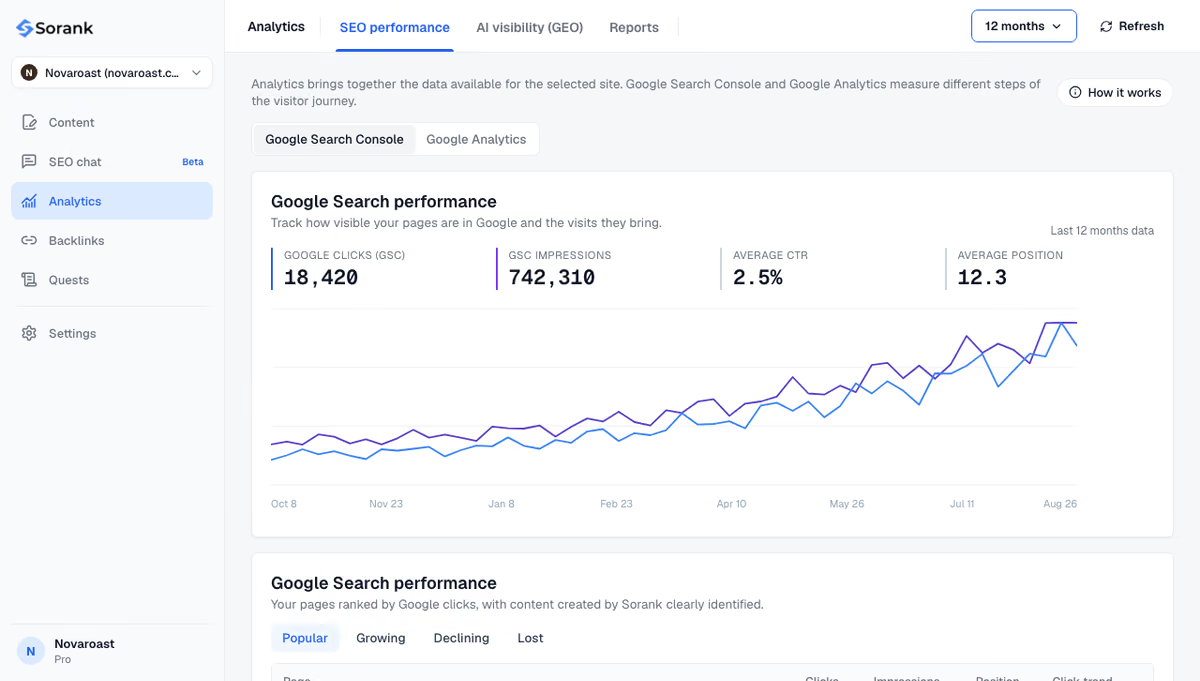
Sorank runs keyword research by product and audience, writes tutorials, comparisons and explainers with sources, images and internal links, publishes them to WordPress, Webflow or your own stack through a webhook, live or as drafts, tracks the AI answers every month, earns backlinks from the sites of other Sorank customers and gathers Search Console, Analytics and AI visits in one dashboard.
Your team keeps what needs an engineer or a contract: the documentation site, the status page, SLAs and uptime figures, price lists, the control panel, compliance certificates, the affiliate program and the review profiles. Every command and version number in a tutorial should be run by someone on your team before approval. Managed service providers will find more in our guide to SEO for MSPs.
Pricing is per website. Essential: $49 a month with yearly billing or $99 without commitment, for 20 articles and 10 prompts in ChatGPT, Claude and Gemini. Pro: $129 or $249, for 60 articles and 20 prompts and Grok included. Business: $249 or $499, for 120 articles and 50 prompts (pricing details). A 3-day free trial and a 90-day results-or-refund guarantee apply to all three. A provider that publishes on a separate docs domain or on one domain per country needs a plan for each of those sites.
Google gives no fixed delay, and the category is crowded. Error fixes and narrow tutorials often collect impressions within weeks of publication; comparison and "best hosting" terms take far longer and depend on links. Review each product silo every quarter on its Search Console impressions and clicks, its AI mentions and the trial sign-ups it brings.
Yes. With drafts mode on, each tutorial waits in your website until someone tests the commands and approves it. Fixed rules, such as the operating system versions you support or the exact names of your products and CLI, go into the writing instructions once.
Give the assistants pages they can rely on: public documentation, tutorials that work, a readable price list and consistent descriptions on review sites and developer communities. Then check every month in Sorank whether ChatGPT names you and which pages it cites.
The errors and tasks tied to your own stack, the migrations toward your service and your brand next to "pricing", "review" or "vs". Broad terms such as "best web hosting" come later, once links and reviews support them.
From $49 a month per website on the annual Essential plan, or $99 month to month, after a 3-day free trial. Pro and Business publish 60 and 120 articles a month for providers with several product lines.
Narrow tutorials and error fixes often show impressions within weeks; sign-ups follow over several months as a silo fills up. Judge each product line every quarter on its impressions, clicks, AI mentions and trials.
Yes. Besides WordPress, Webflow, Wix and Shopify, Sorank sends each article through a webhook to any stack, including static site generators and headless CMSs, and every article can also be exported.
We don't. Sorank isn't trying to be another Semrush or Ahrefs. Those tools are built for data, Sorank is built to do the work. Instead of more dashboards to check, it turns SEO and GEO insights into actions: articles written and published, backlinks earned, technical fixes and AI visibility tracking. Less complexity, more results.
From $49/month per website on a yearly plan, with a 3-day free trial and a 90-day money-back guarantee (conditions apply). Every plan includes articles, AI visibility tracking and access to natural backlink acquisition; higher plans add more articles, more AI prompts tracked and more backlinks. No setup fees, no paying for seats you don't use.
You shouldn't need a full marketing team or expensive tools to grow. Sorank handles your entire SEO and AI visibility, so you save time and money.