
Preferences
Privacy is important to us, so you have the option of disabling certain types of storage that may not be necessary for the basic functioning of the website. Blocking categories may impact your experience on the website. More information
Privacy is important to us, so you have the option of disabling certain types of storage that may not be necessary for the basic functioning of the website. Blocking categories may impact your experience on the website. More information

Prompt variation is rewording the same AI prompt to see how the answer changes. Learn the method, a worked example and how to compare results.








Founder Sorank, 7+ years in SEO.
Summary
Prompt variation is the practice of rewording the same instruction in several ways, then comparing the answers a model gives to each version. It shows whether a result depends on the exact wording or holds up across phrasings, which matters for any brand that wants to track AI answers.
Want to go further? Ask
Prompt variation means you keep the goal of a prompt the same, change its wording, and watch how the answer changes. The aim is not to find one perfect prompt. The aim is to learn whether the answer stays stable. If a model gives a different answer each time you change a phrase, one answer tells you very little.
A prompt is the instruction you send to an AI model such as ChatGPT, Claude or Gemini. A prompt variation is another version of that instruction. It asks for the same thing, with the same meaning, but in different words or with a different setup.
This differs from prompt engineering. Prompt engineering aims at one good prompt for one task. Prompt variation writes several versions on purpose, so you can measure how much the answer depends on the wording.
People use prompt variation for three reasons. They want to test a model's answer before they rely on it. They want to check that a result is not a lucky one-off. And they want to know which wording gets the answer they need.
Take a question about software for a team. Here are two formulations with the same goal, a recommendation:
Version A is short and open. Version B adds a team size and a budget. Both ask for a recommendation, so you might expect the same names back. But the two versions can name different tools, and then one answer cannot stand for both wordings.
Formatting can move the answer too, not only meaning. In the arXiv paper by Melanie Sclar and colleagues, the authors report that subtle changes in prompt formatting moved accuracy by up to 76 points for one open model, LLaMA-2-13B, in few-shot settings. The sensitivity stayed when they used larger models, more examples or instruction tuning.
Comparing answers works best as a fixed method. Use the same steps for every pair of versions:
The table shows a useful set of details to record for every answer.
| What to record | Why it matters |
|---|---|
| Tools or brands named | Shows which names the model returns for this wording. |
| Order of the names | Shows which brand the answer puts first. |
| Claims about price or features | Shows whether facts change with the wording. |
| Sources cited, if any | Shows where the answer says it got its facts. |
Then compare the shares. If Version A names one tool in most runs and Version B names another, the wording decides the answer. Keep the wordings that match how your buyers ask, and keep them in your test set.
Tip
Change one thing at a time. If you change the team size, the budget and the tone together, you cannot tell which change moved the answer.
Five parts of a prompt can change without changing the goal. Test them one at a time:
Before you vary a prompt, make sure the base version is clear. Our guide to AI prompts covers how to write one.
Reading answers by eye does not scale past a few prompts. Anthropic's developer documentation shows a more systematic check. It uses a test set of 50 groups of questions, where each group holds a few paraphrases of one question, including typos and long, rambling wording. The answers in each group should be similar, even when the wording is not.
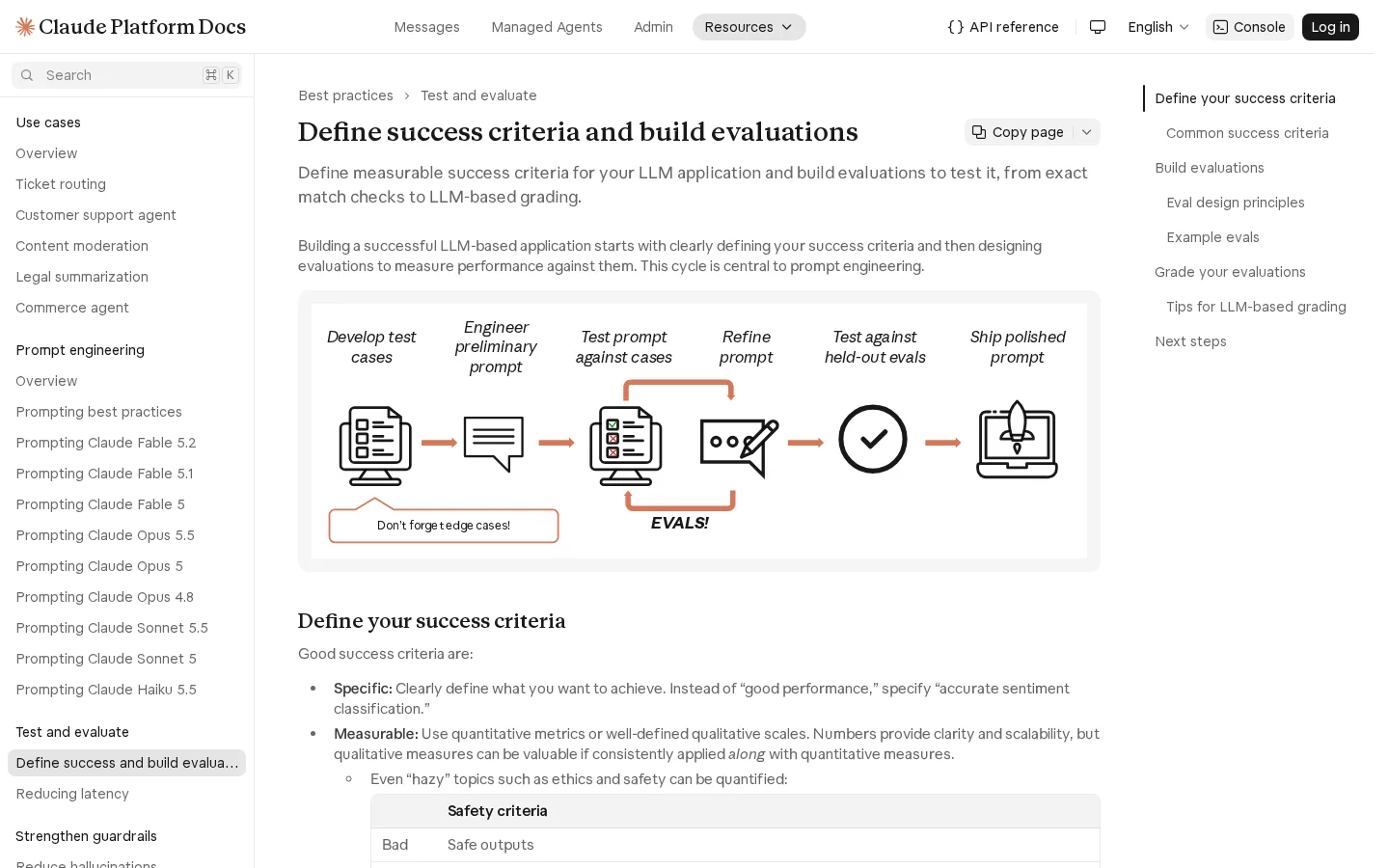
The scoring works in four steps:
score = average of cosine_similarity(answer_i, answer_j) over all pairs i < jA score close to 1 means the answers are consistent. The check compares meaning, not exact text, because the same answer can be written in many ways. This is a simple form of LLM evaluation. It tells you whether the model holds its answer across wordings, not whether the answer is correct, so check accuracy separately.
To run the same kind of check on your own brand, start with the wordings buyers really type, found through AI prompt research. Then follow them over time with AI mention tracking, which asks the same prompts each month to ChatGPT, Claude and Gemini and records your mentions for each prompt and each model.
These mistakes make a comparison useless. Check for each one before you draw a conclusion.
What it is: you change the wording, the context and the format in one go, so the two versions differ in many ways.
How to spot it: the two versions look different everywhere, and you cannot name the cause of a change in the answer.
How to fix it: change one element per test, and write down which element changed.
What it is: you judge a wording by a single reply from the model.
How to spot it: you rate a version after one run, then decide which wording is better.
How to fix it: run each version several times, and compare the share of runs that name each brand or make each claim.
What it is: you read the answers and call one version better, with no rule for what "better" means.
How to spot it: two people read the same answers and reach different verdicts, or the verdict changes from one day to the next.
How to fix it: write down what to record before you run the test. If you have many answers, a second model can grade them against your rules, a method called LLM-as-a-judge. The rules still come first.
What it is: you write prompts that sound like a textbook, not like a customer.
How to spot it: your prompts use terms your buyers never type, or they are all written in the same polished style.
How to fix it: collect real questions from your sales calls, support tickets and search data, and test those wordings first.
What it is: you compare answers from two different models as if they came from one.
How to spot it: your notes do not name the model for each answer, or one table mixes several models.
How to fix it: compare one model at a time, and record the model name next to every answer.
In GEO, the question is which brands an AI names for a topic, and whether that holds across the ways people ask. A brand named for one wording and missing from another has a weak position, even if one answer looked good. Prompt variation is how you find those gaps.
Prompt variation finds the gaps, and prompt monitoring keeps watching them. Run the same set of prompts over time, and you can see whether your brand's place in the answers changes, instead of relying on one run.
Prompt variation turns one answer into evidence. Write two or more wordings of the same goal, change one thing at a time, run each version several times, and compare what the answers name. If the result holds across wordings, you can rely on it. If it changes, the wording decides the answer. Start with the wordings your buyers really use.
Sources
It can. In a study by Melanie Sclar and colleagues, subtle changes in prompt formatting moved accuracy by up to 76 points for one open model in few-shot settings. Test the prompts that matter to you before you trust a single answer.
There is no fixed number. Choose wordings that real people use, and group the ones that mean the same thing. Anthropic's example test uses 50 groups of paraphrased questions.
No. Prompt engineering aims at one good prompt for one task. Prompt variation rewrites the same prompt on purpose, to measure how stable the answers are.
 “I tested Sorank on a real client site and it's insane. It does everything an agency would bill you $1500 a month for. It's going into production on that client now.”

 Guillaume Guersanguersanguillaume.com“We are an Ads agency and we wanted to get our SEO back on track once and for all. Sorank gave us a clear view of our site, helped us prioritize optimizations, and properly structure our content. The tool is easy to use, well designed for a team, and very practical for centralizing tracking without having to juggle multiple platforms. A very solid foundation to start fresh with our SEO.”
 Gaspard MadouiAds Agency
 “I just let the Sorank software do its thing, and now my DR is 25 and my page is ranking higher.”
 Lucas Flandrefoundertrace.fr“I specialized in GEO thanks to Sorank. The GEO Leaderboard allows me to show my clients their position vs competitors on ChatGPT. It’s a real commercial differentiator.”
 MélanieSEO Freelance“Great service, works well for our website and helps us understand how to improve it to rank better on Google and elsewhere. Congrats, keep going, I recommend it.”
 Hugo T.E-commerce merchant



















