
Preferences
Privacy is important to us, so you have the option of disabling certain types of storage that may not be necessary for the basic functioning of the website. Blocking categories may impact your experience on the website. More information
Privacy is important to us, so you have the option of disabling certain types of storage that may not be necessary for the basic functioning of the website. Blocking categories may impact your experience on the website. More information

Content scoring gives a page a number from clear criteria. Learn the six criteria, how to score your content by hand and what a score cannot tell you.








Founder Sorank, 7+ years in SEO.
Summary
Content scoring is a method that gives a page a number from a fixed set of criteria, such as how well it answers the search intent, how deep it goes, how clearly it is structured and whether its claims are sourced. The score does not rank a page on Google. It shows what to fix first.
Want to go further? Ask
Content scoring turns the quality of a page into something you can measure and compare. You check the page against a list of criteria, give points for each one, and add them up. You can then compare pages with each other, and follow one page over time as you update it. The result is not a verdict. It is a way to see where a page is weak and where your effort will pay off most.
Content scoring is a systematic way to judge a piece of content before it is published or after it has been live for a while. Editors have always checked drafts against a mental checklist. Scoring writes that checklist down, gives each item a value and applies it the same way to every page. Two reviewers then reach closer results, and you can spot the weakest pages in a large site.
A content score has three parts: the criteria, the points for each criterion and the formula that turns the points into a result. The criteria should come from your goal. A page that sells a product needs different criteria than a page that explains a term. Some software builds its criteria from the pages that already rank for a keyword. It compares your text with those pages and counts the terms they use that your page leaves out. That measures how close your page is to the others, not how useful it is to a reader, so use that kind of score with care.
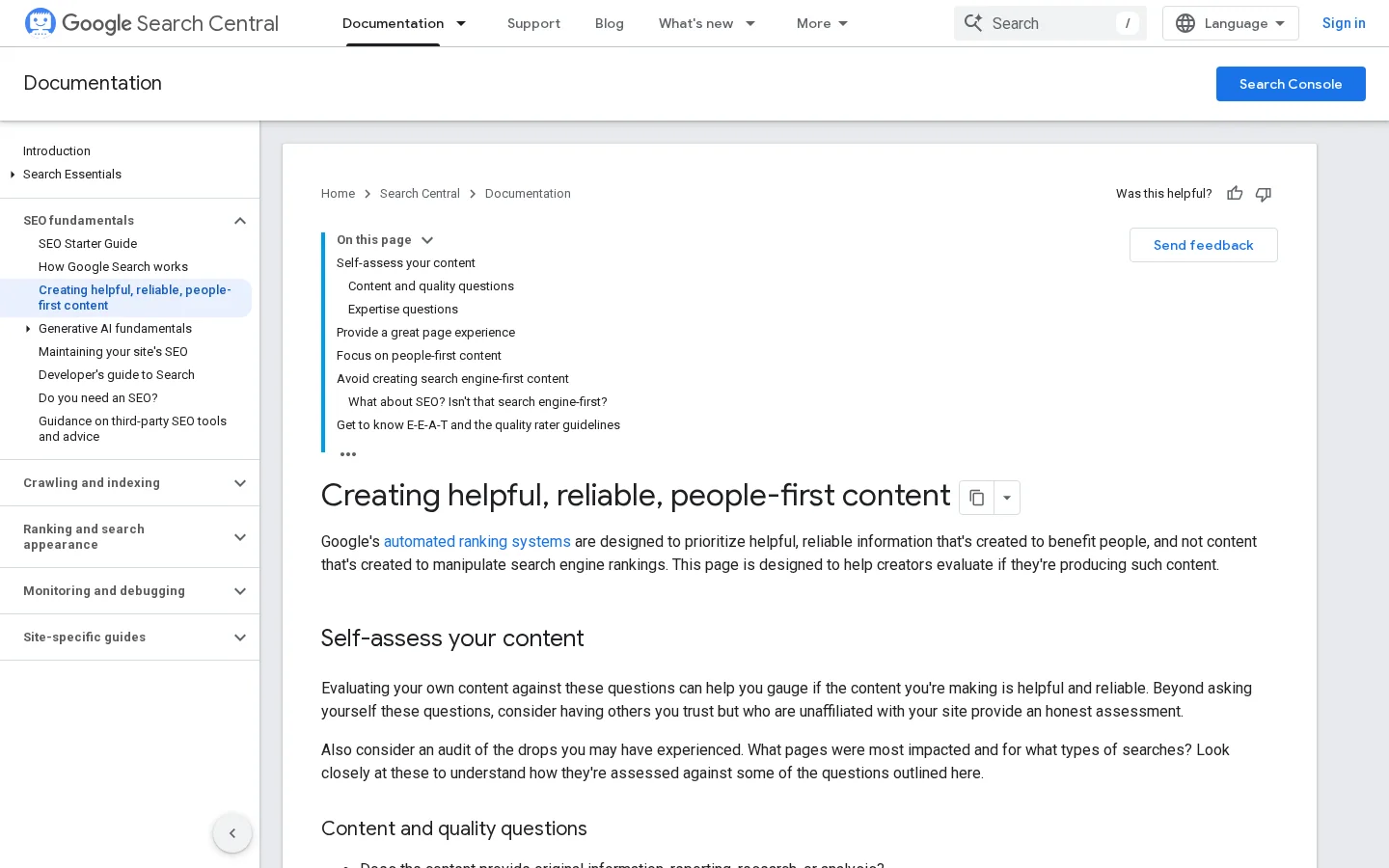
For a score to help, it must be repeatable. Two people checking the same page with the same grid should reach nearly the same number. If they do not, the criteria are too vague. Rewrite them until each one has a clear answer of yes, partly or no. Google's guide to creating helpful, people-first content works the same way. It asks questions a reader can answer about the page itself, such as whether they would bookmark it, share it or recommend it.
Pick criteria that a person can check on the page in a few minutes. These six cover most pages, and you can change them for your sector.
Criteria 3, 4 and 6 match the ideas behind E-E-A-T, which stands for experience, expertise, authoritativeness and trustworthiness. Criteria 1, 2 and 5 are the basics of a page that answers a question well. Google's Search Essentials lists the same goal as a key best practice: create helpful, reliable, people-first content.
You do not need a paid tool. Open a spreadsheet, put the six criteria in rows and add a column for points. Give each criterion 0 points when it is missing, 1 point when it is partly there and 2 points when it is clearly there. Then use this formula:
score = total points / maximum points x 100With six criteria and two points each, the maximum is 12. Here is a worked example. The page answers the question in its first paragraph and has a clear structure. It covers only part of the subtopics, its sources are weak, and it names the author but shows no update date.
| Criterion | Points out of 2 |
|---|---|
| The answer comes first | 2 |
| The subtopics are complete | 1 |
| There is original detail | 2 |
| Every claim has a source | 1 |
| The structure is easy to scan | 2 |
| The author and the date are visible | 1 |
| Total | 9 out of 12 |
The score is 9 / 12 x 100, which gives 75. The number alone says little. The useful part is the rows with 1 point, because those are the fixes: add sources and add an update date. A second pass on those two items takes far less time than writing a new page.
Run the same grid on your newest pages and on your oldest pages that still get visits. The lowest scores show where to start. A full content audit gives you the complete list of pages to review, and it is worth doing once a year.
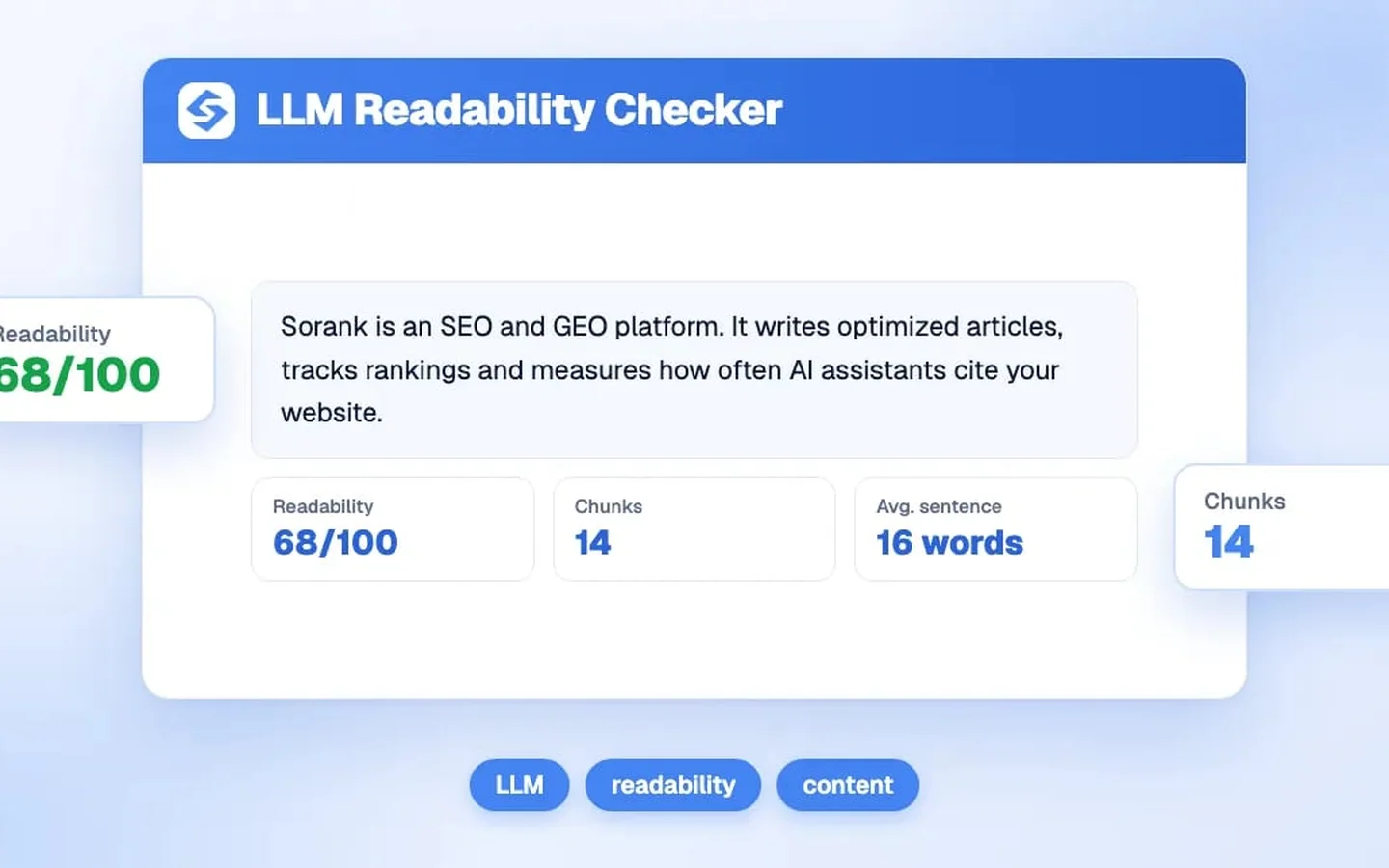
If you want the checks done for you, Sorank has free tools. The LLM Readability Checker gives a page a score out of 100 for how easily an AI model can read it and pull out its answers. It measures readability and structure, not the quality of your ideas, so use it next to your own grid, not instead of it.
Tip
Score the page you want to improve first, not the newest one. An older page that already gets visits gives you the most return for a short fix.
Each tool uses its own criteria, weights and scale. A high score in one tool means little in another, so compare pages inside one tool and keep the same grid over time. Scores also change when the pages that rank for your keyword change, which means a score is a snapshot and not a fixed fact.
Our guide to competitive content analysis includes a scoring grid for comparing your page with the pages that rank. This page takes a different angle. It scores one page on its own quality, before you compare it with anyone. Scores also age. A page that scored well last year can lose visits over time, a pattern known as content decay.
Most mistakes come from treating the score as the goal. Each one below has three parts: what it is, how to spot it and how to fix it.
Scoring makes quality visible before a page goes live. Search engines and AI models look for signals of quality, such as clear answers, sources and expertise, and a grid helps you check those signals one page at a time. The content quality signals that matter are not one number, so a score is always a rough guide. The aim is a page that a reader trusts and that an AI model can quote without changing its meaning. Helpful content is the standard to keep in mind: write for people first, and let the score catch what you miss.
A content score is a checklist with numbers. Choose criteria that a reader can check, score each page with the same grid, and fix the lowest points first. Score again after each update, and keep the reader in mind. The number is a guide for your work, never the goal of it.
Sources
There is no universal good score, because each tool uses its own criteria and scale. Compare your pages with each other and with your own older pages. A page that scores higher than your past work is a sign of progress, not proof of success.
Yes. List six criteria, give each one 0, 1 or 2 points, and divide the total by the maximum. You need a spreadsheet and some time. Use the same grid for every page so that the scores can be compared.
Google's guidance on helpful content does not describe a content score. It asks whether a page is written for people and whether a reader would find it useful. A grid helps you check those questions, but it is not a Google metric.
 “I tested Sorank on a real client site and it's insane. It does everything an agency would bill you $1500 a month for. It's going into production on that client now.”

 Guillaume Guersanguersanguillaume.com“We are an Ads agency and we wanted to get our SEO back on track once and for all. Sorank gave us a clear view of our site, helped us prioritize optimizations, and properly structure our content. The tool is easy to use, well designed for a team, and very practical for centralizing tracking without having to juggle multiple platforms. A very solid foundation to start fresh with our SEO.”
 Gaspard MadouiAds Agency
 “I just let the Sorank software do its thing, and now my DR is 25 and my page is ranking higher.”
 Lucas Flandrefoundertrace.fr“I specialized in GEO thanks to Sorank. The GEO Leaderboard allows me to show my clients their position vs competitors on ChatGPT. It’s a real commercial differentiator.”
 MélanieSEO Freelance“Great service, works well for our website and helps us understand how to improve it to rank better on Google and elsewhere. Congrats, keep going, I recommend it.”
 Hugo T.E-commerce merchant



















