Preferences
Privacy is important to us, so you have the option of disabling certain types of storage that may not be necessary for the basic functioning of the website. Blocking categories may impact your experience on the website. More information

Privacy is important to us, so you have the option of disabling certain types of storage that may not be necessary for the basic functioning of the website. Blocking categories may impact your experience on the website. More information

SEO for payment processors is how an acquirer, a payment service provider or an independent sales organization gets found while a merchant compares options: "interchange plus or flat rate pricing", "payment gateway for WooCommerce subscriptions", "why is my payout on hold". Much of that research now ends in an AI answer that names three or four providers. Sorank writes the pricing, integration and dispute guides that put your company in those answers, publishes them on your site and checks every month which providers ChatGPT, Claude and Gemini recommend.
Your risk and compliance teams can read every article before it goes live.
















































27,136
Articles created
11,063,729
Visits from Google
18,386
Visits from AI
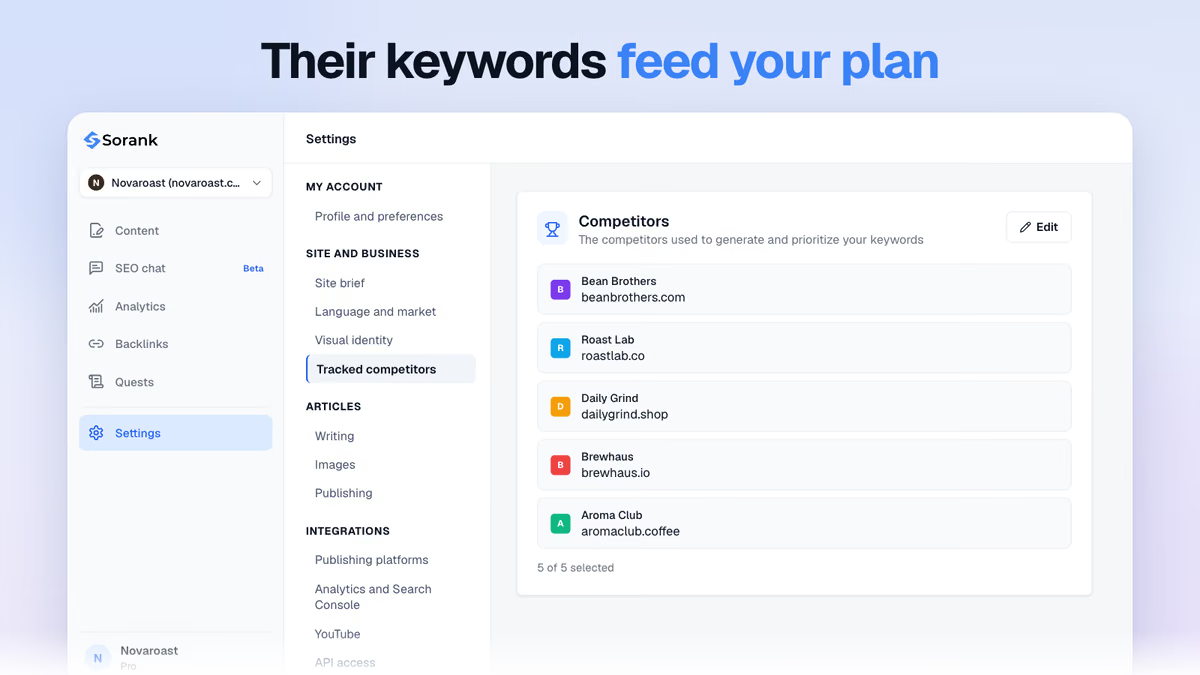
"Interchange plus vs flat rate", "how to lower card processing fees for a restaurant", "switch payment processor without losing saved cards": a merchant who types these already pays someone and is looking for a way out. Sorank reads the keywords of the providers you track and turns them into a plan of pricing explainers, switching guides and fair comparisons, ranked by intent.
Add the competitors you lose deals to in SEO competitor spy.
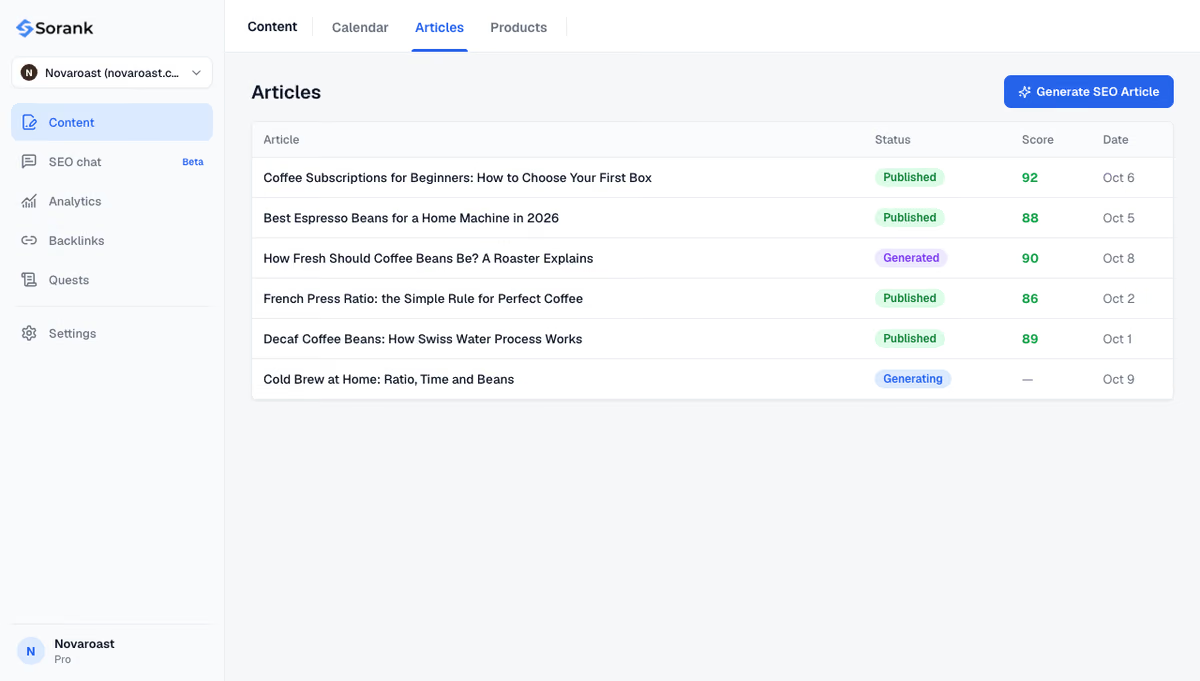
"Accept payments on Wix", "payment processor for a nonprofit", "how to accept iDEAL from Dutch shoppers": each integration, sector and local payment method has its own search. Enter the keywords and the H1 you want for each guide, add image instructions if you wish, and Sorank writes one article per keyword, each pointing to the matching integration or industry page.
Batch them in the blog article generator.
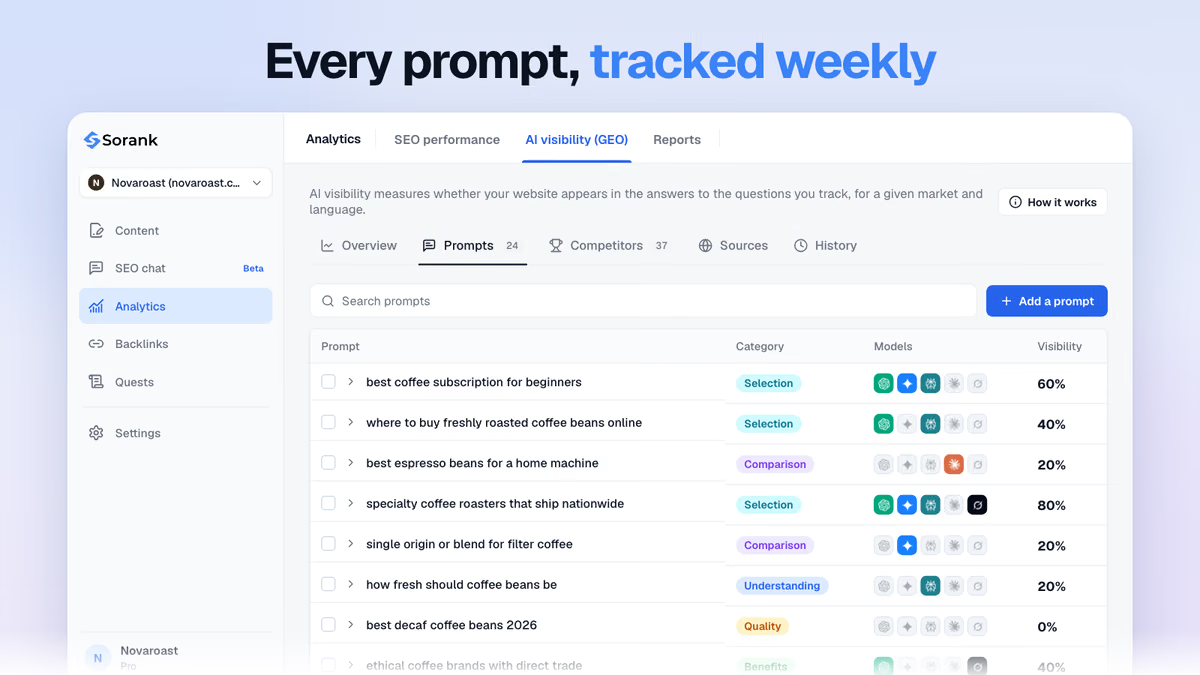
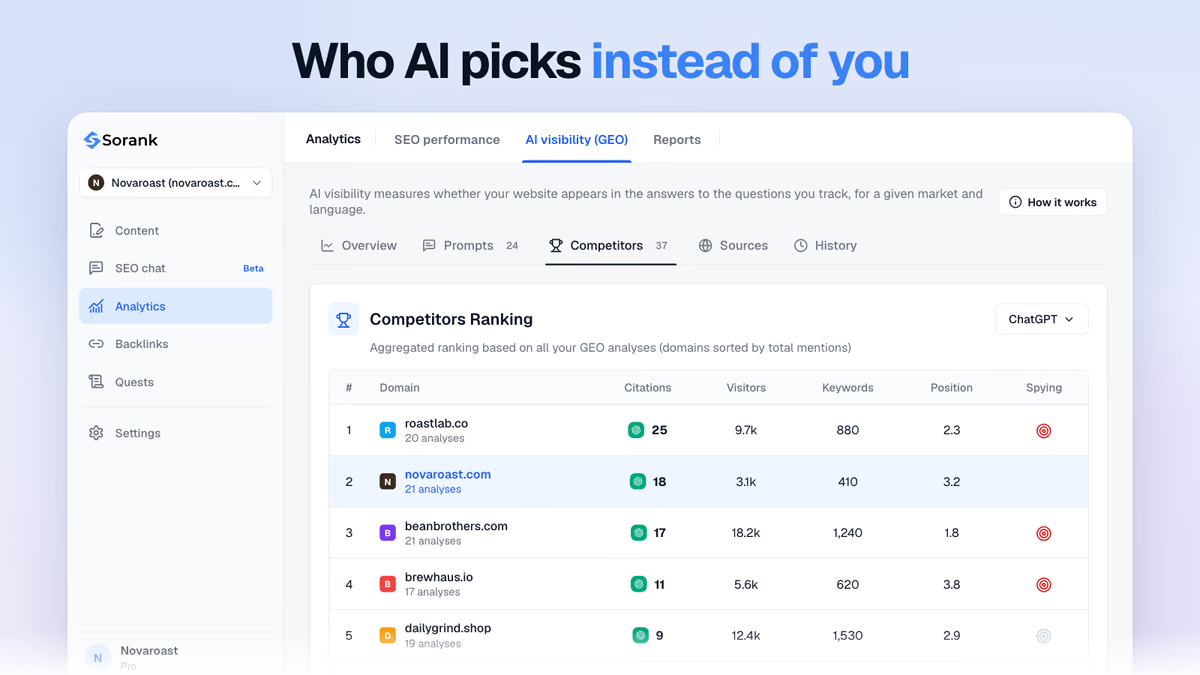
"Best payment processor for a small online store", "best online payment processor for AI companies", "[leading provider] alternatives with lower fees": Sorank asks the prompts you choose every month in ChatGPT, Claude and Gemini, and in Grok on the Pro plan. Filter on Not mentioned to list the questions where your company is absent, and see which providers fill the answer instead.
Read every answer in AI mention tracking.

Sorank only publishes to your marketing site: WordPress, Webflow or Wix connect directly, and a headless site or developer portal receives articles through a webhook. Search Console shows which pricing, integration and help pages already draw merchants.

List the business types you accept, the platforms and payment methods you support, the countries you serve and the providers merchants compare you with. Sorank builds the keyword plan from them, from pricing questions to integration how-tos.

Articles wait as drafts until compliance has checked the fee figures and the wording, then go live on the days you set, each linked to the matching pricing, integration or signup page.
THEY TRIED SORANK BEFORE YOU
 “I tested Sorank on a real client site and it's insane. It does everything an agency would bill you $1500 a month for. It's going into production on that client now.”

 Guillaume Guersanguersanguillaume.com
 “I just let the Sorank software do its thing, and now my DR is 25 and my page is ranking higher.”
 Lucas Flandrefoundertrace.fr“Great service, works well for our website and helps us understand how to improve it to rank better on Google and elsewhere. Congrats, keep going, I recommend it.”
 Hugo T.E-commerce merchant“For 2 years, 100% of my clients came from LinkedIn. Posting daily, commenting, DM follow-ups… totally dependent on the algorithm. I knew I needed to work on SEO but always postponed it: too long, too technical, not my job. With Sorank, I finally took the step. In 4 months, I generate 15 organic leads per month without posting anything. It’s not 50/50 with LinkedIn yet, but I sleep better knowing I now have a second lead source growing on autopilot.”
 Valentin ThomyColdMailing Agency
 “I’m a developer, not a marketer. My Shopify theme was selling only through word-of-mouth and ads. With Sorank I finally understood how to structure my SEO and write articles to rank. The audit showed my product page was too slow. In 2 months, my organic traffic doubled and I’m starting to appear in ChatGPT answers when people search for Shopify themes. All of that with about 2 hours per week.”
 Thème FullStackgo.themefullstack.com“Great solution to manage SEO without headaches. Audits are fast, the interface is clear, and you quickly see which actions to implement. It has become an essential tool to track and improve the SEO of my sites. I highly recommend it.”
 XavEntrepreneur“I used Sorank for a client who needed SEO and it clearly made my life easier. I can quickly audit a site, track my projects, and keep a clear overview without multiplying tools. The onboarding is fast and the interface is great.”
 Céline MaurinFreelance CM
 “Blown away by Sorank’s performance. After testing many solutions on the market, I was amazed by how quickly our articles started ranking in the SERP. The results are concrete and much faster than anything we’ve experienced so far. It has been an excellent surprise for our team. We are confidently renewing our trust and highly recommend Sorank to agencies that demand fast and measurable results.”
 Patrick PerretFreelance Webdesign SEO“We’re a development agency and we use Sorank to run on-page audits on our clients’ Shopify stores. It helps us quickly identify optimization opportunities, structure fixes, and collaborate more easily with clients on the SEO side. Very useful to complement our technical support 🔥”

 Younes Yahyaluvaika.com“We are an Ads agency and we wanted to get our SEO back on track once and for all. Sorank gave us a clear view of our site, helped us prioritize optimizations, and properly structure our content. The tool is easy to use, well designed for a team, and very practical for centralizing tracking without having to juggle multiple platforms. A very solid foundation to start fresh with our SEO.”
 Gaspard MadouiAds Agency“I specialized in GEO thanks to Sorank. The GEO Leaderboard allows me to show my clients their position vs competitors on ChatGPT. It’s a real commercial differentiator.”
 MélanieSEO Freelance“I manage our dealership’s website and it had dozens of issues: slow pages, 404 errors, missing tags. We were losing rankings every month without understanding why. The Sorank audit detected everything in 5 minutes. I sent the report to our web provider with the priority fixes. We regained our rankings and traffic picked back up. Perfect for someone non-technical like me!”
 Xavier BreullMarketing Manager“I’m a CMO for a SaaS and I manage acquisition in a very competitive market. We were investing heavily in our product but not working on our SEO. No visibility on our real competitors, no tracking of our presence in AI. Sorank showed us our positioning vs competitors, which keywords to target, and GEO opportunities we had completely ignored!”
 Louis RAPPCMO SaaS
 “Very good version 2, I recommend it.”

 Antoine Verhillethenewblack.ai“I was skeptical at first, but this is the best SEO tool I’ve ever used. The interface is clear, audits are fast, and the recommendations are easy to implement. I’ve saved hours and hours managing SEO and tracking performance. I recommend it to all my entrepreneur friends who run an agency or work independently.”
 NoahEntrepreneur

Founder’s Note.
I ran my own SEO agency for years. I built Sorank to deliver the same results to every business, at scale.
Everything I know about Google rankings and Generative Engine Optimization (GEO) is coded into this software, and it runs on autopilot for you.
Try for Free
SEO for payment processors is the work that brings merchants, developers and software platforms to a payment company's site from Google and from AI assistants, at each step of their decision: understanding fees, checking that you support their platform and payment methods, comparing providers, then integrating. It covers acquirers, payment gateways, payment facilitators and the sales organizations that resell them.
The market is huge and crowded. According to the Federal Reserve Payments Study, noncash payments in the United States reached 236.6 billion in 2024, and cards made up nearly four-fifths of them by number, debit card payments alone reaching 120.6 billion. Every merchant behind those payments chose a provider, and many reconsider when fees rise or payouts slow down. Consumer apps face other questions, covered on our fintech page.
On a short list of practical questions: the pricing model and what it costs on their basket size, support for their platform and their customers' payment methods, payout speed, how holds and reserves work, and who answers the phone when something breaks. Developers add their own test: documentation that lets them get a first payment through in an afternoon.
They ask Google, then more and more often an assistant. In our finance AI citation study (6600 answers, April to August 2026), Gemini's leading source is YouTube at 3.18% of its answers, and Reddit appears in 1.11% of all answers, the place where merchants describe frozen funds and surprise fees (see our Reddit AI citation study). If your site does not explain reserves and disputes plainly, those threads explain them for you.
By separating what you set from what you pass through. Interchange is paid to the card issuer and varies with the card and the transaction; network fees go to the card schemes; your markup is your own. Part of that chain is regulated: in the United States, the Federal Reserve's Regulation II sets standards for whether a debit card interchange fee is reasonable and proportional to the issuer's cost, and prohibits issuers and networks from restricting the number of networks a debit transaction can be routed over.
A merchant who searches "why did my effective rate go up" wants that breakdown, with a worked example labeled as an illustration and your public price list next to it. Write it once, keep it dated, and link every sector page to it.
Because every merchant has to deal with it and few understand it. The PCI Security Standards Council describes PCI DSS as a baseline of technical and operational requirements designed to protect payment account data, which applies to merchants, processors, acquirers, issuers and service providers alike. Questions such as "do I need PCI compliance with a hosted checkout" are asked by exactly the small merchants a processor wants to sign.
Answer them in plain terms, link to the official documents rather than paraphrasing their requirements, and state what your product handles and what stays with the merchant. Your security team should sign off each of these articles before release.
Sort them by search intent: a merchant comparing pricing models is closer to signing than one reading about chargebacks.
Yes, because developers often decide which provider gets tested. Make sure your API reference and guides can be crawled and indexed, give each error code its own explanation, and link tutorials to the reference. Our guide to SEO for developers covers the technical side, and the one on building a knowledge base covers help content.
Sorank does not write your API reference. It writes the tutorials and use cases around it, the kind of pages that can be produced for each platform without becoming the thin, repeated content our glossary entry on programmatic SEO warns about.
Sorank handles the keyword research by sector, platform and country, the articles with their sources and internal links, publication by CMS connection or webhook, backlinks from other sites of Sorank clients, the monthly tracking of AI answers, and Search Console, Analytics and AI visits in one dashboard.
Your team keeps the price list and contracts, underwriting rules, API documentation, compliance approval, partner app store listings, review profiles and the sales follow-up. Neighboring businesses search differently: see our pages for banks and SaaS companies.
Sorank charges per website, not per seat. The Essential plan is $49 a month on annual billing or $99 month to month, with 20 articles and 10 tracked prompts in ChatGPT, Claude and Gemini. Pro ($129 annual, $249 monthly) publishes 60 articles and adds Grok; Business ($249 annual, $499 monthly) publishes 120 articles and tracks 50 prompts, useful when you serve many sectors or countries. A 3-day free trial and the 90-day results-or-refund guarantee apply to every plan, as detailed on the pricing page.
Google gives no fixed delay, and broad terms such as "best payment processor" are held by large publishers. Integration guides and problem questions usually collect impressions first, because few pages answer them precisely. Judge each sector or platform after three months on its impressions and AI mentions, then on the signups and sales leads Analytics attributes to those articles.
Several months. Integration guides and help questions usually show impressions first; broad comparison terms take longer. Judge each sector after three months on Search Console impressions, AI mentions and the leads it brings.
From $49 a month per website on the annual Essential plan, or $99 month to month, with 20 articles a month and a 3-day free trial. Providers with many sectors or countries usually need Pro or Business.
Give it clear pages to quote: pricing explained line by line, one guide per platform you support, honest answers on holds and disputes, and consistent review profiles. Then track prompts such as "best payment processor for a small online store" every month.
Yes. Drafts mode keeps every article unpublished until your team approves it, and your required wording goes into the writing instructions. Sorank gives no legal or compliance advice.
No. Sorank only publishes articles to your marketing site or help center and links them to your pricing, integration and documentation pages. Your payment stack and API reference stay untouched.
Yes. WordPress, Webflow, Wix and Shopify connect directly, and a headless site or developer portal can receive each article through a webhook. If your site runs on a closed platform, ask its provider whether it accepts a webhook.
We don't. Sorank isn't trying to be another Semrush or Ahrefs. Those tools are built for data, Sorank is built to do the work. Instead of more dashboards to check, it turns SEO and GEO insights into actions: articles written and published, backlinks earned, technical fixes and AI visibility tracking. Less complexity, more results.
From $49/month per website on a yearly plan, with a 3-day free trial and a 90-day money-back guarantee (conditions apply). Every plan includes articles, AI visibility tracking and access to natural backlink acquisition; higher plans add more articles, more AI prompts tracked and more backlinks. No setup fees, no paying for seats you don't use.
You shouldn't need a full marketing team or expensive tools to grow. Sorank handles your entire SEO and AI visibility, so you save time and money.