Preferences
Privacy is important to us, so you have the option of disabling certain types of storage that may not be necessary for the basic functioning of the website. Blocking categories may impact your experience on the website. More information

Privacy is important to us, so you have the option of disabling certain types of storage that may not be necessary for the basic functioning of the website. Blocking categories may impact your experience on the website. More information

An AI citation source audit reveals which sources ChatGPT, Perplexity, and Claude cite for your topics. Learn how to run one and act on it.







Tools


Summary
An AI citation source audit is a structured review of which sources the AIs cite for a set of queries, revealing where your brand is cited, where competitors win, and which content gaps to close.
Want to go further? Ask
An AI citation source audit is the practice of systematically recording which websites assistants like ChatGPT, Perplexity, and Claude cite when they answer questions in your category. Instead of guessing why a model recommends a competitor, you query the engines, log every cited domain, and build a map of who the models trust. It is the diagnostic counterpart to optimization: you cannot earn citations reliably until you can see who is winning them today.
The audit matters because citation behavior is fragmented and unstable. Only about 11 percent of domains cited by ChatGPT are also cited by Perplexity, and roughly 40 to 60 percent of citations change from month to month. Without a repeatable audit you are flying blind across platforms that each pick sources differently. This article explains what an audit covers, how to run one, what it reveals about competitors, and how it ties into your wider strategy.
An AI citation source audit answers a precise question: when assistants respond to the prompts your buyers use, which sources do they cite, and how often? A citation is stronger than a passing mention, because the model is attributing information to a specific domain it judged authoritative enough to source. The audit catalogs those domains across engines so you can compare presence, frequency, and position.
This is the measurement layer beneath AI citation optimization. Optimization changes your content and presence; the audit tells you whether those changes moved the needle and where the remaining gaps are. It also feeds directly into broader AI search analytics, turning scattered observations into a structured dataset.
Start with a query set that mirrors real buyer research. Most teams document 50 to 100 vendor-style questions, such as the best tool for a use case, plus head-to-head comparison prompts. Run each prompt across ChatGPT, Claude, Perplexity, and Google AI Mode, and record every cited domain, its frequency, and where it sits in the answer.
Repeat on a regular cadence, ideally weekly, and resist drawing conclusions too early. Because 40 to 60 percent of citations shift each month, you should track for at least eight weeks before trusting a trend. Running each prompt several times also matters, since model output varies between runs and a single sample can mislead.
The audit quickly shows that each engine has its own taste. ChatGPT leans on encyclopedic authority and pulls heavily from its underlying web index, with Wikipedia making up close to half of citations in some analyses and a strong tilt toward trusted reference sites. Perplexity weights freshness and community heavily, with Reddit alone near 47 percent of its top citations and new content able to appear within days.
Claude is the most cautious and rewards structured, precise content, while Google AI Overviews keep meaningful overlap with classic rankings. The practical lesson is that strong Google rankings do not transfer automatically: by some analyses only around 12 percent of AI citations come from Google's top results. This divergence is why citation diversity across platforms is a goal in itself.
An audit also benchmarks how often engines cite anything at all. ChatGPT cites sources in roughly 87 percent of responses, Google AI Overviews around 85 percent, and Google AI Mode about 76 percent, while Perplexity typically attaches three to four sources per query. Knowing these baselines helps you judge whether a missing citation reflects a content gap or simply an engine that cites sparingly for that query.
Citation frequency targets depend on maturity. Early-stage brands often sit between 2 and 8 percent of relevant prompts, growing companies reach 8 to 20 percent, and category leaders can hit 35 to 50 percent. Tracking your own frequency against these bands turns the audit into a clear scoreboard, closely tied to LLM citations.
The most actionable output is competitive. By dividing your citations by the total citations in your category, you get share of voice: if rivals appear in five-vendor shortlists and you do not, your share is zero for those prompts. That single number exposes where competitors have built third-party validation and community presence that you have not.
Looking at which domains the models actually cite, not just which brands, shows the mechanism behind a competitor's lead, whether it is a strong review-site footprint, active community threads, or authoritative coverage. This makes the audit a sharp input to competitor analysis and to your AI share of voice tracking.
Every prompt where your brand earns zero citations is a documented opportunity. Those gaps point to questions buyers ask that your content does not answer well enough to be retrieved. The fix is to build answer-ready pages that address the main question plus several adjacent questions, so the model can pull a clean passage when the topic comes up.
Pages built this way perform measurably better; research has found that content scoring high on citation-architecture quality reached cross-engine citation rates near 78 percent. Pairing the gap list with disciplined keyword research and content planning turns the audit directly into a prioritized content roadmap.
A citation source audit matters because it is a leading indicator of AI-referred traffic and pipeline. Citations show whether engines treat you as a trusted source for the questions that precede a purchase, often before any classic traffic appears. The traffic that does follow is high intent: AI-referred visitors have been reported to convert well above classic organic search across ChatGPT, Claude, and Perplexity.
It also keeps optimization honest. Because patterns shift monthly and differ by platform, a one-time check is worthless, but a recurring audit shows real movement and protects you from optimizing for a single engine. It is the feedback loop that makes a broader AI content strategy measurable rather than aspirational.
The biggest challenge is volatility. With nearly half of citations changing each month, short audits produce noise rather than signal, so the work only pays off when sustained. Fragmentation compounds this, since tracking a single platform can miss most of the visibility picture across engines.
Coverage is the other limit. You can only audit the prompts you choose, so a poorly designed query set will hide real gaps, and you will never capture every private conversation a user has with an assistant. Treat the audit as a representative sample that guides priorities, not a complete census of every citation in existence.
An AI citation source audit turns the opaque question of who the AIs trust into a structured, repeatable dataset. By logging cited domains across ChatGPT, Perplexity, Claude, and Google over time, you can benchmark your share of voice, see exactly why competitors win, and convert every zero-citation prompt into a content opportunity. The key disciplines are a realistic query set, multi-platform coverage, and patience across at least eight weeks.
To act on the findings, connect the audit with AI citation optimization and a broader AI content strategy, and use Sorank's research and content planning tools to fill the gaps it surfaces. Reference sources: Averi and Discovered Labs.
Sources

A citation source audit is the measurement step: you record which domains the AIs cite for your target prompts so you can see where you and your competitors stand. Citation optimization is the action step that changes your content and presence to win more of those citations. The audit diagnoses the problem and the optimization fixes it, so the two work as a loop.
At least eight weeks. Roughly 40 to 60 percent of AI citations change from month to month as models update and competitors adapt, so a single snapshot is mostly noise. Running the same prompt set repeatedly, several times per run, across multiple engines is what separates a genuine trend from random variation.
Because the platforms barely agree on sources. Only about 11 percent of domains cited by ChatGPT are also cited by Perplexity, and a majority of cited sources appear on just one platform. Auditing a single engine can miss most of your visibility picture, so a useful audit always spans ChatGPT, Perplexity, Claude, and Google together.
THEY TRIED SORANK BEFORE YOU
 “I tested Sorank on a real client site and it's insane. It does everything an agency would bill you $1500 a month for. It's going into production on that client now.”
 Guillaume Guersanguersanguillaume.com“We are an Ads agency and we wanted to get our SEO back on track once and for all. Sorank gave us a clear view of our site, helped us prioritize optimizations, and properly structure our content. The tool is easy to use, well designed for a team, and very practical for centralizing tracking without having to juggle multiple platforms. A very solid foundation to start fresh with our SEO.”
 Gaspard MadouiAds Agency
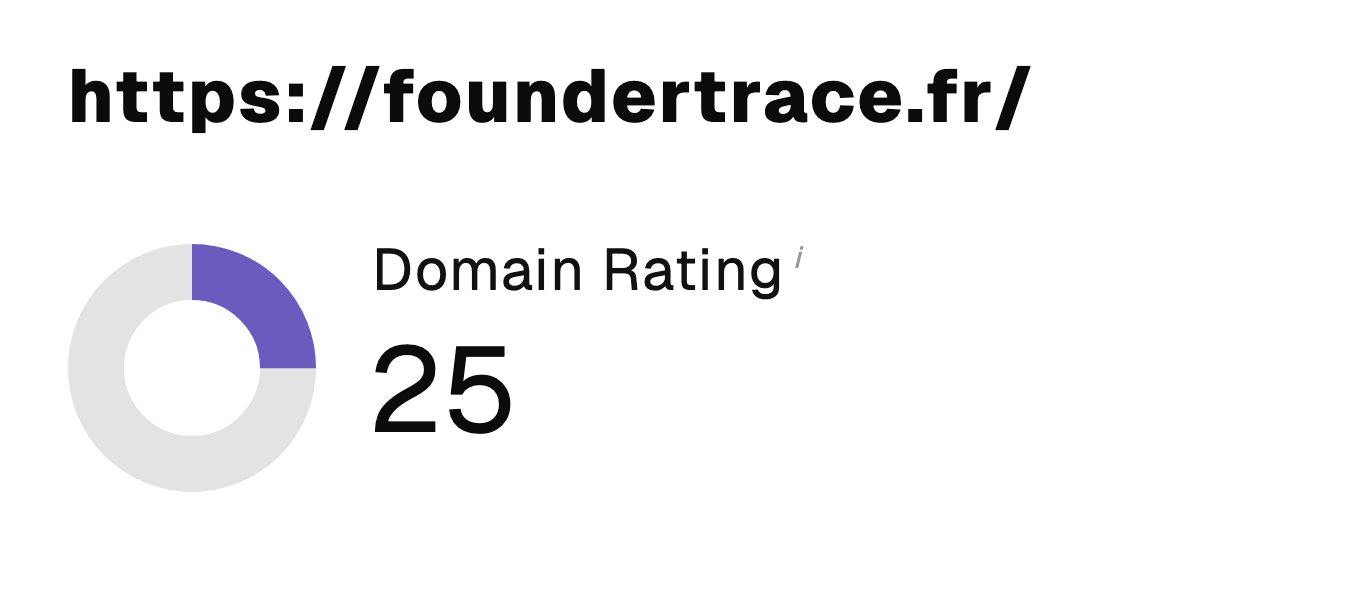 “I just let the Sorank software do its thing, and now my DR is 25 and my page is ranking higher.”
 Lucas Flandrefoundertrace.fr“I specialized in GEO thanks to Sorank. The GEO Leaderboard allows me to show my clients their position vs competitors on ChatGPT. It’s a real commercial differentiator.”
 MélanieSEO Freelance“Great service, works well for our website and helps us understand how to improve it to rank better on Google and elsewhere. Congrats, keep going, I recommend it.”
 Hugo T.E-commerce merchant