Preferences
Privacy is important to us, so you have the option of disabling certain types of storage that may not be necessary for the basic functioning of the website. Blocking categories may impact your experience on the website. More information

Privacy is important to us, so you have the option of disabling certain types of storage that may not be necessary for the basic functioning of the website. Blocking categories may impact your experience on the website. More information

Trucking company SEO serves two audiences at once. A shipping manager searches "flatbed carrier Texas to Oklahoma" or asks ChatGPT for a reliable reefer carrier in the Midwest; a driver searches "CDL A jobs home weekly" or "owner operator lease on". Sorank finds the questions both groups ask about your lanes, equipment and pay, publishes the answers on your website with links to your quote form and your application page, and tracks which carriers the AI assistants name.
Dispatch keeps the trucks moving while the articles go out on autopilot.
















































27,127
Articles created
11,061,488
Visits from Google
18,378
Visits from AI
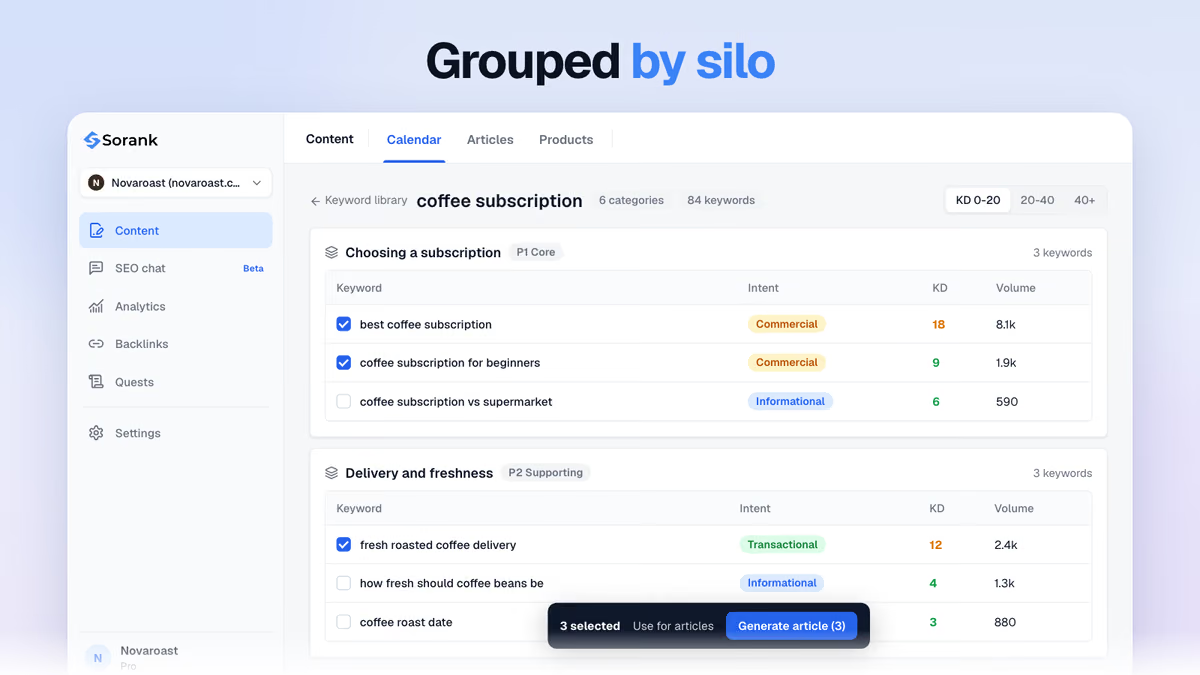
"Dedicated trucking services for retailers", "LTL vs full truckload", "power only trucking": those come from shippers. "Regional CDL jobs no touch freight", "trucking companies that hire recent CDL grads": those come from drivers. Sorank keeps the two groups apart, ranks each by priority and publishes for both, so a sales page and a job page never chase the same search.
Each group becomes a silo in the topical cluster generator.
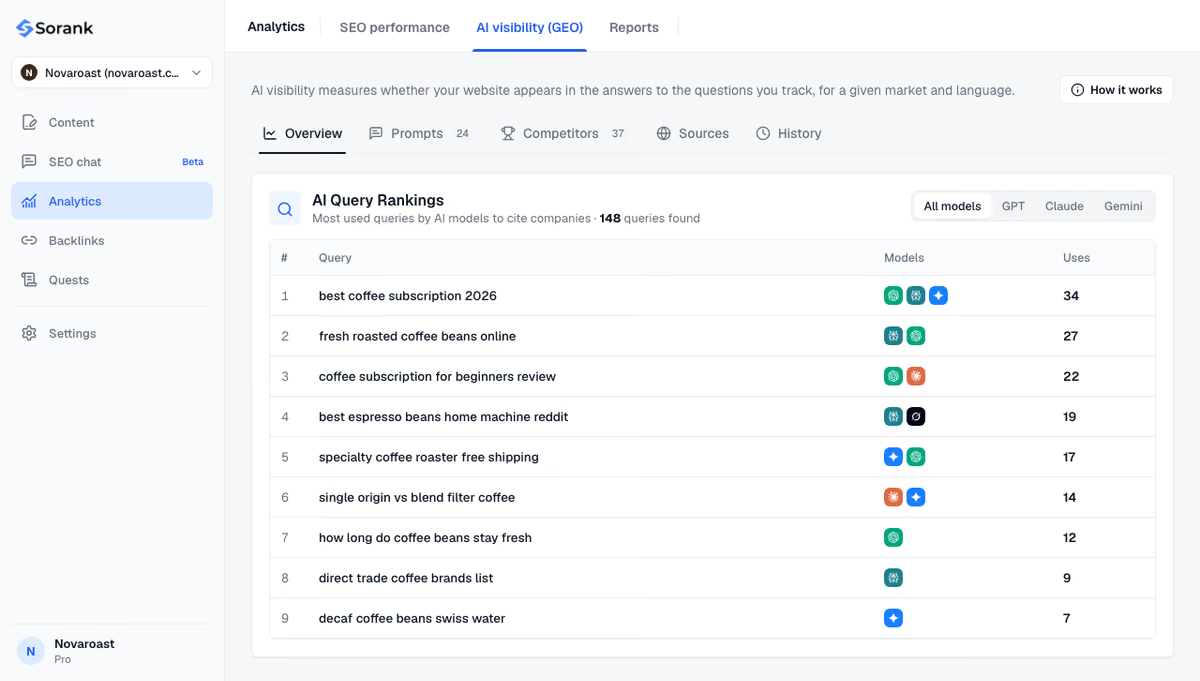
When a shipper asks Gemini for an "asset-based carrier for temperature-controlled freight in Georgia", the answer lists a few companies and the sites behind them. Sorank asks your questions every month, ranks the carriers that get cited and shows the domains feeding the answers, so you know whose content to study.
Follow rival fleets with the competitor spy.
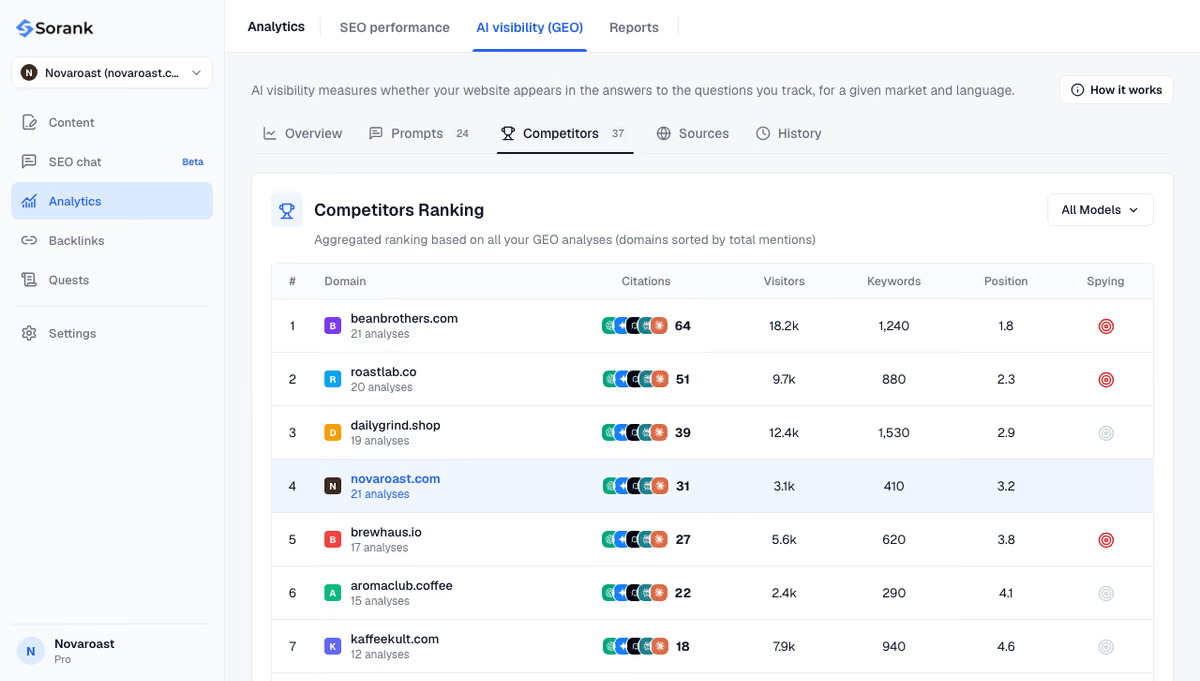
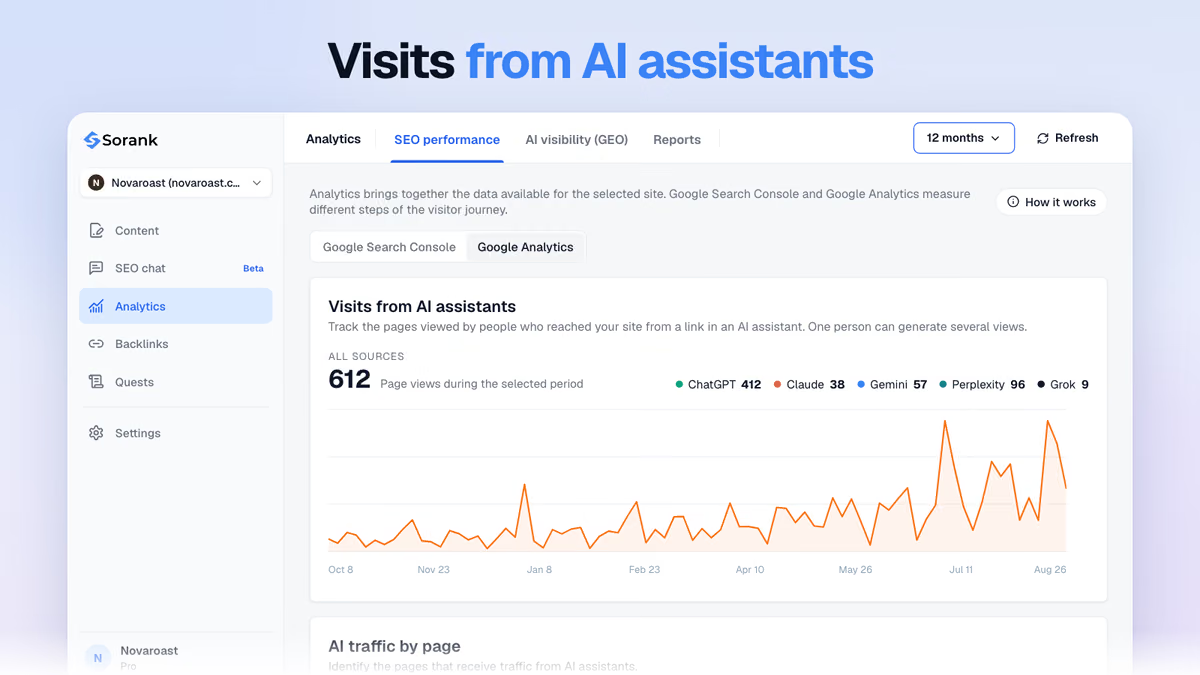
Search Console clicks and the visits coming from ChatGPT, Gemini or Perplexity sit side by side, page by page. You see whether the freight articles or the driver articles bring the traffic, and which lanes deserve the next ones.
Open the SEO and GEO dashboard.

WordPress, Webflow, Wix or any site by webhook. Sorank reads your Search Console data and separates the searches that reach your service pages from those that reach your careers page.

Dry van, reefer, flatbed or tanker; the regions and terminals you run from; your driver positions and home time. Sorank turns that into two keyword plans, one for freight and one for recruiting.

Sorank publishes on the schedule you choose. Freight articles point to your quote form, driver articles to your application page, and both can show your USDOT number if you add it to the instructions.
THEY TRIED SORANK BEFORE YOU
 “I tested Sorank on a real client site and it's insane. It does everything an agency would bill you $1500 a month for. It's going into production on that client now.”

 Guillaume Guersanguersanguillaume.com
 “I just let the Sorank software do its thing, and now my DR is 25 and my page is ranking higher.”
 Lucas Flandrefoundertrace.fr“Great service, works well for our website and helps us understand how to improve it to rank better on Google and elsewhere. Congrats, keep going, I recommend it.”
 Hugo T.E-commerce merchant“For 2 years, 100% of my clients came from LinkedIn. Posting daily, commenting, DM follow-ups… totally dependent on the algorithm. I knew I needed to work on SEO but always postponed it: too long, too technical, not my job. With Sorank, I finally took the step. In 4 months, I generate 15 organic leads per month without posting anything. It’s not 50/50 with LinkedIn yet, but I sleep better knowing I now have a second lead source growing on autopilot.”
 Valentin ThomyColdMailing Agency
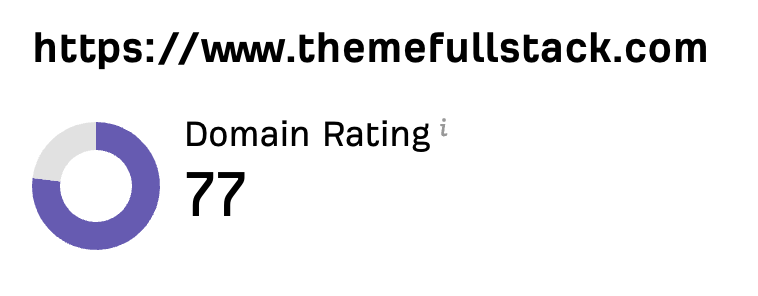 “I’m a developer, not a marketer. My Shopify theme was selling only through word-of-mouth and ads. With Sorank I finally understood how to structure my SEO and write articles to rank. The audit showed my product page was too slow. In 2 months, my organic traffic doubled and I’m starting to appear in ChatGPT answers when people search for Shopify themes. All of that with about 2 hours per week.”
 Thème FullStackgo.themefullstack.com“Great solution to manage SEO without headaches. Audits are fast, the interface is clear, and you quickly see which actions to implement. It has become an essential tool to track and improve the SEO of my sites. I highly recommend it.”
 XavEntrepreneur“I used Sorank for a client who needed SEO and it clearly made my life easier. I can quickly audit a site, track my projects, and keep a clear overview without multiplying tools. The onboarding is fast and the interface is great.”
 Céline MaurinFreelance CM
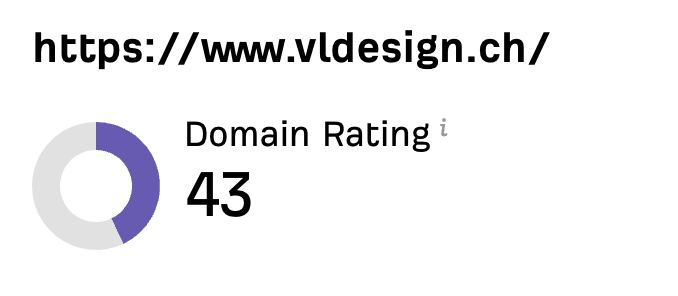 “Blown away by Sorank’s performance. After testing many solutions on the market, I was amazed by how quickly our articles started ranking in the SERP. The results are concrete and much faster than anything we’ve experienced so far. It has been an excellent surprise for our team. We are confidently renewing our trust and highly recommend Sorank to agencies that demand fast and measurable results.”
 Patrick PerretFreelance Webdesign SEO“We’re a development agency and we use Sorank to run on-page audits on our clients’ Shopify stores. It helps us quickly identify optimization opportunities, structure fixes, and collaborate more easily with clients on the SEO side. Very useful to complement our technical support 🔥”

 Younes Yahyaluvaika.com“We are an Ads agency and we wanted to get our SEO back on track once and for all. Sorank gave us a clear view of our site, helped us prioritize optimizations, and properly structure our content. The tool is easy to use, well designed for a team, and very practical for centralizing tracking without having to juggle multiple platforms. A very solid foundation to start fresh with our SEO.”
 Gaspard MadouiAds Agency“I specialized in GEO thanks to Sorank. The GEO Leaderboard allows me to show my clients their position vs competitors on ChatGPT. It’s a real commercial differentiator.”
 MélanieSEO Freelance“I manage our dealership’s website and it had dozens of issues: slow pages, 404 errors, missing tags. We were losing rankings every month without understanding why. The Sorank audit detected everything in 5 minutes. I sent the report to our web provider with the priority fixes. We regained our rankings and traffic picked back up. Perfect for someone non-technical like me!”
 Xavier BreullMarketing Manager“I’m a CMO for a SaaS and I manage acquisition in a very competitive market. We were investing heavily in our product but not working on our SEO. No visibility on our real competitors, no tracking of our presence in AI. Sorank showed us our positioning vs competitors, which keywords to target, and GEO opportunities we had completely ignored!”
 Louis RAPPCMO SaaS
 “Very good version 2, I recommend it.”

 Antoine Verhillethenewblack.ai“I was skeptical at first, but this is the best SEO tool I’ve ever used. The interface is clear, audits are fast, and the recommendations are easy to implement. I’ve saved hours and hours managing SEO and tracking performance. I recommend it to all my entrepreneur friends who run an agency or work independently.”
 NoahEntrepreneur

Founder’s Note.
I ran my own SEO agency for years. I built Sorank to deliver the same results to every business, at scale.
Everything I know about Google rankings and Generative Engine Optimization (GEO) is coded into this software, and it runs on autopilot for you.
Try for Free
Trucking company SEO makes a motor carrier visible to the two groups it depends on: shippers who need capacity on a lane, and drivers deciding where to work. It covers the service and careers pages of your website, the articles that answer their questions, and the way AI assistants describe your company. A large share of freight still moves through brokers and load boards, and SEO does not replace them. What it adds is direct shippers and applicants who reach you without a middleman.
Shippers search by lane, equipment and service: "reefer trucking Atlanta to Chicago", "dedicated fleet services", "hazmat carrier near me", "full truckload cost per mile". Their questions are practical: capacity, transit time, insurance, tracking, extra charges. Drivers search by pay, home time and freight: "CDL A jobs paying 70 cents per mile", "home daily trucking jobs Phoenix", "owner operator lease purchase programs".
Both groups are large. The U.S. Bureau of Labor Statistics counts about 2.2 million heavy and tractor-trailer truck driver jobs in 2025 and projects about 214500 openings a year through 2035, each one requiring a commercial driver's license.
They can look you up by USDOT number. The FMCSA SAFER Company Snapshot gives anyone, free of charge, a carrier's identification, size, cargo, safety rating, roadside out-of-service inspection summary and crash information. Show your USDOT and MC numbers on every page, link to your snapshot, and publish what it does not show: equipment age, claims handling, tracking, insurance limits, the lanes you run every week.
AI assistants work by comparing sources. In our transportation AI citation study (1800 answers from ChatGPT, Gemini and Perplexity), review and classifieds platforms lead, with TripAdvisor at 2.27%, Leboncoin at 2.17% and Trustpilot at 1.89%. The study explains why: the models need structured, comparable information, which a company page limited to a contact form does not offer. Lane articles with transit times, equipment lists and service areas give them that structure.
Drivers compare carriers before they apply, and the industry has been short of them for years: the American Trucking Associations put the gap at 80000 drivers in 2021 and warned it could pass 160000 by 2030. Two things put your openings in front of them. First, your careers page or applicant tracking system should mark up each job with Google's job posting structured data, which makes it eligible for the job listings shown in Google Search, and expire the posting once the seat is filled. Second, publish articles on what drivers ask before applying: how pay is calculated, home time on each route, the trucks, orientation, benefits. Link each article to the matching opening. Sorank writes and publishes those articles, while the job markup stays with your careers platform; our guide to structured data explains how both fit together.
Most are long-tail keywords: low volume, high intent. Our guide to buying intent keywords explains how to rank for them, and the B2B SEO guide covers the longer sales cycle of contract freight.
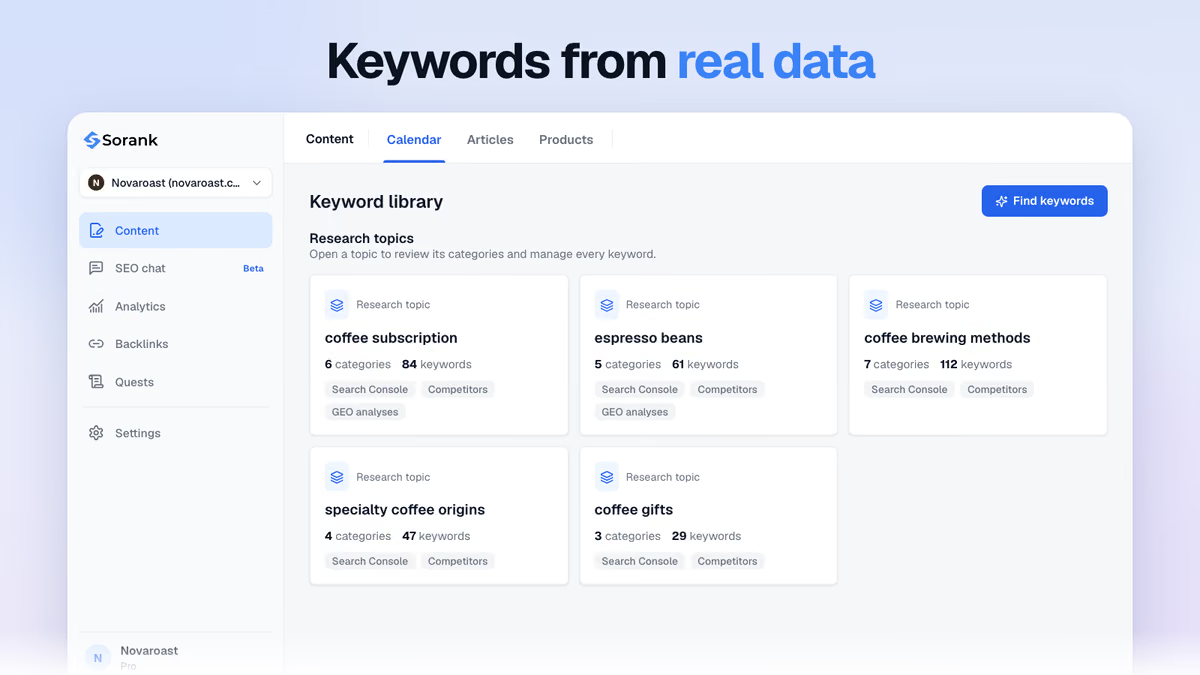
Sorank finds the freight and recruiting keywords, writes the articles with internal links to your service, lane and careers pages, publishes them on WordPress, Webflow, Wix or by webhook, tracks the AI answers every month and shows Search Console data and AI visits in one dashboard. Your team keeps the quotes and rate confirmations, the job postings and their markup, your FMCSA registration, insurance certificates, terminal pages and Google Business Profiles. If you also broker loads or run warehouses, our pages for logistics companies and freight shipping cover those activities, and fleets with several terminals can follow our guide to multi-location SEO.
One site costs $49 a month on the yearly Essential plan, or $99 without commitment, with 20 articles a month: enough to cover freight and recruiting topics every week. Carriers with many lanes can take Pro (60 articles; $129 a month yearly, $249 monthly) or Business (120 articles; $249 yearly, $499 monthly), which also add Grok to the AI tracking (compare plans). The 3-day free trial comes first.
Count in months, not days. Google sets no delay, and lane and job articles usually gather impressions before clicks. Recruiting searches stay steady all year while some freight follows seasons, such as produce or holiday retail, so publish ahead of the peaks. After three months, review clicks, quote requests and applications per article, then extend the lanes that respond.
Give each service, lane and equipment type its own page, show your USDOT and MC numbers, and publish articles that answer what shippers check before booking: transit times, capacity, insurance and how claims are handled.
Yes. Mark up each opening on your careers page with Google job posting structured data, and publish articles on pay, home time and equipment that link to those openings. Sorank writes and publishes the articles; your careers platform handles the job markup.
Yes. Every month Sorank asks ChatGPT, Claude and Gemini the shipper and driver questions you choose, and shows whether your company is named, which carriers appear instead and which sources they cite. Grok joins the tracking on the Pro plan.
From $49 a month per site on the yearly Essential plan, or $99 month to month, for 20 articles a month. Pro and Business publish 60 and 120 articles, and a 3-day free trial comes first.
No. Terminal Business Profiles, job board posts and load board activity stay with your team. Sorank publishes articles on your website, whether it runs on WordPress, Webflow, Wix, Shopify or accepts a webhook, and tracks how AI assistants describe your company.
Usually a few months. Articles gather impressions first, then clicks; judge each lane and job topic on its Search Console clicks, quote requests and applications after three months.
We don't. Sorank isn't trying to be another Semrush or Ahrefs. Those tools are built for data, Sorank is built to do the work. Instead of more dashboards to check, it turns SEO and GEO insights into actions: articles written and published, backlinks earned, technical fixes and AI visibility tracking. Less complexity, more results.
From $49/month per website on a yearly plan, with a 3-day free trial and a 90-day money-back guarantee (conditions apply). Every plan includes articles, AI visibility tracking and access to natural backlink acquisition; higher plans add more articles, more AI prompts tracked and more backlinks. No setup fees, no paying for seats you don't use.
You shouldn't need a full marketing team or expensive tools to grow. Sorank handles your entire SEO and AI visibility, so you save time and money.