Preferences
Privacy is important to us, so you have the option of disabling certain types of storage that may not be necessary for the basic functioning of the website. Blocking categories may impact your experience on the website. More information

Privacy is important to us, so you have the option of disabling certain types of storage that may not be necessary for the basic functioning of the website. Blocking categories may impact your experience on the website. More information

Furniture SEO is how a furniture store or a home decor brand gets found during the weeks a shopper spends deciding: measuring the living room, comparing fabrics, asking ChatGPT which sofa survives two dogs. Sorank works on that research phase. It finds the questions your shoppers type for each room and material, publishes guides on your site that link to the right collections, and checks every month which brands the AI assistants recommend in your category.
It suits retailers with a showroom, online-only furniture brands and decor labels, with plans from $49 a month.
















































27,200
Articles created
11,080,971
Visits from Google
18,447
Visits from AI
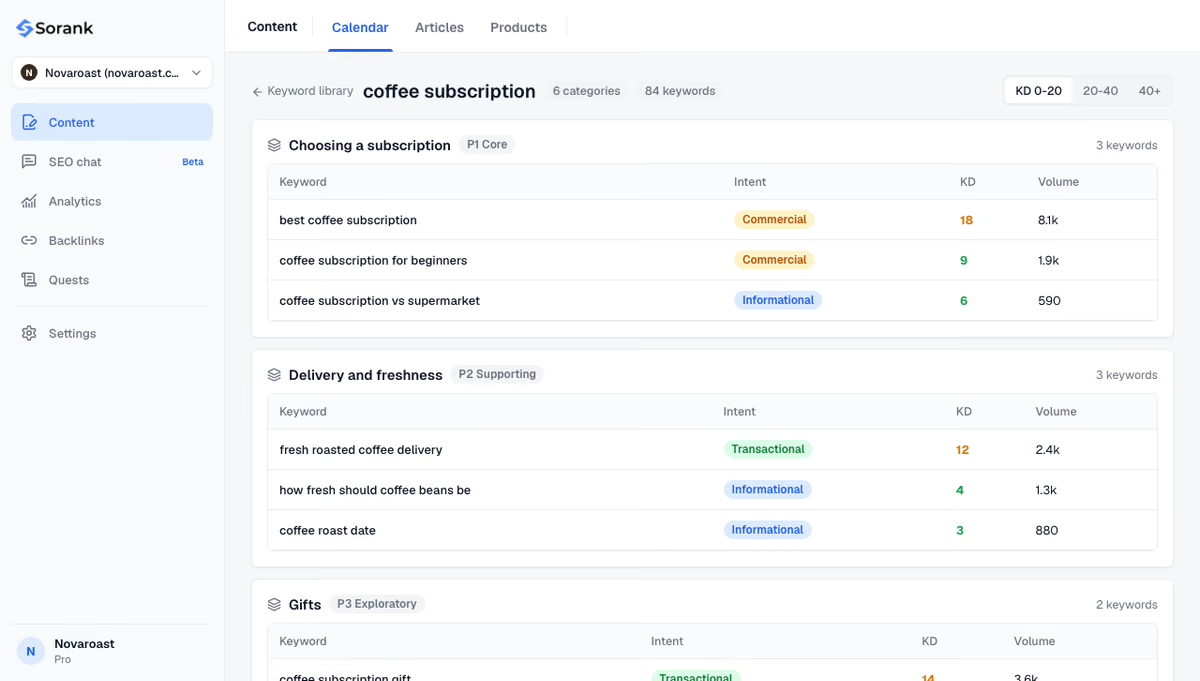
"What size rug for a 12x15 living room", "performance fabric or leather with cats", "how deep should a sofa be for lounging": furniture shoppers search with a tape measure in hand. Sorank sorts these searches into silos by room and by material, with their volume, difficulty and intent, so the rug size guide leads to your rugs and the fabric comparison leads to your sofas.
The silos come from the topical cluster generator, fed by your Search Console data and the stores you compete with.
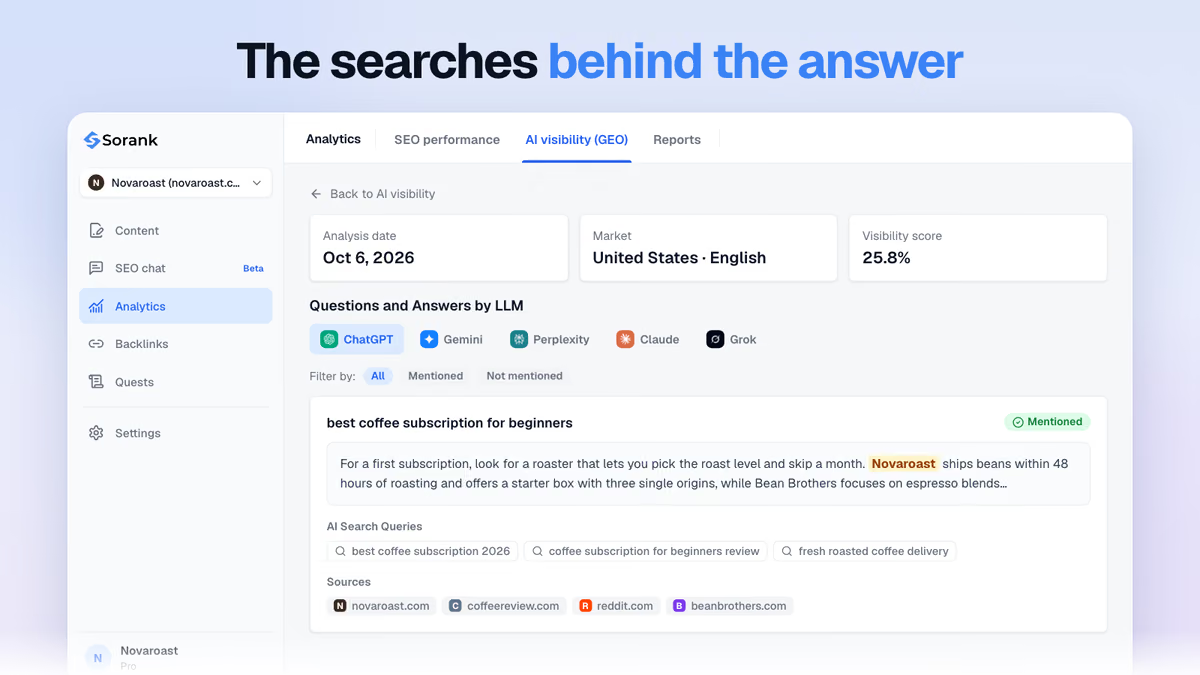
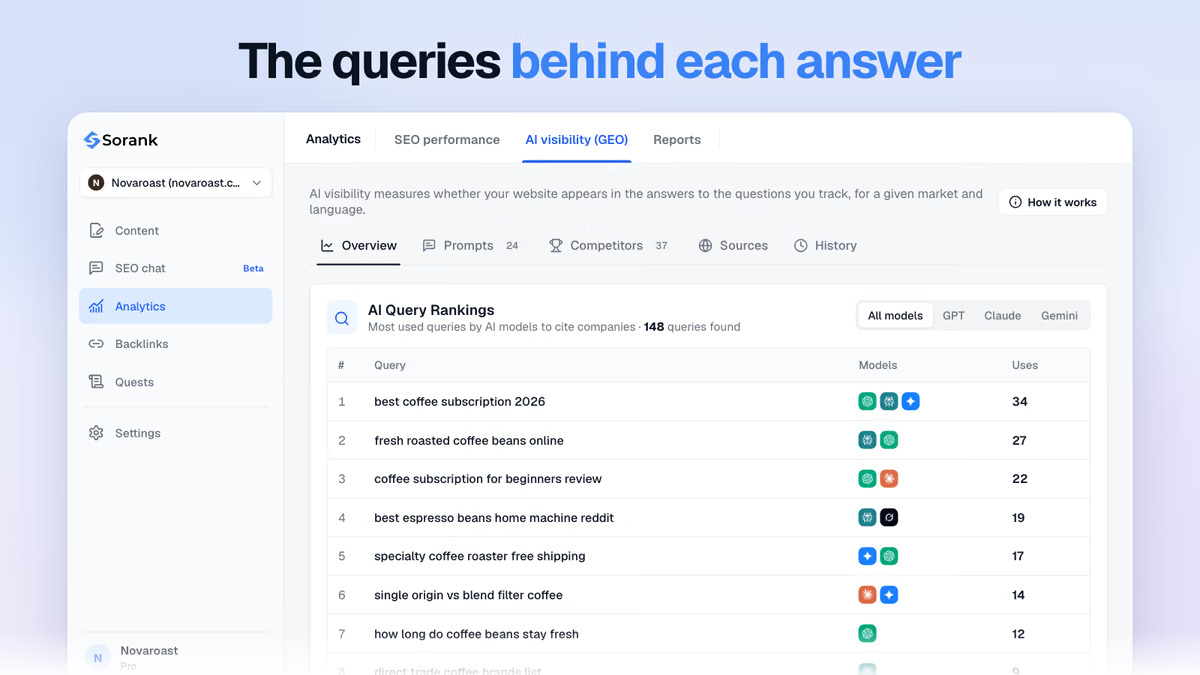
Ask ChatGPT for "the most comfortable sectional under $2000" or "a sleeper sofa for a studio apartment" and the answer names a handful of brands, drawn from review publishers, forums and store pages. Sorank runs the questions you choose every month, records whether your brand is named and lists the sites the answers lean on, so you know which comparisons to publish and which review profiles to keep up to date.
Each answer and its sources are kept in AI mention tracking.
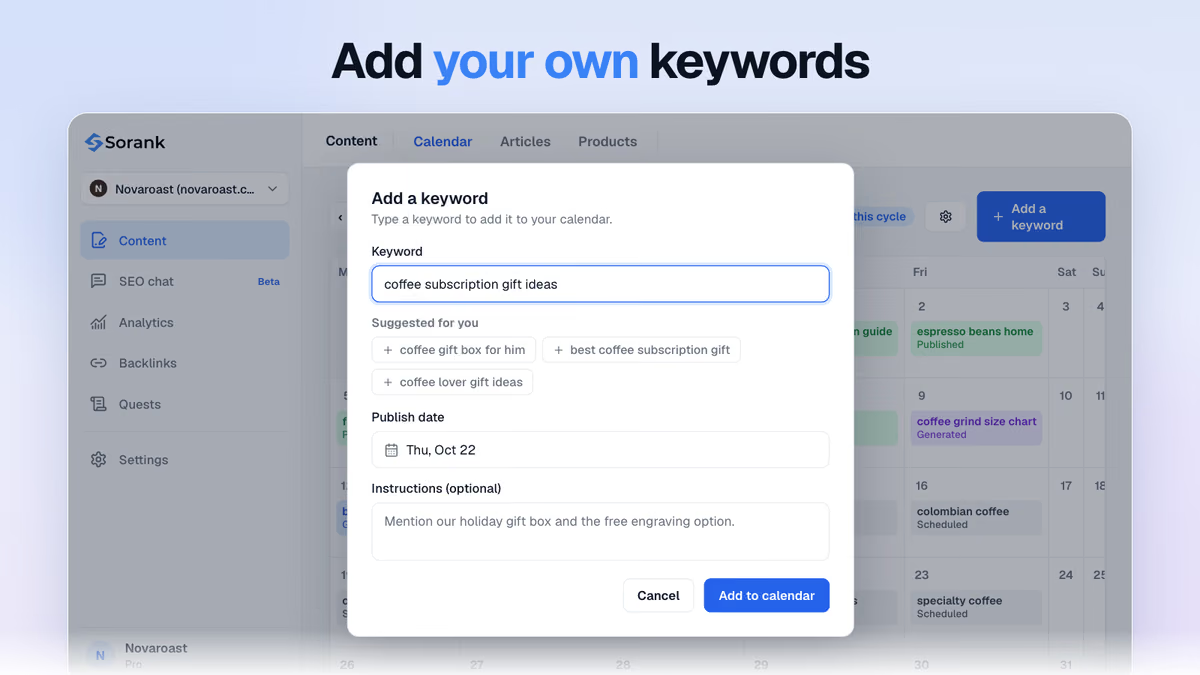
Outdoor furniture sells when the weather turns, desks and bunk beds before the school year, decor gifts in November. Sorank places each topic on a date in your editorial calendar, weeks ahead of the demand, with a note on the collection or the bestseller the article should feature.
Dates and notes live in the content calendar.

Shopify, WooCommerce, Wix, Webflow, WordPress, or a custom site through a webhook. Sorank links your Search Console and Analytics, so it knows which collections already draw visits before it suggests a single topic.
Living room, bedroom, outdoor, lighting, rugs: tell Sorank what you sell, the materials you work with and how you deliver. It proposes the shopper questions for each range, with the volume and difficulty of each one.

Keep the first articles as drafts to confirm dimensions and fabric names, then switch to autopilot. Every guide links to the pages of your store it talks about.
THEY TRIED SORANK BEFORE YOU
 “I tested Sorank on a real client site and it's insane. It does everything an agency would bill you $1500 a month for. It's going into production on that client now.”

 Guillaume Guersanguersanguillaume.com
 “I just let the Sorank software do its thing, and now my DR is 25 and my page is ranking higher.”
 Lucas Flandrefoundertrace.fr“Great service, works well for our website and helps us understand how to improve it to rank better on Google and elsewhere. Congrats, keep going, I recommend it.”
 Hugo T.E-commerce merchant“For 2 years, 100% of my clients came from LinkedIn. Posting daily, commenting, DM follow-ups… totally dependent on the algorithm. I knew I needed to work on SEO but always postponed it: too long, too technical, not my job. With Sorank, I finally took the step. In 4 months, I generate 15 organic leads per month without posting anything. It’s not 50/50 with LinkedIn yet, but I sleep better knowing I now have a second lead source growing on autopilot.”
 Valentin ThomyColdMailing Agency
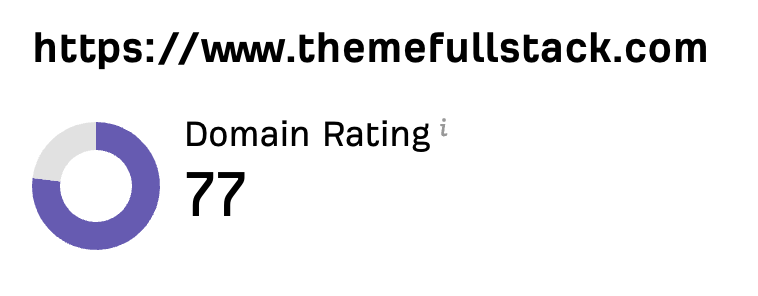 “I’m a developer, not a marketer. My Shopify theme was selling only through word-of-mouth and ads. With Sorank I finally understood how to structure my SEO and write articles to rank. The audit showed my product page was too slow. In 2 months, my organic traffic doubled and I’m starting to appear in ChatGPT answers when people search for Shopify themes. All of that with about 2 hours per week.”
 Thème FullStackgo.themefullstack.com“Great solution to manage SEO without headaches. Audits are fast, the interface is clear, and you quickly see which actions to implement. It has become an essential tool to track and improve the SEO of my sites. I highly recommend it.”
 XavEntrepreneur“I used Sorank for a client who needed SEO and it clearly made my life easier. I can quickly audit a site, track my projects, and keep a clear overview without multiplying tools. The onboarding is fast and the interface is great.”
 Céline MaurinFreelance CM
 “Blown away by Sorank’s performance. After testing many solutions on the market, I was amazed by how quickly our articles started ranking in the SERP. The results are concrete and much faster than anything we’ve experienced so far. It has been an excellent surprise for our team. We are confidently renewing our trust and highly recommend Sorank to agencies that demand fast and measurable results.”
 Patrick PerretFreelance Webdesign SEO“We’re a development agency and we use Sorank to run on-page audits on our clients’ Shopify stores. It helps us quickly identify optimization opportunities, structure fixes, and collaborate more easily with clients on the SEO side. Very useful to complement our technical support 🔥”

 Younes Yahyaluvaika.com“We are an Ads agency and we wanted to get our SEO back on track once and for all. Sorank gave us a clear view of our site, helped us prioritize optimizations, and properly structure our content. The tool is easy to use, well designed for a team, and very practical for centralizing tracking without having to juggle multiple platforms. A very solid foundation to start fresh with our SEO.”
 Gaspard MadouiAds Agency“I specialized in GEO thanks to Sorank. The GEO Leaderboard allows me to show my clients their position vs competitors on ChatGPT. It’s a real commercial differentiator.”
 MélanieSEO Freelance“I manage our dealership’s website and it had dozens of issues: slow pages, 404 errors, missing tags. We were losing rankings every month without understanding why. The Sorank audit detected everything in 5 minutes. I sent the report to our web provider with the priority fixes. We regained our rankings and traffic picked back up. Perfect for someone non-technical like me!”
 Xavier BreullMarketing Manager“I’m a CMO for a SaaS and I manage acquisition in a very competitive market. We were investing heavily in our product but not working on our SEO. No visibility on our real competitors, no tracking of our presence in AI. Sorank showed us our positioning vs competitors, which keywords to target, and GEO opportunities we had completely ignored!”
 Louis RAPPCMO SaaS
 “Very good version 2, I recommend it.”

 Antoine Verhillethenewblack.ai“I was skeptical at first, but this is the best SEO tool I’ve ever used. The interface is clear, audits are fast, and the recommendations are easy to implement. I’ve saved hours and hours managing SEO and tracking performance. I recommend it to all my entrepreneur friends who run an agency or work independently.”
 NoahEntrepreneur
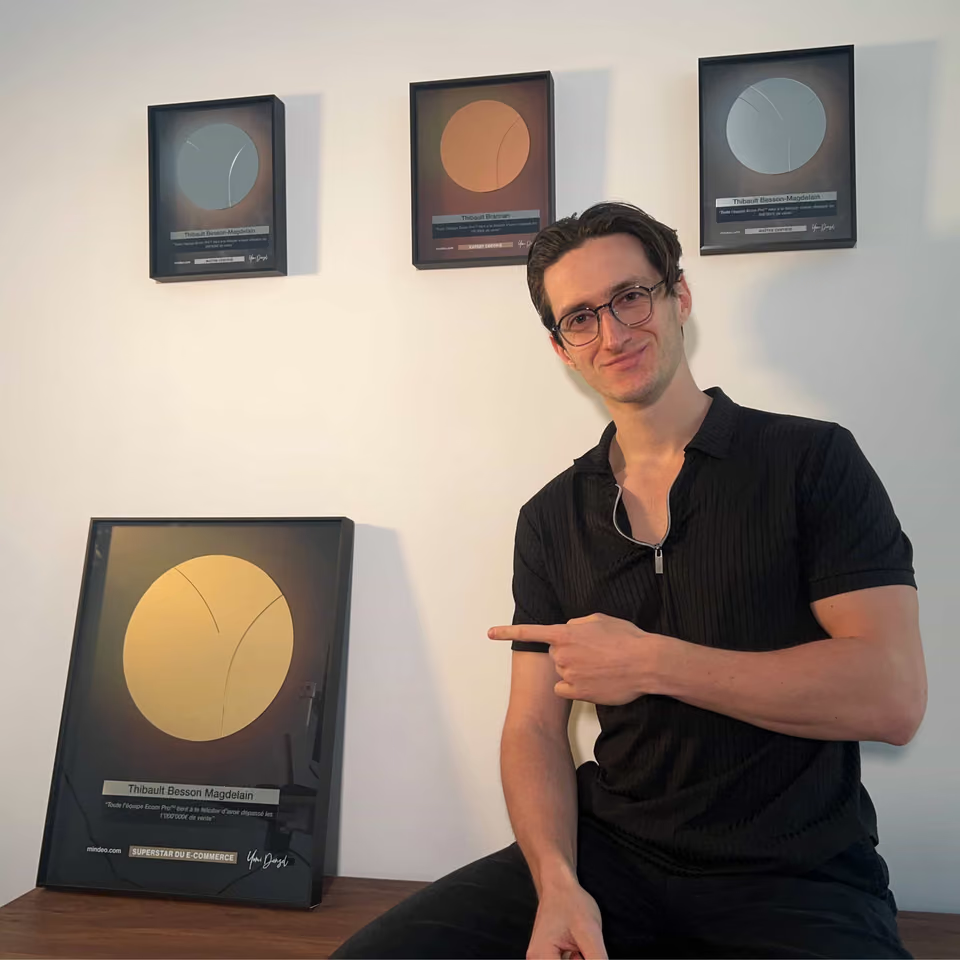
Founder’s Note.
I ran my own SEO agency for years. I built Sorank to deliver the same results to every business, at scale.
Everything I know about Google rankings and Generative Engine Optimization (GEO) is coded into this software, and it runs on autopilot for you.
Try for Free
Furniture SEO is the work that gets a furniture store or a home decor brand found while people plan a room: in Google, in Google Images and in the answers of AI assistants such as ChatGPT. It covers three kinds of pages. Category pages answer broad searches such as "velvet sofa" (see category page SEO), product pages answer precise ones with dimensions and fabrics, and guides answer the questions asked weeks before the order.
A sofa or a dining table is rarely an impulse buy. Between the first search and the checkout, shoppers measure doorways, order swatches, read reviews and compare delivery terms. Each of those steps is a search a store can answer.
They start with pictures and finish with numbers. Inspiration is visual: Google counts nearly 20 billion visual searches a month with Lens, and says 20% of them are about shopping, in its October 2024 announcement. Then come the checks: seat depth, fabric durability, return costs.
AI assistants now sit in the middle of that path. A shopper asks for "a durable sofa for a family with a dog" and gets three or four brands with a reason for each. Those reasons come from the pages the assistant reads, and each model reads different ones: in our retail AI citation study, run on a panel asked mostly in French, Gemini leans first on Shopify store pages (9.3% of its answers), Grok on Facebook (8.79%) and Claude on Trustpilot (1.41%). A brand that publishes clear comparisons on its own store and keeps its review profiles alive gives every model something to quote. Our article on ChatGPT shopping explains how product answers are put together.
Because one sofa often comes in six fabrics, three lengths and two leg finishes, and each combination can end up on its own URL. Google's documentation on product variants names furniture among the products sold in several sizes, colors and materials, and asks stores to group them with ProductGroup and to state what changes with variesBy. That way, Google understands that twenty URLs describe one product.
Photos do the selling, and Google reads them too. Its image guidelines explain that alt text is used along with computer vision and the content of the page, and recommend placing images near relevant text with short, descriptive file names: "oak-sideboard-180cm.jpg" tells more than "IMG_4821.jpg" (see image SEO).
Our guide to buying intent keywords shows how to rank these groups by closeness to the order.
Numbers a shopper can check with a tape measure: overall width, seat depth and height, the clearance a recliner needs, the size of the box on delivery day. Then the materials named precisely (kiln-dried hardwood frame, top-grain leather, the rub count of a fabric), the care routine, the delivery and assembly terms, photos of the piece in a lived-in room and the date of the last update, since ranges change every season.
Safety has its place too. In the United States, dressers and chests made after September 1, 2023 must meet the CPSC clothing storage unit standard, which requires an anti-tip device in the box. A short guide on anchoring a dresser answers a real question from parents. Sorank writes from what it finds on your site and from the writing instructions you give it; keep the first guides as drafts to confirm every figure.
Sorank finds the keywords of each room and material, writes and illustrates the guides, links them to your collection pages, publishes them on Shopify, WooCommerce, Wix, Webflow or WordPress, earns backlinks from other Sorank users' sites and checks the AI answers every month. Search Console, Analytics and visits from AI assistants sit in one dashboard.
Your team keeps the product data: titles, dimensions, variant markup, the Merchant Center feed, photography, prices and delivery promises. A showroom also keeps its Google Business Profile and its reviews. A store selling far beyond furniture will find the general case on our ecommerce page; flooring and renovation businesses have their own (flooring contractors, remodeling contractors).
The Essential plan is $49 a month per store when paid yearly, $99 without commitment, and covers 20 guides a month with 10 AI prompts checked on ChatGPT, Claude and Gemini. Pro ($129 yearly, $249 monthly) brings 60 articles and adds Grok; Business ($249 or $499) brings 120 (see pricing). You get 3 free days to try it, and a 90-day results-or-refund guarantee. Our breakdown of SEO costs compares it with agency retainers.
Google gives no fixed delay. A new guide usually collects impressions in Search Console before it earns clicks, and furniture buyers take weeks to decide, so orders come later still. Give each room three months, publish seasonal guides well ahead (patio sets before spring, gift decor before November), and keep adding to the ranges whose impressions climb.
Count in months. A guide shows impressions in Search Console first, then clicks, and furniture buyers take weeks before they order. Judge each room or range after three months, and publish seasonal guides well before the season.
Sorank starts at $49 a month per store on a yearly plan, or $99 month to month, with 20 articles a month and 10 AI prompts checked. Every plan starts with 3 free days and a 90-day results-or-refund guarantee.
Clicks from Google's organic results cost nothing, but the content behind them takes time or software. Ads bring visits from day one and stop when the budget stops; guides keep working. Most furniture stores run both.
Be present in the pages ChatGPT reads: sizing guides and material comparisons on your own site, review profiles with recent reviews, and the same product facts everywhere you sell. Then check every month whether your brand is named and which sources the answers rely on.
No. Your Google Business Profile, your reviews and your Merchant Center feed stay with your team. Sorank works on the guides published on your site and tracks the AI answers.
Sorank publishes to Shopify, WooCommerce, Wix, Webflow and WordPress, and to other sites through a webhook. It adds articles to your blog and links them to your collections; product titles, dimensions and descriptions stay in your store admin.
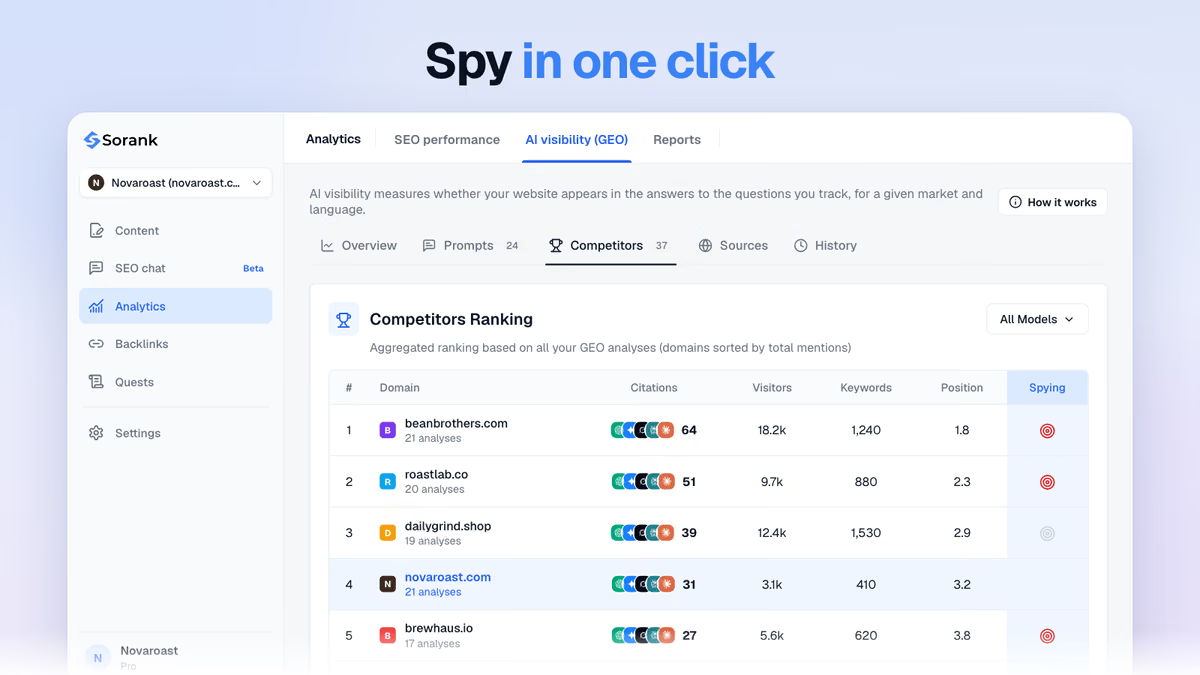
We don't. Sorank isn't trying to be another Semrush or Ahrefs. Those tools are built for data, Sorank is built to do the work. Instead of more dashboards to check, it turns SEO and GEO insights into actions: articles written and published, backlinks earned, technical fixes and AI visibility tracking. Less complexity, more results.
From $49/month per website on a yearly plan, with a 3-day free trial and a 90-day money-back guarantee (conditions apply). Every plan includes articles, AI visibility tracking and access to natural backlink acquisition; higher plans add more articles, more AI prompts tracked and more backlinks. No setup fees, no paying for seats you don't use.
You shouldn't need a full marketing team or expensive tools to grow. Sorank handles your entire SEO and AI visibility, so you save time and money.