Preferences
Privacy is important to us, so you have the option of disabling certain types of storage that may not be necessary for the basic functioning of the website. Blocking categories may impact your experience on the website. More information

Privacy is important to us, so you have the option of disabling certain types of storage that may not be necessary for the basic functioning of the website. Blocking categories may impact your experience on the website. More information

Franchise SEO is how a franchise network gets found by two audiences: customers who search for a service near them, and future franchisees who research what it takes to open a unit. Sorank handles the content of the brand site. It finds the questions customers ask about each service, writes the articles in one brand voice set once for the network, links them to the right location pages, and checks every month which brands ChatGPT, Claude and Gemini recommend in your category.
Location pages, Google Business Profiles and reviews stay with the brand and its franchisees. One brand site costs $49 a month on the annual plan.
















































27,199
Articles created
11,080,695
Visits from Google
18,446
Visits from AI
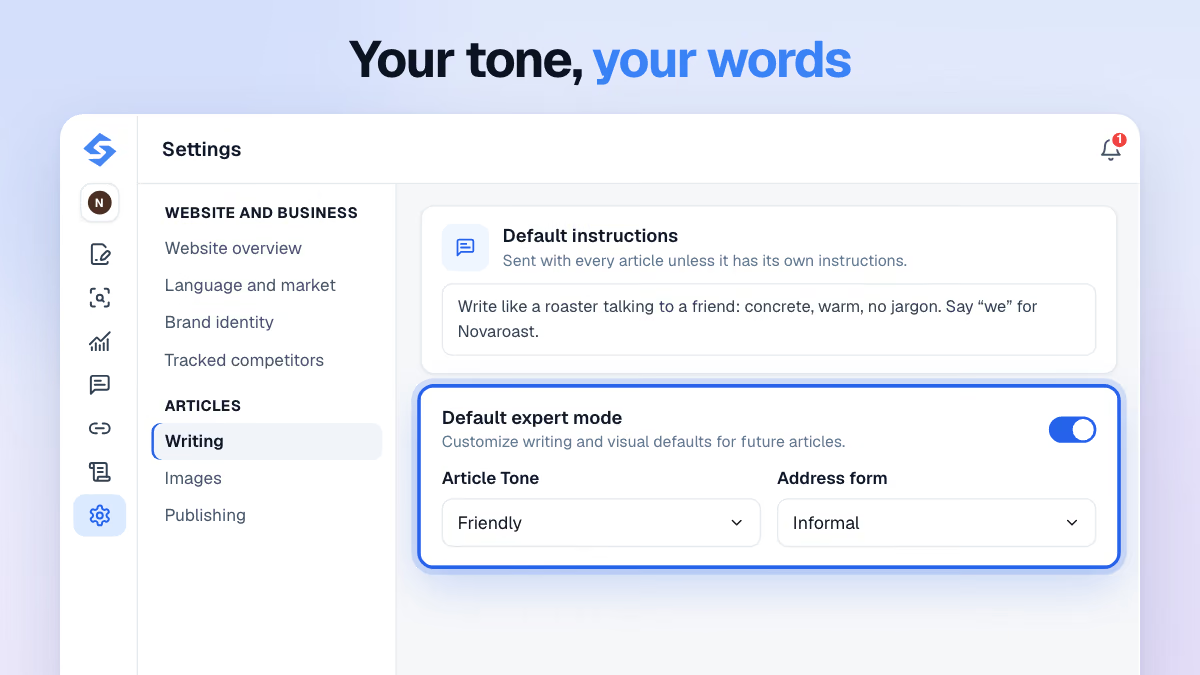
When each franchisee writes its own blog, the network ends up with forty versions of the same service, outdated prices and promises the brand never approved. Yet customers search the same things in every town: "how often should a lawn be aerated", "how much does weekly house cleaning cost", "what happens at a first kids swim lesson". Sorank writes these answers once, centrally, from a brief and writing rules you set for the whole network: tone, form of address, words to avoid.
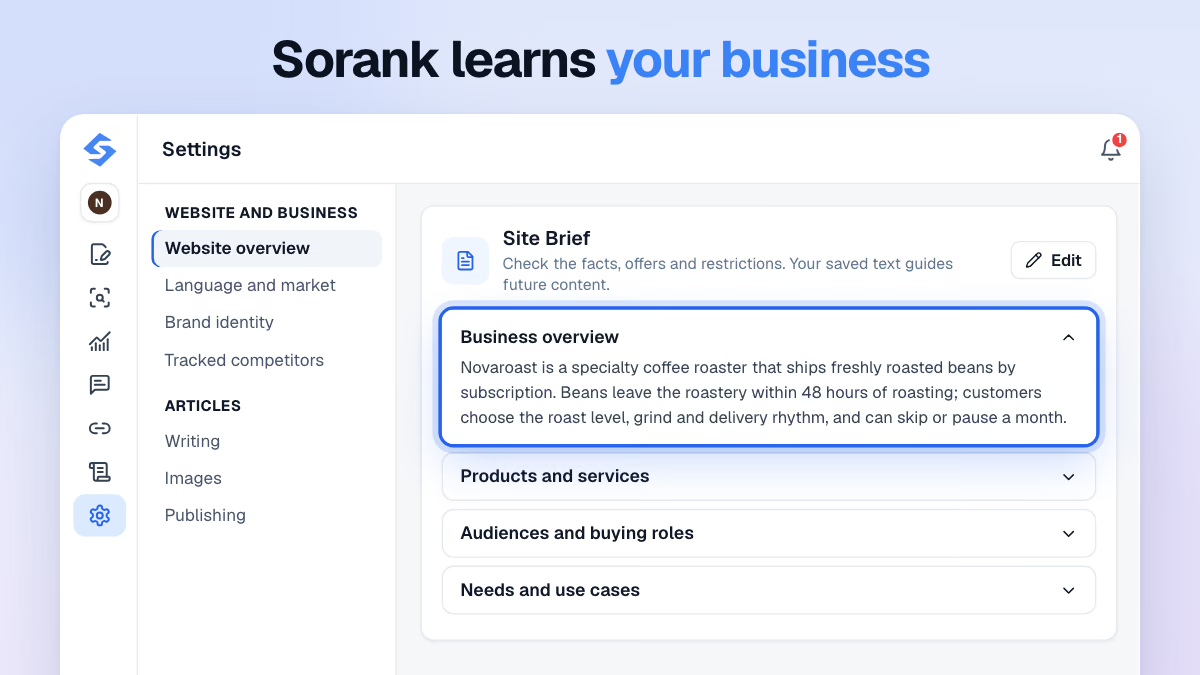
The brief and the rules live in brand voice.
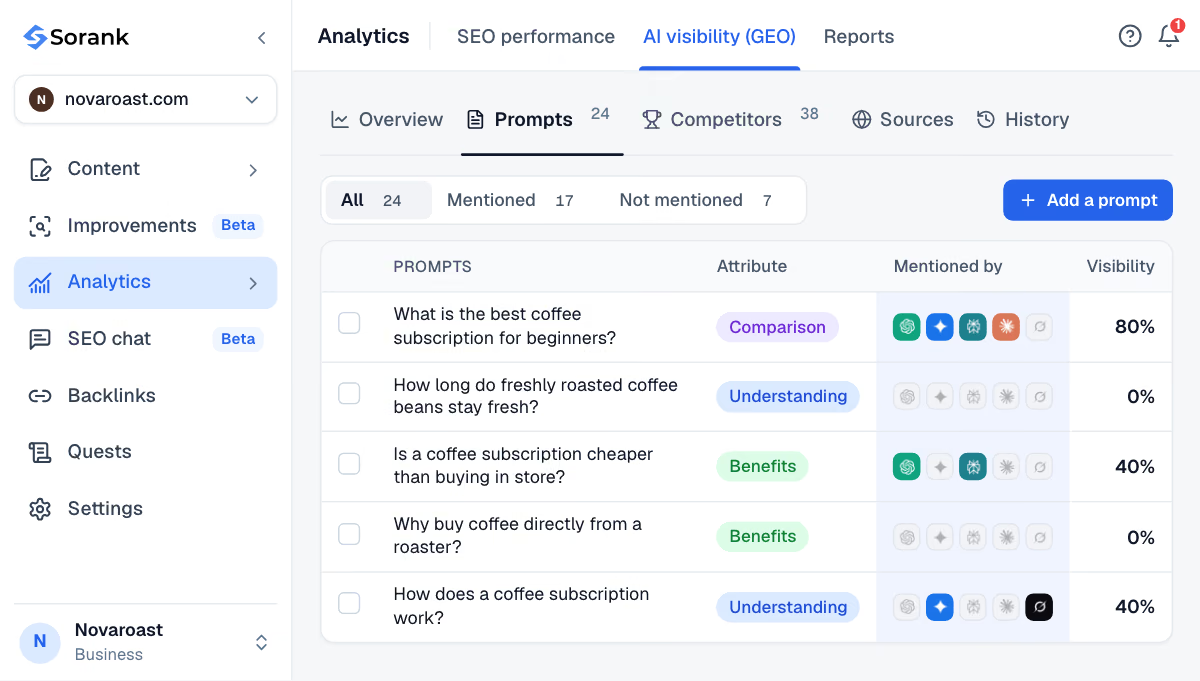
"Best lawn care company in Dallas", "most reliable pest control franchise", "is this home cleaning brand worth the price": customers now ask AI assistants, and the answer names two or three networks. You write the prompts, with the cities where you operate, and Sorank asks them every month in ChatGPT, Claude and Gemini, plus Grok from the Pro plan. You see which prompts cite your brand, which ones cite a rival network and which sources the answers lean on.
Every answer is kept in AI mention tracking.
Future franchisees research for months: "how much does a cleaning franchise cost to open", "best franchises under $100k", "what is a franchise disclosure document". Sorank schedules these development articles next to the customer topics and links them to your "own a franchise" page. In the United States, any claim about sales, income or profits must appear in Item 19 of your disclosure document, so these articles can wait as drafts until your franchise lawyer approves them.
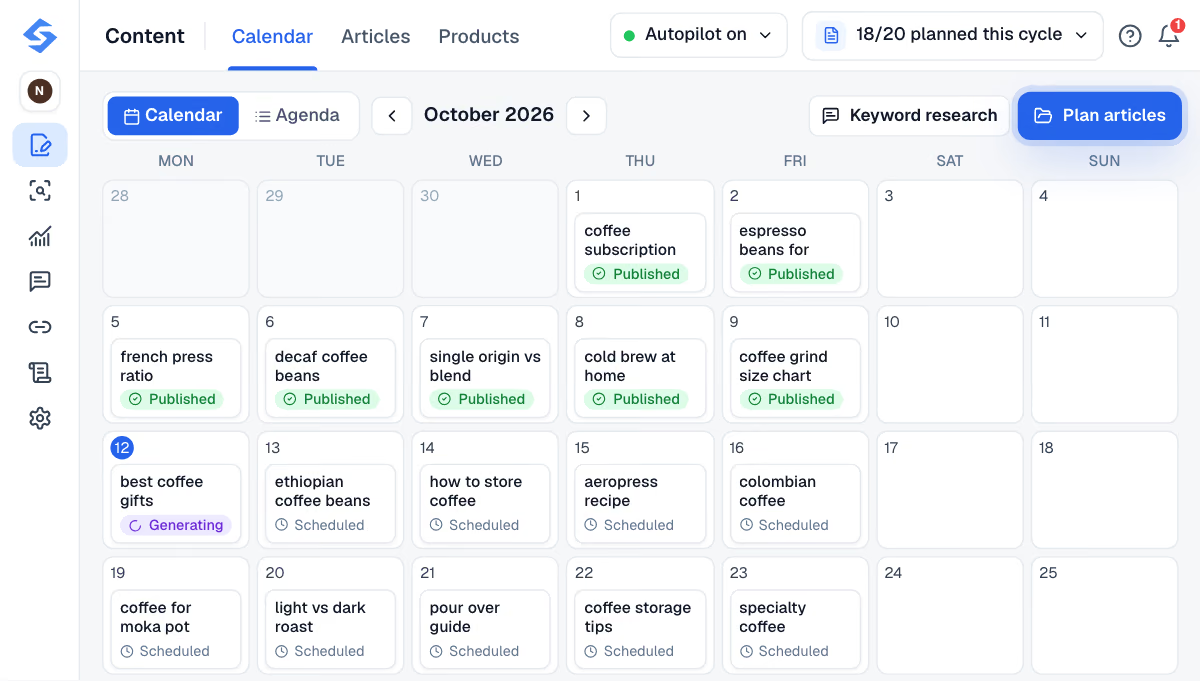
The month's articles are planned in the content calendar.

WordPress, Webflow, Wix or Shopify connect in a few minutes, any other platform through a webhook. If some franchisees run their own website, add each one as a separate site in the same account.
Enter your services, your customers, your tone, the claims franchisees may not make and the rival networks. Sorank proposes the customer questions of each service and the questions of future franchisees, ranked by intent.

Articles reach brand marketing as drafts, or go live on the days you choose, with links to the location pages they mention and to your franchise page.
THEY TRIED SORANK BEFORE YOU
 “I tested Sorank on a real client site and it's insane. It does everything an agency would bill you $1500 a month for. It's going into production on that client now.”

 Guillaume Guersanguersanguillaume.com
 “I just let the Sorank software do its thing, and now my DR is 25 and my page is ranking higher.”
 Lucas Flandrefoundertrace.fr“Great service, works well for our website and helps us understand how to improve it to rank better on Google and elsewhere. Congrats, keep going, I recommend it.”
 Hugo T.E-commerce merchant“For 2 years, 100% of my clients came from LinkedIn. Posting daily, commenting, DM follow-ups… totally dependent on the algorithm. I knew I needed to work on SEO but always postponed it: too long, too technical, not my job. With Sorank, I finally took the step. In 4 months, I generate 15 organic leads per month without posting anything. It’s not 50/50 with LinkedIn yet, but I sleep better knowing I now have a second lead source growing on autopilot.”
 Valentin ThomyColdMailing Agency
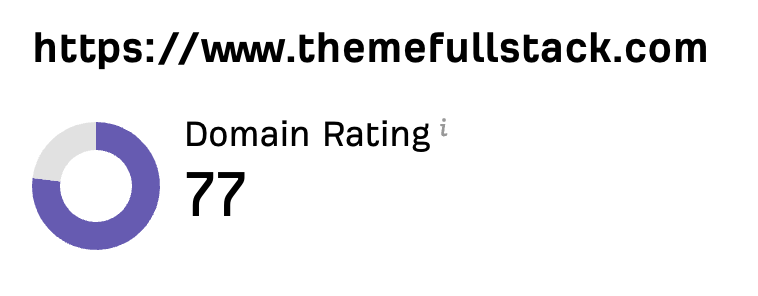 “I’m a developer, not a marketer. My Shopify theme was selling only through word-of-mouth and ads. With Sorank I finally understood how to structure my SEO and write articles to rank. The audit showed my product page was too slow. In 2 months, my organic traffic doubled and I’m starting to appear in ChatGPT answers when people search for Shopify themes. All of that with about 2 hours per week.”
 Thème FullStackgo.themefullstack.com“Great solution to manage SEO without headaches. Audits are fast, the interface is clear, and you quickly see which actions to implement. It has become an essential tool to track and improve the SEO of my sites. I highly recommend it.”
 XavEntrepreneur“I used Sorank for a client who needed SEO and it clearly made my life easier. I can quickly audit a site, track my projects, and keep a clear overview without multiplying tools. The onboarding is fast and the interface is great.”
 Céline MaurinFreelance CM
 “Blown away by Sorank’s performance. After testing many solutions on the market, I was amazed by how quickly our articles started ranking in the SERP. The results are concrete and much faster than anything we’ve experienced so far. It has been an excellent surprise for our team. We are confidently renewing our trust and highly recommend Sorank to agencies that demand fast and measurable results.”
 Patrick PerretFreelance Webdesign SEO“We’re a development agency and we use Sorank to run on-page audits on our clients’ Shopify stores. It helps us quickly identify optimization opportunities, structure fixes, and collaborate more easily with clients on the SEO side. Very useful to complement our technical support 🔥”

 Younes Yahyaluvaika.com“We are an Ads agency and we wanted to get our SEO back on track once and for all. Sorank gave us a clear view of our site, helped us prioritize optimizations, and properly structure our content. The tool is easy to use, well designed for a team, and very practical for centralizing tracking without having to juggle multiple platforms. A very solid foundation to start fresh with our SEO.”
 Gaspard MadouiAds Agency“I specialized in GEO thanks to Sorank. The GEO Leaderboard allows me to show my clients their position vs competitors on ChatGPT. It’s a real commercial differentiator.”
 MélanieSEO Freelance“I manage our dealership’s website and it had dozens of issues: slow pages, 404 errors, missing tags. We were losing rankings every month without understanding why. The Sorank audit detected everything in 5 minutes. I sent the report to our web provider with the priority fixes. We regained our rankings and traffic picked back up. Perfect for someone non-technical like me!”
 Xavier BreullMarketing Manager“I’m a CMO for a SaaS and I manage acquisition in a very competitive market. We were investing heavily in our product but not working on our SEO. No visibility on our real competitors, no tracking of our presence in AI. Sorank showed us our positioning vs competitors, which keywords to target, and GEO opportunities we had completely ignored!”
 Louis RAPPCMO SaaS
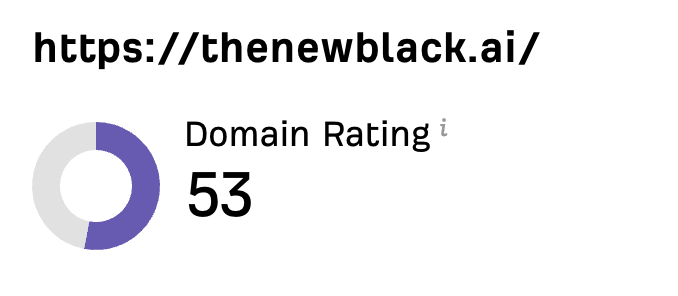 “Very good version 2, I recommend it.”

 Antoine Verhillethenewblack.ai“I was skeptical at first, but this is the best SEO tool I’ve ever used. The interface is clear, audits are fast, and the recommendations are easy to implement. I’ve saved hours and hours managing SEO and tracking performance. I recommend it to all my entrepreneur friends who run an agency or work independently.”
 NoahEntrepreneur
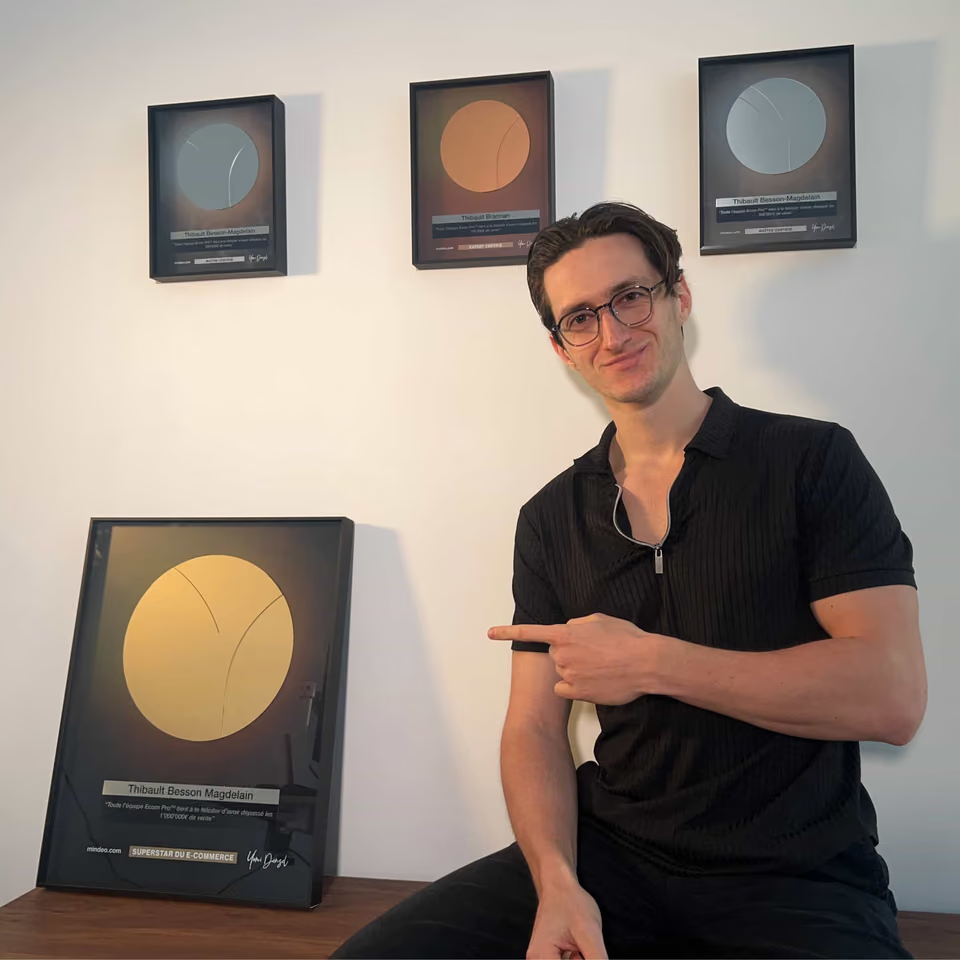
Founder’s Note.
I ran my own SEO agency for years. I built Sorank to deliver the same results to every business, at scale.
Everything I know about Google rankings and Generative Engine Optimization (GEO) is coded into this software, and it runs on autopilot for you.
Try for Free
Franchise SEO is the search work of a network that sells under one brand from many locations. It plays on two levels at once: the brand, which must rank and be recommended for its service everywhere, and each location, which must appear when a customer searches nearby. It rests on three assets: the brand website with one page per location, one Google Business Profile per location, and the articles that answer customer questions.
A franchise also has an audience that a single shop never meets: people who want to buy a franchise. A business with one address and no network will find a better fit on our page for local businesses.
The franchisor, on one domain, with a page for each location. A single domain gathers the links and the reputation the whole network earns; forty franchisee sites split them forty ways and repeat the same text. Our guide on subfolders and subdomains compares the structures, and the one on multi-location SEO covers the rest.
Franchisees still bring what only they know: the team, the photos, the neighborhoods served, the local events. The location page should carry that, so it does not read like the page of the next town with another address (see local landing pages).
Consistency first. Google's guidelines for Business Profiles ask chains to use the same name for all locations in the same country, and the same category for every location that provides the same service. Each location gets one profile, never two, even across separate accounts.
Then ownership. A brand with 10 or more profiles for the same business can request bulk verification instead of verifying each location by hand; service-area businesses are not eligible, and only owners or authorized representatives may verify. Keeping the brand as owner and giving each franchisee a manager role means the profile stays with the network when a unit changes hands. Sorank does not manage these profiles; our guide to Business Profile verification explains the steps.
They ask for a type of service in a city, and the assistant answers with a few brand names drawn from the pages it reads: the brand site, the location pages, directories and review platforms. Reviews count at two levels. Google reviews belong to each location, while review platforms often judge the brand as a whole. In our Trustpilot AI citation study, Trustpilot is the most cited platform of the dataset, in 2.7% of the AI answers of the last three months, and its monthly rate rose from 0.24% in August 2025 to 1.81% in August 2026.
A complaint left unanswered in one town can therefore weigh on the whole network. Answer reviews at both levels (see how to respond to Google reviews), and publish on the brand site the clear answers the assistants can quote.
With facts that match the disclosure document. In the United States, the Federal Trade Commission's guide to buying a franchise explains that the franchise disclosure document must reach a candidate at least 14 days before any contract is signed or any money is paid, that it holds 23 items, and that any claim about sales, income or profits must appear in Item 19, with no other financial performance claim allowed. The same guide tells candidates to call current and former franchisees.
Good development articles follow that line: the steps from first call to opening day, the training, the territory, the investment ranges you already disclose, the questions to ask existing owners. Keep each one as a draft until your franchise lawyer has read it; the Sorank publishing settings allow it. Outside the United States, check the disclosure rules of each country before publishing.
Our guide to local keyword research shows how to find the city terms.
Sorank handles keyword research by service, customer and development articles written in the brand voice, internal links to location and franchise pages, publication on the brand site, monthly tracking of the AI answers and your Search Console data in one dashboard.
The brand keeps the location pages, the Business Profiles, the review policy and the legal review. Franchisees keep what happens on site: photos, opening hours, answers to their own customers' reviews. Our guide to brand consistency helps split these roles.
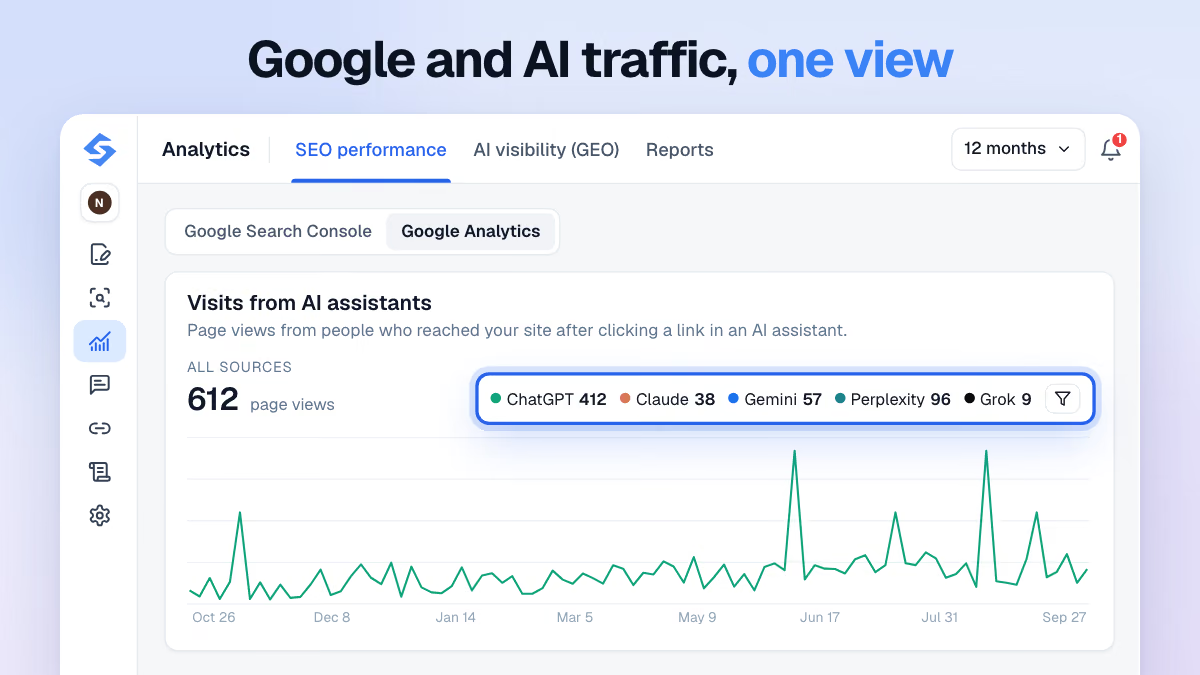
A brand site costs $49 a month on the annual plan, or $99 month to month, for 20 articles and 10 tracked prompts. Pro ($129 annual, $249 monthly) and Business ($249 annual, $499 monthly) publish 60 and 120 articles and track 20 and 50 prompts, which suits a network that follows several cities (see pricing). If franchisees run their own sites, each site is a subscription and volume discounts apply automatically: 10% from 2 to 4 sites, 15% from 5 to 19, 20% from 20 to 25. Every plan starts with a 3-day free trial.
Profile changes can show within weeks; articles earn impressions, then clicks, over several months, and Google gives no fixed delay. Compare your markets after three months on Search Console data and AI visibility.
No. Location pages, Google Business Profiles and reviews stay with the brand and its franchisees. Sorank publishes articles on the brand site and links them to the location pages they mention.
Yes. Each website is its own subscription in one account, and volume discounts apply automatically: 10% from 2 to 4 sites, 15% from 5 to 19 and 20% from 20 to 25.
Write the brief and the writing rules once in Sorank: offer, audiences, tone, form of address and claims to avoid. Every article follows them, and drafts can wait for brand approval.
Yes. You write the prompts, including the cities where you operate, and Sorank asks them every month in ChatGPT, Claude and Gemini, plus Grok from the Pro plan.
Sorank costs $49 a month per site on the annual plan, or $99 month to month, with a 3-day free trial and a 90-day results-or-refund guarantee.
Profile changes can show within weeks, articles over several months. Judge each market after three months on Search Console impressions and clicks, and on AI visibility.
We don't. Sorank isn't trying to be another Semrush or Ahrefs. Those tools are built for data, Sorank is built to do the work. Instead of more dashboards to check, it turns SEO and GEO insights into actions: articles written and published, backlinks earned, technical fixes and AI visibility tracking. Less complexity, more results.
From $49/month per website on a yearly plan, with a 3-day free trial and a 90-day money-back guarantee (conditions apply). Every plan includes articles, AI visibility tracking and access to natural backlink acquisition; higher plans add more articles, more AI prompts tracked and more backlinks. No setup fees, no paying for seats you don't use.
You shouldn't need a full marketing team or expensive tools to grow. Sorank handles your entire SEO and AI visibility, so you save time and money.