Preferences
Privacy is important to us, so you have the option of disabling certain types of storage that may not be necessary for the basic functioning of the website. Blocking categories may impact your experience on the website. More information

Privacy is important to us, so you have the option of disabling certain types of storage that may not be necessary for the basic functioning of the website. Blocking categories may impact your experience on the website. More information
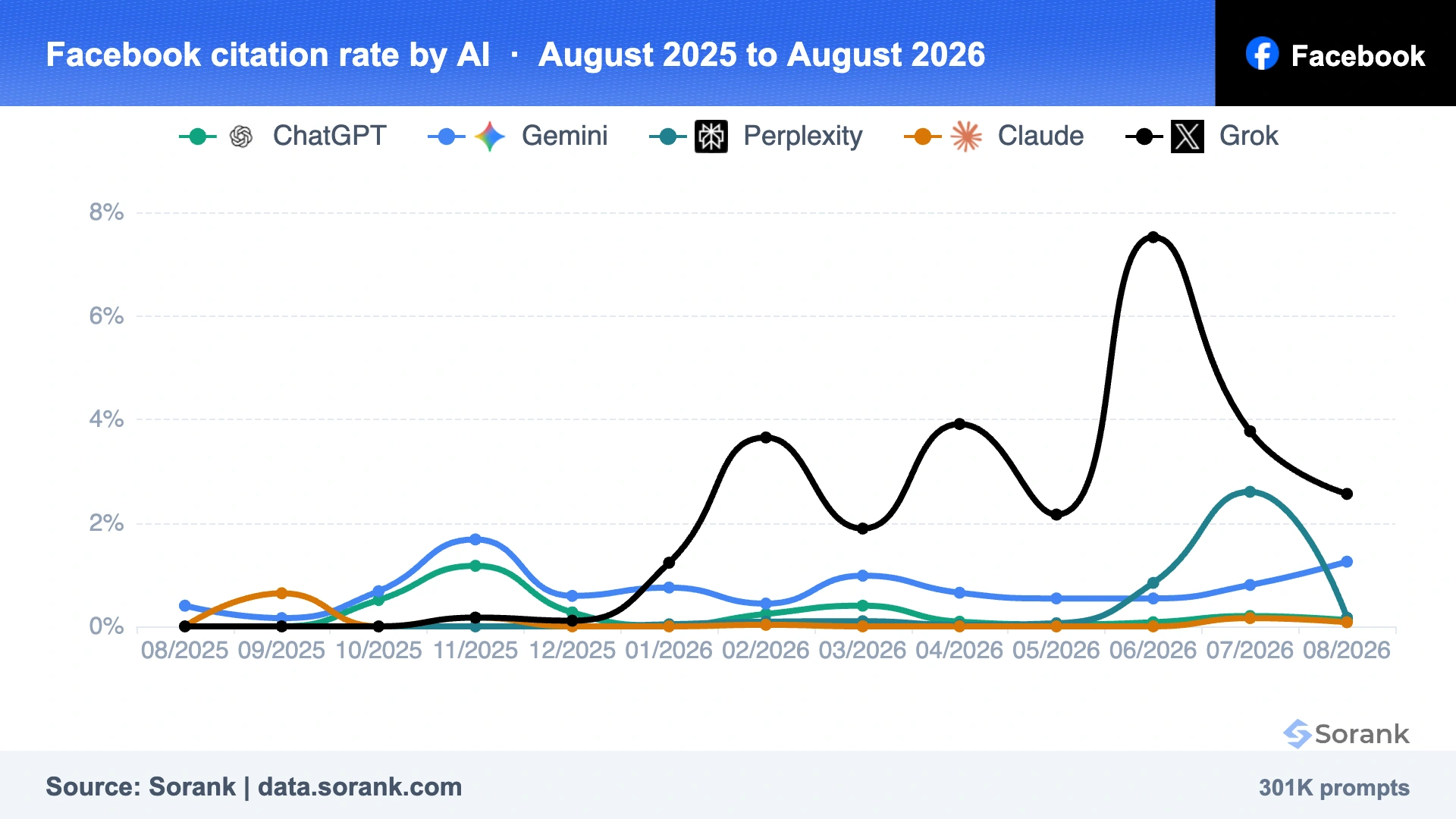
Data study of 301025 AI answers: how often Facebook is cited by ChatGPT, Gemini, Perplexity, Claude and Grok, month by month over 13 months.
Summarize this article with AI
Facebook is cited in 0.85% of measured answers over the last three months, which places it ninth of the platforms tracked. It is cited by all five models, most often by Grok at 3.81% and least often by Claude at 0.11%.
Facebook is close to invisible on the analytical models and a significant source on the community driven one.
A citation rate of 2% means the source was cited twice for every 100 measured answers. Rates are computed per model against the number of answers of that model, so a model with a smaller sample never distorts a column. A source cited several times inside one answer is counted once per company block, which keeps a single verbose answer from dominating a month.
The gap between the model that cites Facebook most and the one that cites it least is 3.7 points. That spread, not the average, is what should decide a budget: the same work returns most on Grok and least on Claude. Across all tracked platforms, Facebook ranks ninth.
Over the 13 months measured, Facebook moved from 0.08% in August 2025 to 0.55% in August 2026, with a peak of 1.24% in July 2026. Averaged over the first three months against the last three, the movement is plus 0.65 points.
The pattern matches how the platform is used rather than how marketers rank it: groups and local pages are where answers about local services, food and events get their material. That gives a real but narrow lever. A complete, current page with correct hours and location can be quoted for a local question, while the same page contributes almost nothing to a considered business purchase. Treat it as local infrastructure, not as a citation strategy.
Every number on this page comes from the public Sorank dataset. The underlying figures, the monthly detail and the filters are available here:
Open the source data on data.sorank.com
Data updated on 2026-08-26.
This study is free to quote, in an article, a deck or a report. Please cite the source and the measurement period, because the numbers move every month.
Sorank (2026). Facebook AI Citation Study: Does Facebook Get You Cited by the AIs. Sorank GEO studies, measured on 301025 AI answers collected between August 2025 and August 2026. Available at https://www.sorank.com/data/facebook-ai-citation-study
The same panel, read from another angle:
This study describes a market. Sorank measures your site: which questions mention you, which mention someone else, and what to publish to change that, tracked weekly across the same five AI.
Start with 3 days free. A payment card is required to open the trial.

Facebook is cited by all five models measured. Grok cites it most, in 3.81% of its answers, and Claude least, in 0.11%. The full model by model breakdown is on this page.
On 301025 answers from five AI, collected between August 2025 and August 2026, with every cited source extracted and normalised. The citation rate is the number of citations per 100 measured answers. The public dataset is on data.sorank.com.
For local businesses it remains part of the basic record the models can read. For business to business sellers, this dataset offers no evidence that it produces citations worth an investment.
THEY TRIED SORANK BEFORE YOU
 “I tested Sorank on a real client site and it's insane. It does everything an agency would bill you $1500 a month for. It's going into production on that client now.”
 Guillaume Guersanguersanguillaume.com“We are an Ads agency and we wanted to get our SEO back on track once and for all. Sorank gave us a clear view of our site, helped us prioritize optimizations, and properly structure our content. The tool is easy to use, well designed for a team, and very practical for centralizing tracking without having to juggle multiple platforms. A very solid foundation to start fresh with our SEO.”
 Gaspard MadouiAds Agency
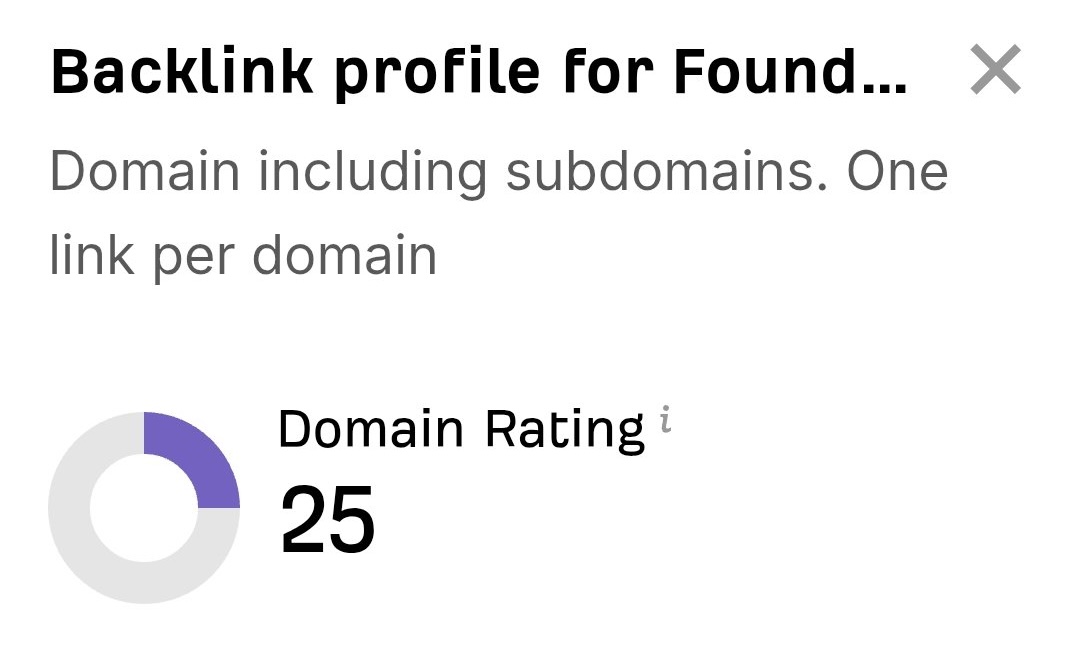 “I just let the Sorank software do its thing, and now my DR is 25 and my page is ranking higher.”
 Lucas FlandrePodcast Host“I specialized in GEO thanks to Sorank. The GEO Leaderboard allows me to show my clients their position vs competitors on ChatGPT. It’s a real commercial differentiator.”
 MélanieSEO Freelance“Great service, works well for our website and helps us understand how to improve it to rank better on Google and elsewhere. Congrats, keep going, I recommend it.”
 Hugo T.E-commerce merchant