



환경 설정

개인정보 보호는 저희에게 중요합니다. 웹사이트의 기본 기능에 반드시 필요하지 않은 특정 유형의 저장소는 사용자가 직접 비활성화할 수 있습니다. 카테고리를 차단하면 웹사이트 이용 경험에 영향을 줄 수 있습니다. 더 보기


모든 쿠키 허용

Conversion Rate Calculator: Calculate Your CR and Revenue

Calculate your conversion rate from visits and conversions in seconds. See the revenue it represents and how to improve it. Free conversion rate calculator.

Thibault Besson-Magdelain, Sorank 설립자

저자 소개

Thibault Besson-Magdelain

Sorank 설립자, 5년 이상의 SEO 경력 보유, GEO 전문가.

Learn everything to know on Conversion Rate Calculator !

생성일
4/9/26
최종 업데이트:
4/9/26
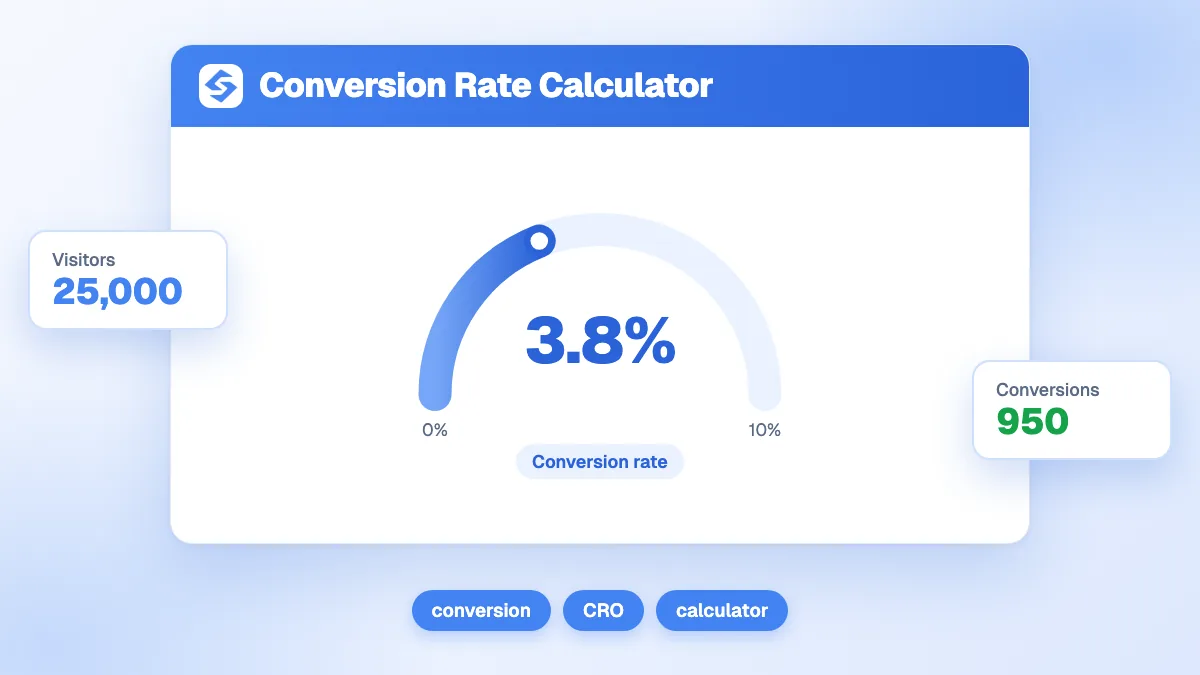
Conversion rate calculator showing a 2% conversion rate from 5000 visits and 100 conversions

Conversion rate is the percentage of visitors who complete a target action: a purchase, a signup, a form fill. It is the multiplier that connects your traffic efforts to revenue. Use the calculator above to get your current conversion rate and the revenue it represents in a few seconds.

How conversion rate is calculated

The formulas are straightforward:

  • Conversion rate (%) = conversions / visits x 100
  • Revenue = conversions x average order value

Example: 5000 visits, 100 conversions, average order value 90€.

  • Conversion rate = 100 / 5000 x 100 = 2%
  • Revenue = 100 x 90€ = 9000€

This is why conversion rate matters: adding 500 more visits at 2% generates 10 extra conversions (900€). Improving your rate from 2% to 2.5% generates 125 conversions from the same 5000 visits, adding 2250€ in revenue without a single extra click.

How to interpret and improve your conversion rate

  • Segment before acting: overall conversion rate is an average. Break it down by traffic source, device, landing page and audience segment. A 0.5% mobile rate and a 3% desktop rate are two very different problems to solve.
  • Fix the page, not just the ads: organic visitors arriving on a slow or unclear page convert poorly regardless of how relevant the keyword was. Page speed, clear value proposition and a visible call to action are the three highest-leverage on-page factors.
  • Test one change at a time: A/B testing headline, CTA copy or layout changes is the only reliable way to know what actually improves the rate. Running several changes simultaneously makes the result unreadable.
  • Align intent with the page: a page ranking for an informational keyword will convert at a fraction of the rate of one ranking for a transactional keyword. Match your SEO targets to the intent that matches your offer.
  • Reduce friction: each extra step in a checkout or signup form reduces conversions. Autofill, guest checkout and social login each have measurable impact.
  • Track micro-conversions: if a visitor adds to cart but does not buy, that is still signal. Recovering abandoned carts is often faster to optimise than the top of the funnel.

Benchmark to keep in mind

Average conversion rates across all industries sit at around 2.6% (First Page Sage). E-commerce specifically averages 1.8%, with a range of 0.8% to 4% depending on category and traffic quality. Traffic from AI assistants like ChatGPT and Perplexity converts at approximately 7% according to early 2025 data, reflecting higher purchase intent at the moment of the query. These are averages; your baseline depends on your vertical, price point and funnel structure.

To track how your SEO and AI visibility investments translate into conversion gains over time, Sorank connects your organic and AI traffic data in one dashboard.

자주 묻는 질문

What is a good conversion rate?

It depends heavily on the industry and traffic source. A rough guide: e-commerce averages around 1.8%, SaaS B2B ranges from 1.9% to 7%, and AI-referred traffic averages around 7%. Compare within your own sector first.

How do I increase conversion rate without increasing traffic?

Focus on the page experience: improve load speed, clarify the value proposition, reduce form fields and make the call to action prominent. A/B testing each change separately is the most reliable way to find what actually moves the rate.

Should I use sessions or users as the denominator?

Sessions (or visits) is the standard denominator for most conversion rate calculations because each session represents an opportunity to convert. Use the same definition consistently so your rate is comparable over time.

기타 무료 SEO 도구