
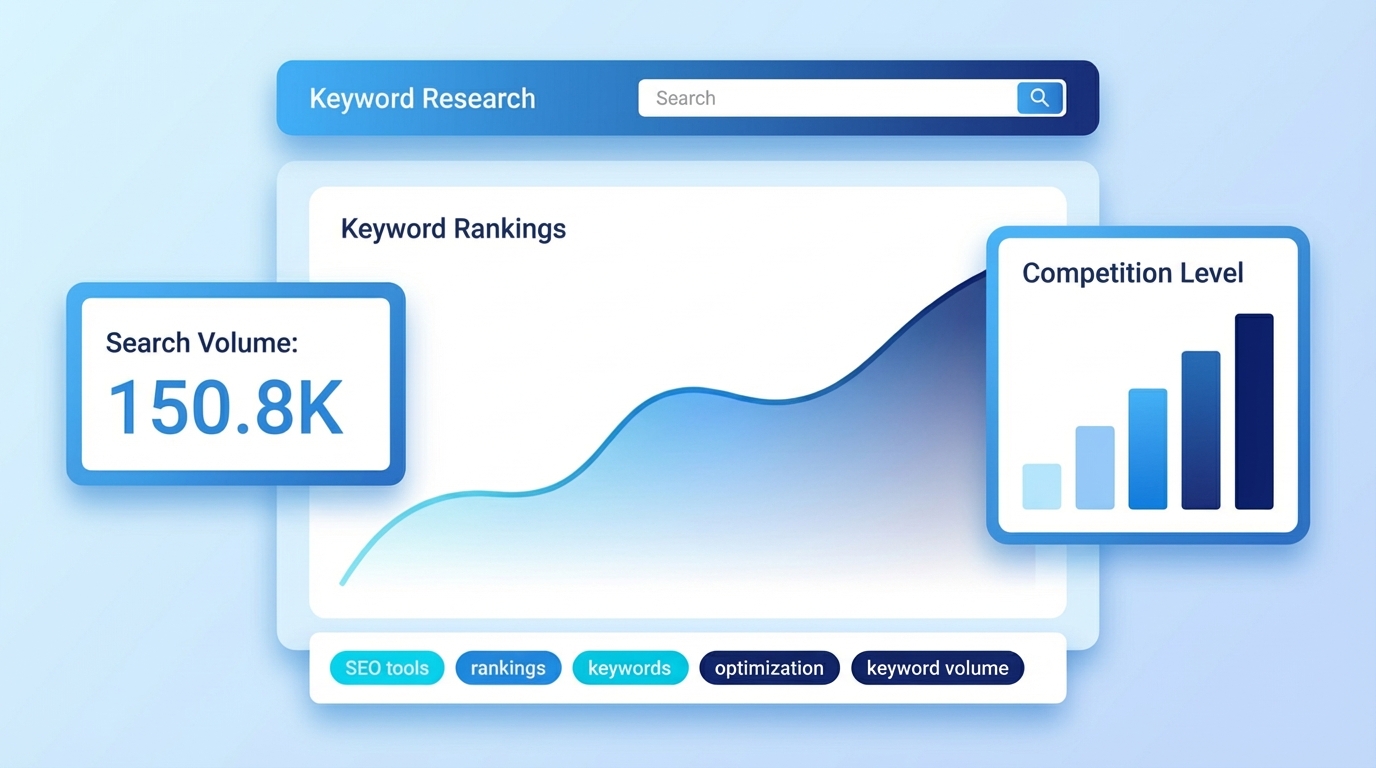
Summary: 94.7% of keywords get 10 or fewer monthly searches. A free keyword research tool helps you find the ones that actually drive traffic.
Most websites target keywords blindly. They guess what their audience searches, write content around assumptions, and wonder why traffic never materializes. The data tells a different story: according to Search Engine Journal, over 94% of all keywords receive 10 or fewer searches per month. Picking the right targets from the remaining fraction is the difference between growth and stagnation.
A free keyword research tool eliminates the guesswork. It shows you real search volumes, competition levels, and related queries that your audience actually types into Google. No budget required. Just data-driven decisions from the start.
What a Keyword Research Tool Reveals
At its core, a keyword research tool takes a seed term and returns a list of related queries along with their metrics. The essential data points include monthly search volume, keyword difficulty, cost per click, search intent classification, and related keyword suggestions.
Search volume tells you how many people search for a term each month. Keyword difficulty estimates how hard it will be to rank for that term based on the authority and optimization of currently ranking pages. Cost per click reflects commercial value, because advertisers bid more on keywords that convert. Together, these metrics let you prioritize keywords that balance opportunity with achievability.
The best tools also surface long-tail variations, question-based queries, and trending terms you would never discover through brainstorming alone. A single seed keyword can generate hundreds of actionable targets.
Why Keyword Research Is the Foundation of Every SEO Strategy
Without keyword data, SEO becomes a guessing game. You might write an excellent article on a topic nobody searches for. Or you might target a keyword so competitive that reaching page one would take years. Keyword research prevents both mistakes by grounding your strategy in actual demand.
It also shapes your content architecture. By mapping keywords to specific pages, you create a logical site structure that helps search engines understand your topical authority. Sites that organize content into topic clusters around researched keywords consistently outperform sites that publish randomly.
Keyword research extends beyond blog content. It informs product page optimization, meta descriptions, URL structures, image alt text, and even paid advertising targeting. Every search-visible element on your site should be informed by keyword data.
How to Find Keywords That Actually Drive Traffic
Start broad, then narrow. Enter your main topic into the tool and review the full list of suggestions. Sort by search volume to see the highest-demand terms, then filter by difficulty to find keywords where you have a realistic chance of ranking.
The sweet spot for most sites is keywords with moderate search volume (100 to 1,000 monthly searches) and low to medium difficulty. These terms attract enough traffic to matter but face less competition than head terms with tens of thousands of searches. In SEO, this category is called long-tail keywords, and they collectively account for the majority of all Google searches.
Pay special attention to question-based keywords. Queries starting with "how," "what," "why," and "best" reveal explicit user intent. They also align perfectly with featured snippets and AI Overviews, which increasingly dominate the top of search results. According to Search Engine Journal, roughly 12% of search queries trigger a featured snippet.
Finally, check the search intent behind each keyword. A transactional keyword like "buy running shoes" requires a product page. An informational keyword like "how to choose running shoes" needs a guide. Mismatching content type with intent guarantees poor performance regardless of optimization quality.
Competitor Keyword Analysis: Learn From What Works
Your competitors have already done keyword research for you, whether they know it or not. By analyzing which keywords drive traffic to their sites, you skip months of experimentation and focus on proven opportunities.
Enter a competitor's domain into the keyword tool. The results show every keyword they rank for, their position, and the estimated traffic each keyword sends. Look for keywords where your competitor ranks in positions 4 through 20. These are terms where the competition has validated demand, but the top spots remain within reach for a stronger piece of content.
Also identify keywords your competitors rank for that you do not target at all. These content gaps represent immediate opportunities. If three competitors all rank for a term and you have no corresponding page, creating one becomes a priority. For agencies managing multiple clients, our SEO platform automates this gap analysis across unlimited competitor domains.
Understanding Search Intent: The Key to Keyword Selection
Google's algorithm has become remarkably good at matching results to intent. A keyword can have identical search volume and difficulty but perform completely differently based on the intent behind it. The four primary intent types are informational, navigational, commercial, and transactional.
Informational intent drives the largest share of searches. Users want answers, explanations, or how-to guidance. Content targeting these keywords should educate comprehensively without a hard sell.
Commercial investigation keywords signal that the user is comparing options before making a decision. Reviews, comparison articles, and "best of" lists perform well here. Transactional keywords indicate readiness to buy or sign up. Product pages and landing pages with clear calls to action match this intent.
A common mistake is optimizing a blog post for a transactional keyword or a product page for an informational query. The mismatch confuses both users and search engines. According to a Google Search Central guide, helpful content that satisfies user intent is the primary criterion for ranking in 2026.
Keyword Research for AI Search Optimization
Traditional keyword research targets Google. But in 2026, a growing share of search happens through AI platforms like ChatGPT, Perplexity, and Google's AI Overviews. These systems do not rank pages the same way. They synthesize answers from sources they consider authoritative and comprehensive.
For AI visibility, keyword research shifts toward entity coverage and topical completeness. Instead of optimizing for a single keyword, you optimize to be the most thorough source on an entire topic. AI systems prefer content that answers multiple related questions within a single resource, uses clear structure with logical headings, and cites credible data.
This means your keyword research should identify not just your primary target but every related query, subtopic, and question that a user might have. Covering this full semantic field increases the probability that AI platforms cite your content when generating answers. Our GEO tools track which keywords AI engines associate with your brand, so you can measure and improve your AI search presence alongside traditional rankings.
Building a Keyword Strategy From Scratch
A structured keyword strategy follows five steps. First, list your core topics. These are the broad themes your business covers. A marketing agency might list SEO, content marketing, paid ads, and social media.
Second, generate seed keywords for each topic using the research tool. Aim for 20 to 50 keywords per topic. Third, evaluate each keyword against volume, difficulty, and intent. Remove terms that are too competitive, too low-volume, or misaligned with your content capabilities.
Fourth, map remaining keywords to specific pages. Each page targets one primary keyword and two to three secondary keywords. Avoid keyword cannibalization by ensuring no two pages target the same primary term.
Fifth, prioritize content creation based on a combination of search volume, business relevance, and ranking difficulty. Start with the keywords where you can realistically reach page one within three to six months. Quick wins build momentum and generate the traffic that funds more ambitious targets later.
Common Keyword Research Mistakes to Avoid
The most frequent error is chasing high-volume head terms without the authority to compete. A new site targeting "SEO" as a keyword is competing against massive established platforms and Google's own documentation. The probability of ranking on page one is near zero. Long-tail variations like "SEO audit checklist for small business" offer a realistic path to visibility.
Another mistake is ignoring keyword difficulty entirely. Volume without context is misleading. A keyword with 10,000 monthly searches and extreme difficulty will generate zero traffic if you cannot rank for it. A keyword with 200 searches and low difficulty can send consistent visitors every month for years.
Relying exclusively on Google Keyword Planner is also a limitation. Google rounds search volumes into broad ranges and prioritizes data useful for advertisers over organic SEOs. Free third-party tools often provide more precise volumes and additional metrics like click-through rate estimates and trend data. Pairing a browser extension with a dedicated research tool gives you the most complete picture.
Conclusion
Every page that ranks started with a keyword. Every page that does not rank either skipped this step or chose the wrong target. A free keyword research tool gives you the data to make informed decisions about where to invest your content efforts, which competitors to study, and which opportunities to pursue first.
The 5.3% of keywords that actually drive meaningful traffic are not hidden. They are waiting in your research tool, ready to be found, mapped, and turned into content that ranks. The sooner you start building your keyword strategy on data rather than intuition, the faster your organic growth compounds.
To discover the keywords your competitors rank for and build a strategy that covers both Google and AI search, try our free keyword tools and start building your roadmap today.














.svg)
.svg)